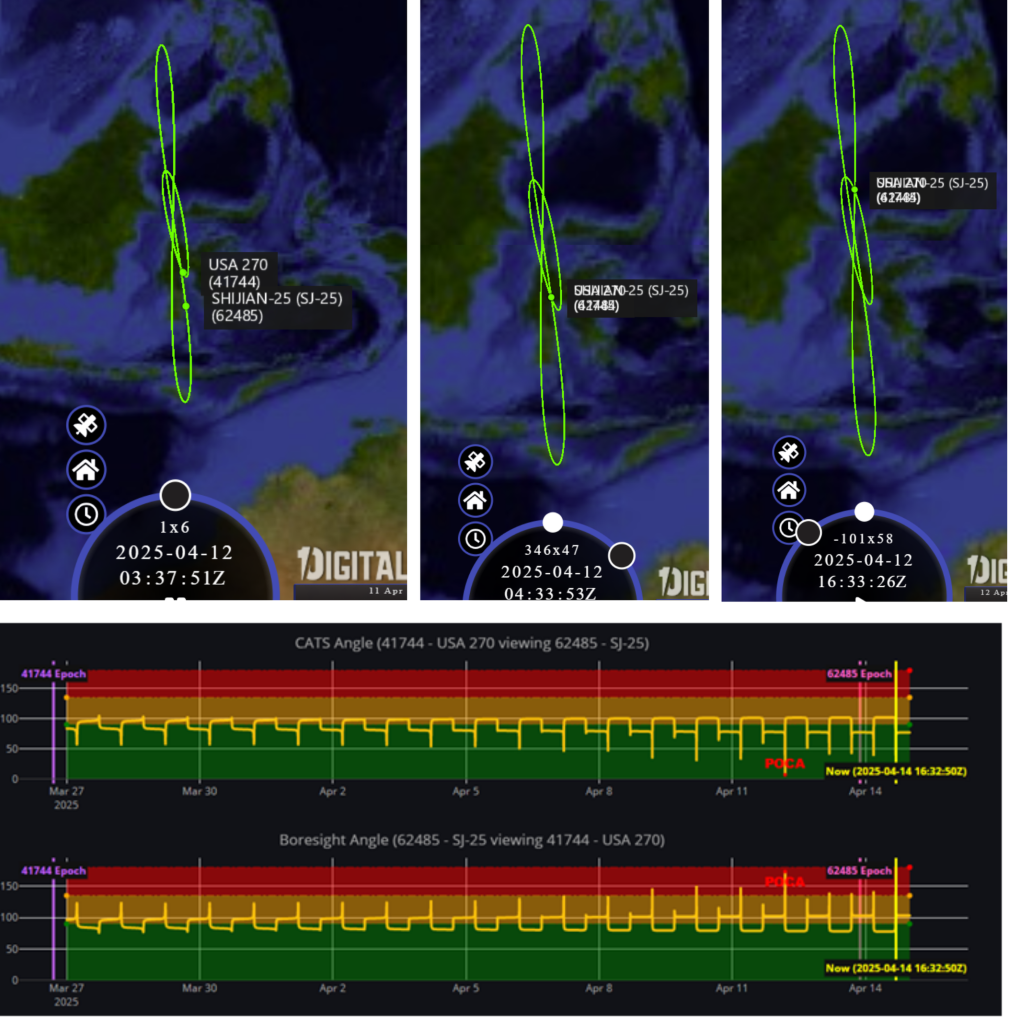
10 Apr: China launched a Long March-3B with TJS-17 (King of the North) (63524) from Xichang. According to official sources, the satellite has entered the planned orbit and will be “mainly used to verify multi-band and high-speed satellite communication technology” which is identical to the description provided for TJS-15 (King of the West) (63157) and TJS-16 (King of the East) (63397). Launch Video.
On 17 Apr the Joint Commercial Operations cell (JCO) noted TJS-17 had parked in GEO at 152.74 E longitude with a drift rate of 0.01 E deg/day. At this location, TJS-17 is only 0.24° east (171 km) of TJS-16 which is located at 152.50°E longitude.
- Placing 2 TJS satellites in proximity is unusual. We did see TJS-3 and TJS-10 operate within ~50km of one another for a year following TJS-10’s launch in December 2023. After a year of testing TJS-3 eventually maneuvered and is no longer in the vicinity of TJS-10.
- Of the remaining TJS satellites the closest pairing is between TJS-16 and TJS-1 (40892). Separation between these two satellites is ~2,000km.
- Orbital information is not yet available via space-track.org. Comparing the orbital parameters between TJS-16 and -17 may (or may not) yield clues as to their mission/relationship.
– Both TJS-15 & 17 were observed releasing a secondary object (believed to be an apogee kick motor
- TJS-15 and -17 both launched on a LM-3B from Xichang while TJS-16 used a LM-7A from Wenchang.
- I suspect because China used the older/slightly less capable LM-3B they likely needed an AKM to reach the desired orbit. Because TJS-16 used the more capable LM-7A it was able to reach its intended orbit without the assistance of an AKM.
- The LM-3B can deliver up to 5,500 kg (12,100 pounds) to GTO, while the LM-7A is capable of delivering up to 7,000 kg (15,000 pounds) to GTO. Wenchang southern location also makes it a more favorable launch site for delivering satellites to GTO/GEO.
– Then there are those amazing mission patches. Per Andrew Jones: “The TJS-17 mission patch from SAST depicts the King of the North, one of the Four Heavenly Kings; a set of Buddhist deities each guarding one cardinal direction of the world. The TJS-15 and TJS-16 mission patches depicted the King of the West and King of the East, respectively. This hints at a possible forthcoming TJS mission to complete the celestial quartet.”
Â
https://www.youtube.com/watch?v=go8PZ7sFaiM


We’ll see if the trend continues if/when there’s a “King of the South” TJS-18 launch. Along with launch vehicle selection it will also be interesting to see if TJS-18 settles near TJS-15 to form a second pairing of TJS satellites.
TJS Summary
– In the past 10 years China has launched 16 TJS satellites, 11 of which were launched in just the past 4 years. 2025 is shaping up to be a year of unprecedented activity for the TJS family. TJS-17 is the 4th TJS launch for the first half of 2025:
- 2015 (1): TJS-1 (suspected SIGINT)
- 2016 (0): No Launches
- 2017 (1): TJS-2 (suspected Missile Warning)
- 2018 (1): TJS-3 (suspected satellite inspection)
- 2019 (1): TJS-4 (suspected SIGINT)
- 2020 (1): TJS-5 (suspected Missile Warning)
- 2021 (3): TJS-6 (suspected Missile Warning), TJS-7 (Unknown), & TJS-9 (suspected SIGINT)
- 2022 (0): No Launches
- 2023 (1): TJS-10 (unknown)
- 2024 (3): TJS-11 (unknown), TJS-12 (unknown), TJS-13 (HEO, suspected Missile Warning)
- 2025 (3): TJS-14 (unknown), TJS-15 (unknown), TJS-16 (unknown), TJS-17 (unknown)




 https://www.youtube.com/watch?v=qwRXF-JkagUhttps://www.youtube.com/watch?v=pHrxDGafnV4