Issue 63

Jack’s Astro Corner: Reader Challenge FalconSat-3 Decay Monitoring Mission

Jack's Astro Corner: Reader Challenge FalconSat-3 Decay Monitoring Mission YOUR MISSION -- MONITOR THE DECAY OF FALCONSAT-3 Here’s a chance for you, your family or friends to experience being in a Space Operations Center monitoring an important on-orbit event playing out in December and January, maybe extending into February. It’s a miss…

Jack's Astro Corner: Reader Challenge FalconSat-3 Decay Monitoring Mission

YOUR MISSION — MONITOR THE DECAY OF FALCONSAT-3 Here’s a chance for you, your family or friends to experience being in a Space Operations Center monitoring an important on-orbit event playing out in December and January, maybe extending into February. It’s a mission to monitor the decay and re-entry of the USAF Academy’s FalconSAT-3 spacecraft. It’s been on-orbit for almost 16 years and has been slowly getting closer and closer to Earth and will soon (1-2 months?) enter the earth’s atmosphere and burn up. Interested in taking on this mission? Hope so!

REVIEW OF WHAT LIES AHEAD IN THIS ARTICLE TO ENABLE YOU TO DO THIS MISSION First, I’ll introduce you to the USAF Academy’s FalconSAT-3 satellite, mission and crew force. It’s an amazing story involving more than 1000 cadets, staff and many dignitaries who got to operate FalconSAT-3. Secondly, I’ll review how to get the FalconSAT-3 orbit element set data each day (or every 2-3 days, you decide your “ops tempo”). I recommend you visit Celestrak.org as your source for the FalconSAT-3 TLE (Two-Line Element Set). I’ll explain how. Thirdly, and maybe the most “fun” part of preparing for your mission, is developing your own mission software that YOU will create on an MS Excel spreadsheet. I provide you the equations. If you are good with spreadsheets, that will be easy. If not, here is a chance to learn and have fun and create astrodynamics capability to analyze a satellite’s orbit decay. Find someone who knows how to use a spreadsheet to solve equations and they can help you. If you want to skip this “develop your software” step, you can ask me to send you a nifty spreadsheet I made. Lastly, getting underway. You and your crew can get the FalconSAT-3 TLE daily (or every 2-3 days, you decide your tempo) and get the data items you need (there’s 2) and run your mission software tool to get 4 parameters that give insight into the FalconSAT-3 decay: the FalconSAT-3’s orbit semi-major axis, orbital period, and the altitudes of perigee and apogee. You can plot these on graph paper or using Excel to make plots. Maybe just mark these indicators of decay progress on your calendar. How low will FalconSAT go before is plummets into the Earth’s atmosphere? You will find out! If you want me to send you a mission spreadsheet tool I made, send me an email at jack.anthony@integrityisr.com. Better yet, if you decided to tackle this mission, send me an email and I’ll make sure to email you any updates or other helpful hints. FALCONSAT-3 SATELLITE, MISSION AND CADET CREW FORCE

FalconSAT-3 was built by the cadets and Space Systems Research Center (SSRC) staff at the USAF Academy 2002-2006. The AF Research Lab is the primary sponsor and benefactor of the Academy’s FalconSAT program. Their cadets and SSRC are the “go to” team for AFRL. FalconSAT-3 is a 119lbs (54kg) small spacecraft hosting several experiments including two space environment sensors developed by the Physics Department and an AFRL sponsored Micro Propulsion Attitude Control System that earned a patent. The main body of the satellite is the size of a college dorm refrigerator. FalconSAT-3 also has a 10-ft gravity gradient boom that was deployed. It has a small mass at the end of

FalconSAT-3

Jack's Astro Corner: Reader Challenge FalconSat-3 Decay Monitoring Mission - PDF page 15

Jack's Astro Corner: Reader Challenge (Cont)

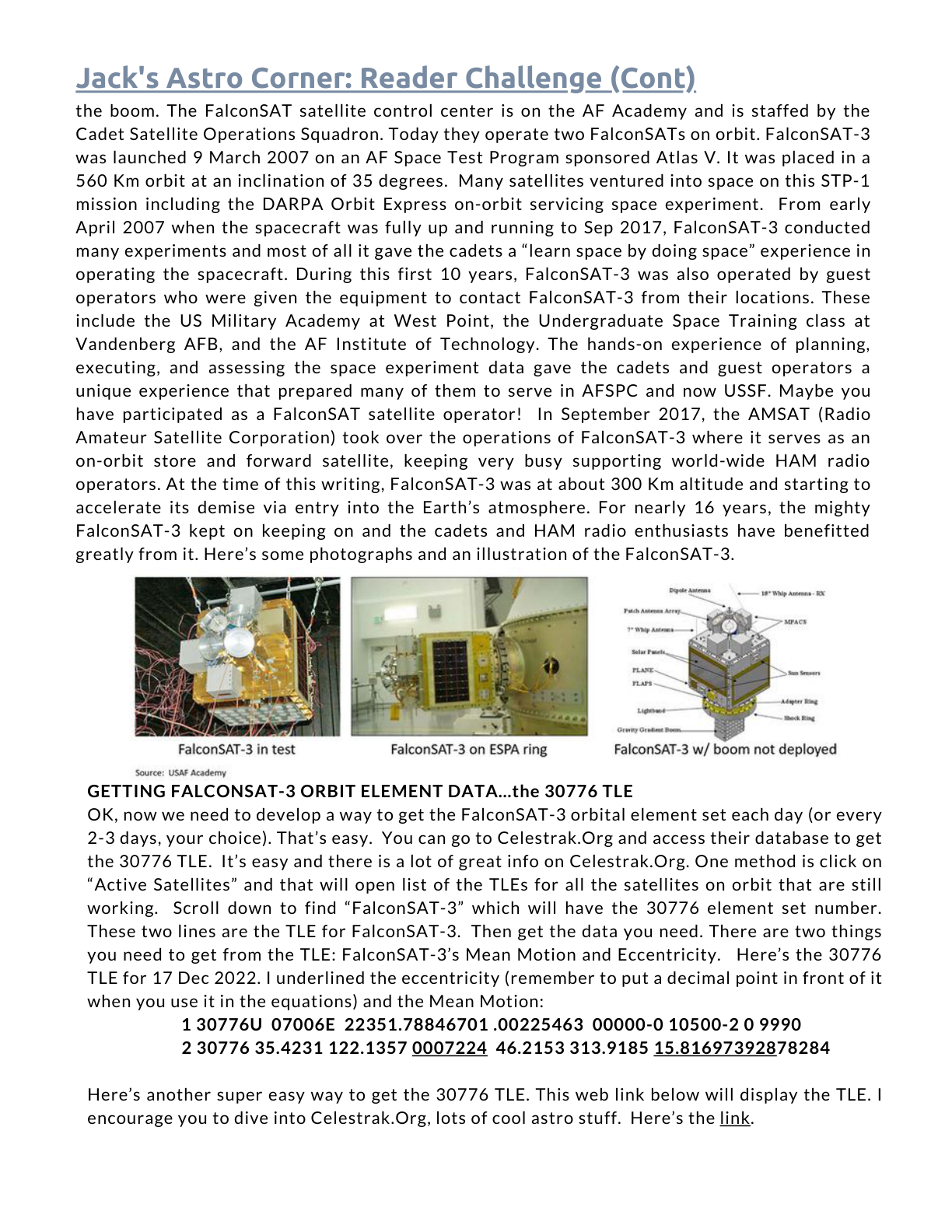
the boom. The FalconSAT satellite control center is on the AF Academy and is staffed by the Cadet Satellite Operations Squadron. Today they operate two FalconSATs on orbit. FalconSAT-3 was launched 9 March 2007 on an AF Space Test Program sponsored Atlas V. It was placed in a 560 Km orbit at an inclination of 35 degrees. Many satellites ventured into space on this STP-1 mission including the DARPA Orbit Express on-orbit servicing space experiment. From early April 2007 when the spacecraft was fully up and running to Sep 2017, FalconSAT-3 conducted many experiments and most of all it gave the cadets a “learn space by doing space” experience in operating the spacecraft. During this first 10 years, FalconSAT-3 was also operated by guest operators who were given the equipment to contact FalconSAT-3 from their locations. These include the US Military Academy at West Point, the Undergraduate Space Training class at Vandenberg AFB, and the AF Institute of Technology. The hands-on experience of planning, executing, and assessing the space experiment data gave the cadets and guest operators a unique experience that prepared many of them to serve in AFSPC and now USSF. Maybe you have participated as a FalconSAT satellite operator! In September 2017, the AMSAT (Radio Amateur Satellite Corporation) took over the operations of FalconSAT-3 where it serves as an on-orbit store and forward satellite, keeping very busy supporting world-wide HAM radio operators. At the time of this writing, FalconSAT-3 was at about 300 Km altitude and starting to accelerate its demise via entry into the Earth’s atmosphere. For nearly 16 years, the mighty FalconSAT-3 kept on keeping on and the cadets and HAM radio enthusiasts have benefitted greatly from it. Here’s some photographs and an illustration of the FalconSAT-3.

GETTING FALCONSAT-3 ORBIT ELEMENT DATA…the 30776 TLE OK, now we need to develop a way to get the FalconSAT-3 orbital element set each day (or every 2-3 days, your choice). That’s easy. You can go to Celestrak.Org and access their database to get the 30776 TLE. It’s easy and there is a lot of great info on Celestrak.Org. One method is click on “Active Satellites” and that will open list of the TLEs for all the satellites on orbit that are still working. Scroll down to find “FalconSAT-3” which will have the 30776 element set number. These two lines are the TLE for FalconSAT-3. Then get the data you need. There are two things you need to get from the TLE: FalconSAT-3’s Mean Motion and Eccentricity. Here’s the 30776 TLE for 17 Dec 2022. I underlined the eccentricity (remember to put a decimal point in front of it when you use it in the equations) and the Mean Motion:

1 30776U 07006E 22351.78846701 .00225463 00000-0 10500-2 0 9990 2 30776 35.4231 122.1357 0007224 46.2153 313.9185 15.81697392878284

Here’s another super easy way to get the 30776 TLE. This web link below will display the TLE. I encourage you to dive into Celestrak.Org, lots of cool astro stuff. Here’s the link.

Jack's Astro Corner: Reader Challenge FalconSat-3 Decay Monitoring Mission - PDF page 16

Jack's Astro Corner: Reader Challenge (Cont)

DEVELOPING YOUR MISSION SOFTWARE ON MS EXCEL Ok, so how do you develop (or get from me) your Mission Software? Let’s call it Orbit Monitoring Tool. You’ll need MS Excel to create your spreadsheet. I encourage you to make your own tool, become an astrodynamics rockstar in your family, neighborhood or at work. Imagine telling your boss or your mom or dad “why yes, I develop and write astro code for real world space use,” YOU will impress everyone…no kidding!

From the FalconSAT-3 TLE, we will be getting the Mean Motion of FalconSAT-3 and the eccentricity (shape) of the orbit. As you remember, Mean Motion is in revs/day, how many orbits FalconSAT-3 makes in a 24-hour day. Within this parameter is the size of the orbit, the semi- major axis. That’s the mean altitude over an orbit. The eccentricity will enable us to calculate the altitude of perigee (closest) and apogee, furthest away. We’ll assume a spherical Earth. Here below are the equations to calculate the semi-major axis of the orbit in Km, orbit period in minutes, as well as the altitudes of apogee and perigee. If you are confident in your MS Excel spreadsheet equation skills you can code this up and have your tool ready for operations. Make it spiffy! If you are new to Excel, find a person to help you, maybe a kid, they know this stuff! Another option that is AOK to use is send me an email and say “Jack, send me your Orbit Monitoring Tool.” I encourage you to try to learn this spreadsheet equation skill or have someone (your kid) help you…it will empower you to be numerically agile and awesome. But again, I can send you what you need to get underway, happy to do so. Here’s the equations:

To validate your own developed tool, here's a test case using the 17 Dec 2022 FalconSAT-3 TLE I provided above. From the TLE: Eccentricity = .0007224 & Mean Motion = 15.8169739 revs/day. Answers are:

Orbit Period: 91.04 minutes Semi Major Axis: 6703.2 Km

Apogee Altitude: 330.0 Km Perigee Altitude: 320.4 Km

GETTING UNDERWAY OK, so you are set to start. You know how to get the FalconSAT-3 TLE, get the two data items needed as inputs to your mission software and calculate the 4 parameters that can give insight into the FalconSAT-3 decay. So now what do you do each day (or every other day, or few days)? Run your mission software, get the 4 parameters it calculates and write these values down on a calendar. Maybe get a piece of graph paper and plot them. Track the decay of FalconSAT-3 by monitoring these key parameters daily or every 2-3 days. When will FalconSAT-3 “burn in?” Who knows, but with this mission software you can witness how these key indicators of orbit decay play out. The general rule of thumb is between 200 and 225 Km the decay can really accelerate,

Jack's Astro Corner: Reader Challenge FalconSat-3 Decay Monitoring Mission - PDF page 17

Jack's Astro Corner: Reader Challenge (Cont)

the FalconSAT-3 spaceship is within a few days of burning in. Maybe pick up the tempo of monitoring the TLE to daily. There are many variables, mostly due to the Sun’s activity and how it effects the atmosphere and the FalconSAT-3’s orientation as it “hits the atmosphere.” Things like Solar Storms affect the atmosphere density “way out there.” Plus, there’s always modelling uncertainties. It’s the nature of our astro business. When the FalconSAT-3 decays, the TLE will no longer be updated. You’ll have great data to make your assessment of what altitude it came in. Kerplunk…it quits orbiting and flutters down in a fiery breakup. Not sure where until after and most burns up. Good luck with your mission and most of all involve your family, friends, co- workers. Have fun with astro!

Again, here’s my email: jack.anthony@integrityisr.com. Send me an email letting me know you are going to give this mission a try. Also, if you want me to supply you my mission software spreadsheet I created, I am happy to send it to you for your use. If in giving this mission a try you have questions, send me an email. I’ll help. This will be fun, that’s an order…LOL.

Jack's Astro Corner: Reader Challenge FalconSat-3 Decay Monitoring Mission - PDF page 18

Original PDF links: Source 1