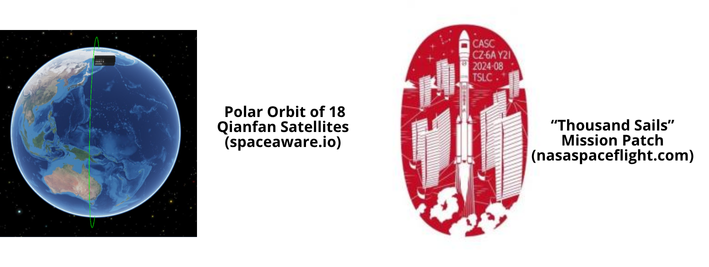
6 Aug: China launched a Long March-6A with the first 18 Qianfan polar orbit satellites from Taiyuan. The 18 satellites are in a onboard constitute the first batch of the SpaceSail Constellation, developed by Shanghai Spacecom Satellite Technology (SSST) to “provide global users with low-latency, high-speed and ultra-reliable satellite broadband internet services”.
Launch Video.
– Qianfan translates to “Thousand Sails” and the first satellites are currently in a 811x789km, 89.0° orbit.
-SSST filings with the ITU notes the constellation may consist of 1,296 satellites at an altitude of about 1,160 kilometers (721 miles). By comparison, SpaceX satellites operate at ~500km and OneWeb satellites are at ~1,200km.
– The first phase of the constellation is to have 1,296 satellites at 1,100km by the end of 2027.
– Second phase will be at a lower altitude, 300-500km and consist of 13-14,000 satellites. SSST hopes to begin launching this phase in 2028.
-Images from Chinese media reveal the Qianfan satellites incorporate flat-panel/stackable design. “It meets the needs of stacking multiple satellites with one rocket,” said Shanghai Gesi Aerospace Technology, a joint venture set up by SSST and the Chinese Academy of Sciences to oversee manufacturing of Qianfan satellites.
-Last year Blaine Curcio published an article on G60’s development and history. Excerpts below:
– The documentation sets out plans for 36 polar orbital planes, each filled with 36 satellites, totaling 1,296 spacecraft. The satellites would operate in the Ku, Q and V bands.
– The G60 constellation is separate from Guowang, state-owned enterprise China established in 2021 to oversee and coordinate the construction of a 13,000-satellite network.