31 Dec: China placed its TJS-12 (62374) satellite, launched on 20 Dec 2024, into Geosynchronous Orbit (GEO) over the Earth at 146.5°E. TJS-12 is inclined 2.0°; higher than any of the other suspected TJS Missile Warning or SIGINT satellites. At its current location, TJS-12 is located 1.7° west of Gaofen-13 02 (55912), a Chinese GEO based imaging satellite launched in 2023. Interestingly, GF-13 02 maneuvered from its position at 146.6°E to 148.2°E in early October 2024. The relationship between TJS-12 and GF-13 02 has some similarities to that of TJS-11 (59020) and Yaogan-41 (58582).
– TJS-12 was first observed at 146.5°E and 2.0° inclination on 31 Dec 2024.
- Per Orbital Focus other GEO satellites in the area are GF-13 02 at 148.2°E and Shiyan 9 (47851) at 149.0°E. Shiyan 9 is inclined 17.7°.
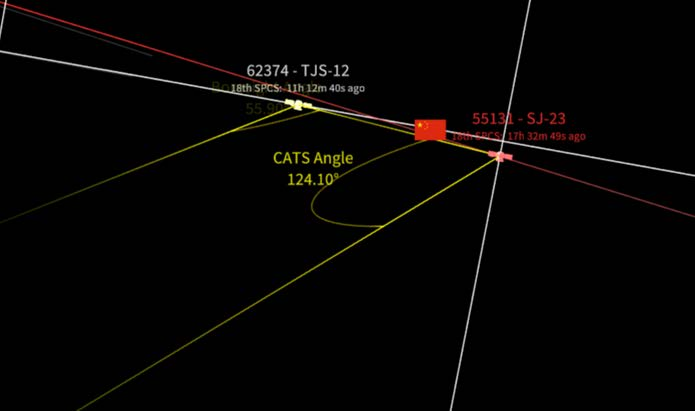
- Coincidentally, SJ-23 (55131) was also in the area as it drifts east along the GEO belt. On 10 Jan 2025 SJ-23 was ~120km from TJS-12 with a solar phase angle of 124° making it favorable for imaging (see graphic next page).
- TJS-12’s GEO position, 146.5°E, was also the initial position for TJS-7 (49115) before it relocated to the western hemisphere. TJS-7 is now over the equator at 99.4°W which is due south of the state of Texas. However, China is actively maintaining TJS-7’s inclination between 0.0 and 0.6°. The mission of TJS-7 remains unknown.
- Gunther’s lists TJS-1 (40892), 4 (44637), & 9 (40892) as being possible SIGINT satellites.
- TJS-12 is situated between TJS-1 and TJS-9. It is 8.5° west of TJS-1 (155.0°E) and 9.4° east of TJS-9 (137.1°E).
- TJS-12’s 2.0° inclination is unique to this group of satellites. TJS-1, 4, & 9 inclinations are 0.1°.
- Location
- TJS-12 is at 146.5°E, GF-13 02 is at 148.2° a difference of 1.7.°
- TJS-11 is at 120.3°E, YG-41 is at 123.1°E a difference of 2.8°.
- Inclination
- GF-13 is inclined 1.6° or 80% of TJS-12 2.0° inclination.
- YG-41 is inclined 4.2° or 84% of TJS-11 5.0° inclination.
- Phasing
- TJS-12 “leads” GF-13 02 by about 1hr 45min.
- YG-41 “leads” TJS-11 by about 1hr 06 min.
- GF-13 02 is one of China‘s GEO based imagery satellites and are believed to have a 15m resolution. China launched GF-13 02 on 17 Mar 2023. From Apr 2023 – Oct 2024 GF-13 02 was located at 146.7°E, very near where TJS-12 is now. On ~8-9 Oct GF-13 02 decreased its SMA ~52km initiating an eastward drift. China relocated the satellite at 148.2°E on 13 Oct 2024 where it has remained.
- YG-41 is also an imagery satellite (launched in late-2023) but has a better resolution than GF-13 02. China used its most powerful rocket, the LM-5, with an extended fairing to launch the satellite into GTO. Yaogan-41 is believed to have resolution down to around 2.5 meters and can likely see, identify and track car-sized objects throughout the entire Indo-Pacific region.
- The mission of TJS-11 remains unknown. Like YG-41, China used the LM-5 with extended fairing to launch the satellite. China released little information regarding the satellite’s mission, stating it would be mainly used to carry out multi-band, high-speed satellite communication technology verification.

Possible Chinese GEO-based SIGINT satellites, including TJS-12 at 146.5°E with a 2.0° inclination (spaceaware.io).
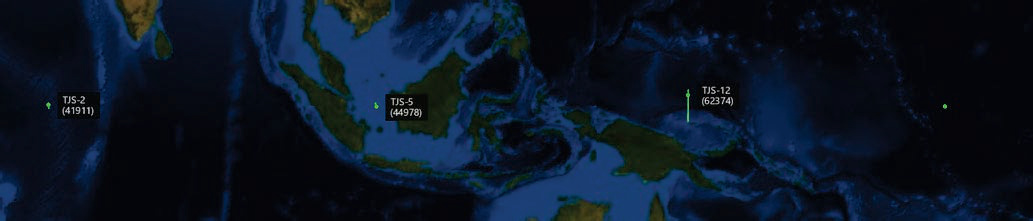
Possible Chinese GEO-based missile-warning satellites, including TJS-12 at 146.5°E with a 2.0° inclination (spaceaware.io).

Overview of the TJS-11/Yaogan-41 and TJS-12/Gaofen-13 02 pairings (spaceaware.io).
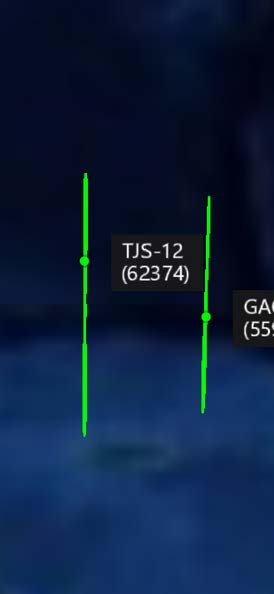
TJS-12 and Gaofen-13 02 pairing comparison: longitude, inclination and relative phasing (spaceaware.io).
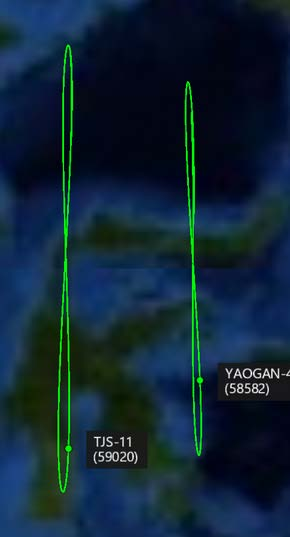
TJS-11 and Yaogan-41 pairing comparison: longitude, inclination and relative phasing (spaceaware.io).

Gaofen-13 02 decreased altitude on 8 Oct 2024 and drifted from 146.6°E to 148.2°E before the TJS-12 launch (celestrak.org).
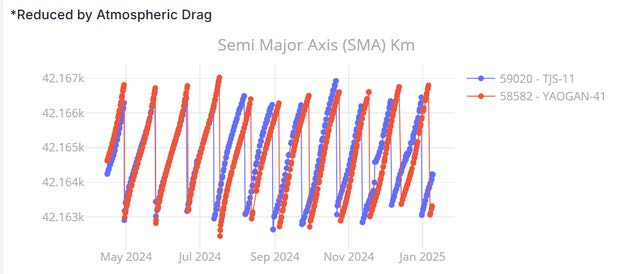
Yaogan-41 and TJS-11 stationkeeping from mid-April 2024 through early January 2025 (spacecockpit.com).