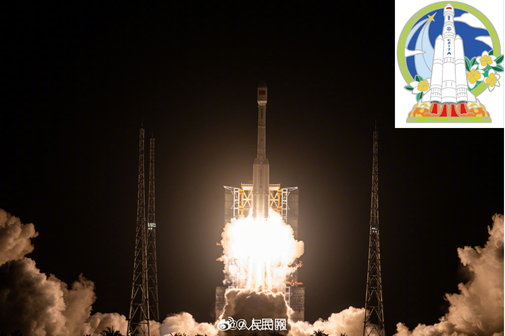
12 May: China launched a Long March-3C with TJS-19 (King of the South) (63924) from Xichang. According to official sources, the satellite has entered the planned orbit and will be “mainly used to verify multi-band and high-speed satellite communication technology” which is identical to the description provided for TJS-15 (King of the West) (63157), TJS-16 (King of the East) (63397), and TJS-17 (King of the North) (63524). On ~20 May, western observers located TJS-19 in GEO at 141.15°E. Launch Video.
– With its location at 141.15°E TJS-19 is located between TJS-9 (137.2°E) and TJS-12 (146.5°E). TJS-9 is a suspected SIGINT collection satellite while the mission of TJS-12 remains unknown.
-Initial orbit observations detected TJS-19 inclined at 4.0°, far greater than any of the other TJS “Kings.” TJS-15, 16, & 17 are all inclined 0.1°. The only TJS satellite with a greater inclination is TJS-11 (59020) which is now inclined at 4.8°.
– Of the 4 recently launched “Kings,” TJS-15 and TJS-19 appear to be operating alone, while China parked TJS-16 and TJS-17 in (relative) proximity with one another.
- In April 2025 China parked its recently launched TJS-17 in GEO at 152.74 E longitude. At this location, TJS-17 is only 0.24° east (171 km) of TJS-16 which is located at 152.50°E longitude.
– This is only the second TJS launch to use the LM-3C, the only previous use was for TJS-3 back in 2018. The LM-3C has 2 strap-on boosters and can deliver a maximum mass capacity to GTO of 3,800kg, while the LM-3B has 4 strap-on boosters capable of delivering 5,500kg to GTO.
– There was a secondary object also associated with TJS-19. The object appeared after the satellite had circularized its orbit in GEO and per the Joint Commercial Operations Cell “is possibly the apogee kick motor (AKM) which is currently drifting west at a rate of 5.14 W deg/day.”
- China used the LM-3B to launch both TJS-15 and TJS-17. In both instances observers noted a secondary object in GEO, likely an apogee kick motor.
– Speaking of TJS-15, it appears to have been visited by TJS-3 (43874) on 21 May 2025 at ~0730UTC. Minimum range between the two satellites was just over 100km and lighting conditions were ideal for TJS-3 to observe TJS-15. TJS-3 is a suspected inspection satellite. TJS-3 does not appear to have performed any specific maneuvers for this imaging opportunity. It is currently orbiting 73km above the GEO belt and drifting westward 1° per day.
https://www.youtube.com/watch?v=CCNh9Xxjrcc


TJS Summary
– TJS-19 is the 5th TJS launch in 2025, the most ever for a single year (and we’re not even to June yet). In the past 10 years China has launched 17 TJS satellites, half of which were launched in the past 18 months. For some reason China avoided the TJS-8 and TJS-18 designations…
- 2015 (1): TJS-1 (suspected SIGINT)
- 2016 (0): No Launches
- 2017 (1): TJS-2 (suspected Missile Warning)
- 2018 (1): TJS-3 (suspected satellite inspection)
- 2019 (1): TJS-4 (suspected SIGINT)
- 2020 (1): TJS-5 (suspected Missile Warning)
- 2021 (3): TJS-6 (suspected Missile Warning), TJS-7 (Unknown), & TJS-9 (suspected SIGINT)
- 2022 (0): No Launches
- 2023 (1): TJS-10 (unknown)
- 2024 (3): TJS-11 (unknown), TJS-12 (unknown), TJS-13 (HEO, suspected Missile Warning)
- 2025 (5): TJS-14 (unknown), TJS-15 (unknown), TJS-16 (unknown), TJS-17 (unknown), TJS-19 (unknown)