Issue 124

Cosmos 2558 Has A New Visitor

26 Jun - 5 Jul: On 26 June Russia released a sub-satellite from Cosmos 2558 which the 18 Space Defense Squadron has cataloged as “Object C” (64627). Initially believed to be debris, Object C has maneuvered and is undoubtedly an active sub-satellite. Watch Video from Marco Langbroek. Recall that Cosmos 2558 is believed…

26 Jun – 5 Jul: On 26 June Russia released a sub-satellite from Cosmos 2558 which the 18 Space Defense Squadron has cataloged as “Object C” (64627). Initially believed to be debris, Object C has maneuvered and is undoubtedly an active sub-satellite. Watch Video from Marco Langbroek.

Recall that Cosmos 2558 is believed to be a Nivelir inspector satellite. It was launched in Aug 2022 into a co-planar orbit with a US reconnaissance satellite USA 326. Previous Nivelir satellites, Cosmos 2519 and Cosmos 2542, also released sub-satellites. These sub-satellites (Cosmos 2521 and Cosmos 2543 respectively) eventually released a third object at high velocity. In response USSPACECOM noted that Russia had “conducted a non-destructive test of a space-based anti-satellite weapon.”

Russian space operators last conducted orbital maintenance maneuvers for Cosmos 2558 (53323) in mid-April 2025. Over the past 2.5 months the satellite has naturally lost ~10km in average altitude (from 461.1 to 451.0 km).


From 26 Jun – 3 Jul Cosmos 2558 and Obj C were separated by 70-150km. After reducing Obj C’s average altitude on 3 Jul the satellites began to separate and will continue to do so as Obj C has a shorter orbital period than Cosmos 2558. As of 5 Jul the two objects were separated by over 4,000km. Eventually Obj C will lap Cosmos 2558 and they will have another close approach.


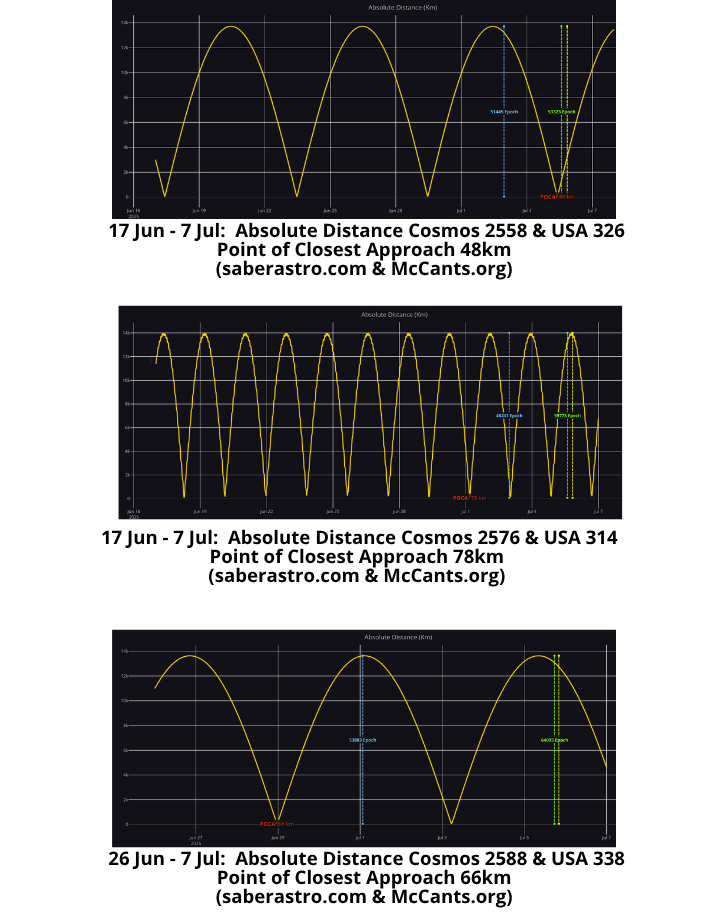
Cosmos 2558 and Object C are nearly co-planar with a US reconnaissance satellite USA 326 (51445). With orbital information from 5 Jul for Cosmos 2558/Obj C and 3 Jul for USA 326 (see McCants Catalog) the Point of closest approach between Cosmos 2558 and USA 326 is ~50km. Object C’s point of closest approach to USA 326 is ~80km. Both objects will have a close approach with USA 326 approximately every 4 days. It is important to note that these close approaches are not a result of Russian maneuvers, but rather are just orbital mechanics at work. However, Russia did intentionally launch Cosmos 2558 into a co-planar orbit with USA 326 and for years maintained Cosmos 2558’s orbit. With the satellites nearly plane-matched Russia could reduce the point of closest approach distance for either Cosmos 2558 (assuming it is still operational) or Object C using relatively small maneuvers.


Quick Look At Nivelir Satellites and Their US Companions

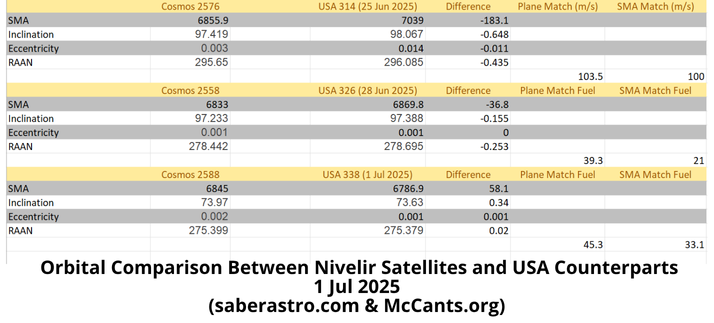
Using the information from the McCants Catalog I went ahead and compared the orbits of the 3 suspected Nivelir satellites (Cosmos 2558/2576/2588) with their USA objects of interest (USA 326/314/338 respectively). Results can be found in the table below. I then asked Jack Anthony for his take on what constitutes classifying 2 objects as being co-planar…in other words how close is close enough for inclination and RAAN? Jack noted one useful metric is to determine how much energy/fuel would be required from a “chaser” spacecraft to best match its “target.” Jack then computed the energy/fuel required to match the satellites’ average altitude (thanks Jack!)


Based on the valued in the spacetrak.org and McCants catalogs Cosmos 2558 remains the closest match with its corresponding USA satellite. The newly launched Cosmos 2588 is second with Cosmos 2576 having the greatest plane and SMA differences with its target US satellite.


Editor’s Note: the dates for the latest observations in the McCants catalog are noted next to the satellite name.