Issue 127

Jack’s Astro Corner XSS-11 – Daring Greatly in Rendezvous & Proximity Operations (RPO) (Part 3 of 3) by Jack Anthony

I hope you enjoyed XSS-11 Part 2, and of course Part 1. Here's Part 3 that will summarize the accomplishments of XSS-11 during its on-orbit activity April 2005 to December 2006. XSS-11 was America's first small satellite adventure into the world of RPO-it was a learning experience, and a confidence builder. Speaking of…

I hope you enjoyed XSS-11 Part 2, and of course Part 1. Here’s Part 3 that will summarize the accomplishments of XSS-11 during its on-orbit activity April 2005 to December 2006. XSS-11 was America’s first small satellite adventure into the world of RPO-it was a learning experience, and a confidence builder. Speaking of great space experimentation, I wish AFRL and their partners good luck as they have just commenced the NTS3 space mission to explore the future of position, navigation and timing.


BOTTOMLINE UP FRONT. XSS-11 was launched into an 860 Km circular orbit inclined at 98.8 degrees on 11 April 2005 from Vandenberg AFB in California using a Minotaur-IV rocket. The team carefully activated and conducted early orbit checkout operations through May 2005. Then it was time to “dance” with the Minotaur upper stage which remaining in the same orbit plane as the XSS-11 spacecraft. By “dance,” I mean conduct RPO experimentation. From June 2005 to April 2006 the team got into a rhythm via a 5-day week of planning, executing and then digesting what was learned and then doing it again the next week. I will explain this next but let me get you through the mission and summarize their RPO experiments “box score” of what they did. I should note here that after almost a year of RPO activity with the Minotaur upper stage the team executed orbital maneuvers to change the right ascension of the ascending node (RAAN), leaving the upper stage behind and drifting the XSS-11 orbit plane to visit a derelict space object they were OK’ed to visit. That took about 4 months. As you know, to change orbit plane can be a very propulsive expensive deal (see Jason’s numbers in the SJ-21/25 article.) But by changing the semi-major axis they were able to slowly drift the plane to realign with their next partner in RPO with minimal fuel expenditure. After 2 months of that they prepared to end the mission by lowering the orbit to facilitate decay and deorbit and acting to safe and deactivate systems on the spacecraft. That takes us to December 2006 when it was lights out. It took about 5 years for the Earth’s atmosphere to grab onto and bring this mighty “dishwasher” sized spacecraft into the upper atmosphere to burn up.


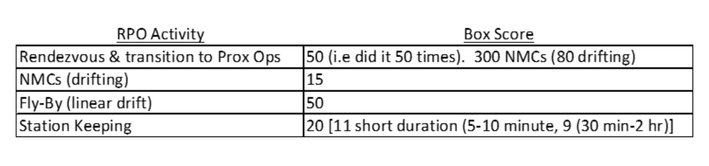
THE BOX SCORE OF AMAZING RPO ACCOMPLISHMENTS I made a table summarizing the RPO techniques they tried, demonstrated and learned as they attempted and accomplished them. They worked well within 1 Km of the upper stage, sometimes within 100 meters. Each time a tremendous effort was mounted to plan, simulate and attempt a specific goal. Sometimes it was fraught with challenges, and other times it worked fine. Such is space experimentation, it’s “like a box of chocolates, you never know what you are going to get.” (using my Forrest Gump voice). Well, actually with planning and simulation and such you can have a good idea of what you’ll get. As Clark would say “let’s run the numbers before we try.” If it’s a glitch or surprise, work it! Learn! Here’s the summary.


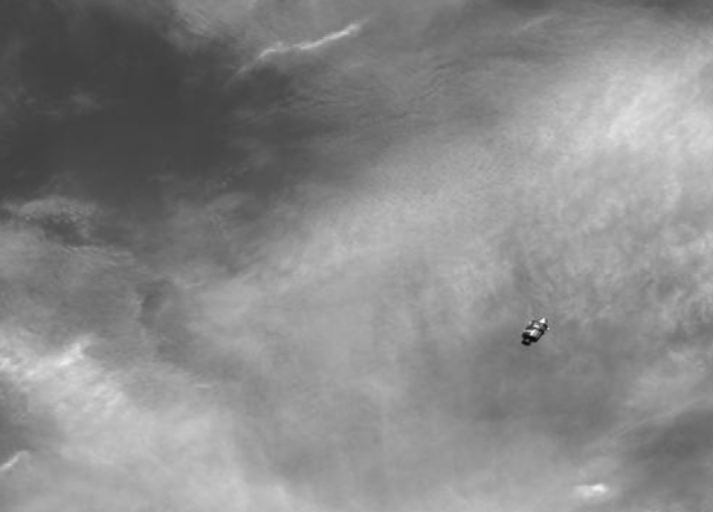
A WEEK IN THE LIFE OF XSS-11. I spoke with several veterans of the mission and those deeply involved with mission operations spoke about the weekly tempo. My friend Clark Keith shared many stories about the tempo the team stayed in. A typical week started with XSS-11 in a Staging orbit. By that I mean it was not cozied up to its Minotaur upper stage RPO partner. As I said, both spacecraft shared an 860 Km orbit inclined at 98 degrees and stayed relatively synched up in right ascension of ascending node and inclination. With a plan in mind, the XSS-11 team commanded their spaceship to execute delta V’s to start XSS-11 on a course to close the distance with their awaiting target (again, just using the term I’ve always used). Clark was encouraged to not use Chaser and Target, I think that irritated him, but he complied and I’ll say he came up with the Chaser being called “Doing Object” and the Target as “Recipient Object.” XSS-11 made 14 or so orbits per day, about a 100-minute orbit period. To depart the staging area and head for the Minotaur, a little delta-V would shift the closure rate and bring it on a course to meet up with the Minotaur upper stage. As they got closer the Space Command folks in Cheyenne Mountain would share their perspectives as to “where you both are” from an orbit determination sense and of course XSS-11 had a beacon to help the AFSCN get a good orbit fix. Soon, delta V’s would be executed to set up the RPO objective. These were small burns and at times the ops team had to tweak the propulsion system tank pressure to get a tiny burn, very precise throttle adjustments. That proved to be a challenge, but they made it all work. Sometimes they would “fly-by” and use the XSS-11 LIDAR and cameras to get an image or see how the system was behaving. Here’s a photo of the upper stage from XSS-11.

Never boring and always a step forward. Other times they would set up a natural motion circumnavigation (NMC), or as some folks called it a “football” orbit. OK, let’s hear a cool XSS-11 story courtesy of Mike Drews of Lockheed-Martin. He was LM’s RPO Leader and resonated with Clark and others as they explored RPO with XSS-11.

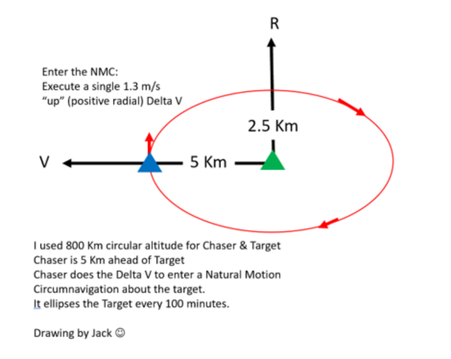
A key objective in the XSS-11 on orbit activity was to establish a natural motion circumnavigation (NMC) relative motion trajectory around the Minotaur upper stage. For those of you involved in RPO, you’ll recognize the term NMC. “It’s a household word in the RPO business” (again, using my Forrest Gump voice). Guess what? The NMC term was created in the XSS-11 program. No kidding. Here’s the story. From Mike’s account, the Draper Lab folks called the NMC pattern the “football orbit,” after all it was somewhat shaped like the planar view of an (American) football. Mike felt a better name for the “football” orbit was needed, more descriptive. Mike proposed “Natural” Motion Circumnavigation. Here’s a simple illustration of the NMC, in this case a 5km x 10 Km NMC (that happens to be shaped like a football I guess). To enter a NMC a radial delta V is what’s needed and the NMC pattern commences. Here’s my drawing and thank you Mike for your NMC idea!

Sometimes the NMC drifted as intended and others times it needed to be stopped so they could execute proximity ops with the upper stage, loiter! My drawing is a much larger NMC than what XSS-11 routinely did. The key was to get the teeny weenie thrust necessary stop the drift. The spacecraft was equipped with a pressurized propulsion system that allowed the system to scale impulse to very small burns for precise RPO maneuvering. So you might say they had to dial it down. This helped to eliminate drift when it was not desired or get the slow drift for a NMC fly-by or hold the NMC in the vicinity of the upper stage being circumnavigated. The spacecraft team also could scale up the RPO thrusters to settle out the disturbance torque when they fired the larger thrusters for orbit changing burns. Thank you, Mike Drews and Stan Kennedy, for helping me be aware of and explain this awesomeness of capability.

There was another cool and SAFE thing they did. They would kick in some crosstrack to make a drifting ellipse safe with regard to passing the target. This prevented a V-bar crash as the XSS-11 would pass off to the side instead of through the V-bar. Today many call it the safety ellipse, “kick in” cross track at the right place and enhance safety!


Sometimes the NMC “stopped” relative to the target and truly did some fancy proximity operations. Hanging around, loitering, that sort of activity. Later they would attempt and successfully do station keeping. By that they would set up a position relative to the Minotaur upper stage and “hold it”…you might say they battled Kepler and made fine delta-V’s to keep in position. Never a dull day or week in the life of XSS-11. Lots of lessons learned, a few episodes or “knock it off” and back out. Safety was paramount and in the end they did not “BONK.” When the objective was attempted and completed or waved off, they would maneuver to a staging orbit and catch their breath over the weekend. For everyone on the team, it was a busy time and a time of exploring the RPO world using a small satellite. The Space Command leaders took great notice. Often detailed questions came from the stars (Generals), and they learned more about the RPO techniques and lessons learned. This RPO thing was for real and this first test flight in orbit was proving to be an eye opener and got more thinking on how this can be used for servicing spacecraft or just checking things out “out there.”


Whew, this brings me the end of this XSS-11 journey in three parts. I hope you enjoyed it. The XSS-11 team would receive shout outs from the American Institute of Aeronautics and Astronautics as the recipient of the 2007 Technical Achievement Award. They also got nice accolades in Popular Science magazine as a 2005 “What’s New in Aviation & Space” category. As I said in part 1, there is a lot going on “out there” in space with regard to small satellites and big ones doing RPO, and sometimes docking or grabbing. With regard to RPO, the XSS-11 team stepped up and “dared greatly” backed up with a lot of work to ensure safety and success each time they gave it a try. While I have been mentioning my friend Clark and Vern and a few others, I could fill pages with the many space pioneers who served on the XSS-11 team. They should all stand proud as they were first to step up and “dare greatly.”


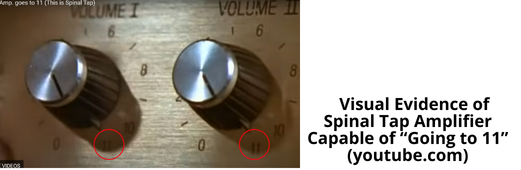
The “This is Spinal Tap” story I shared in Part 2 got some laughter. Mike Drew’s sent me a note and provided this paragraph he wrote that I thought would explain more so the connection of that corny “mockumentary” and the XSS-11 adventure. Enjoy!


“Some of the team were fans of the movie ‘This is Spinal Tap‘ (came out mid-1980’s) and many folks at Octant and LM had worked both XSS-10 and XSS-11. When they were deciding on the team shirt design, quoting the famous line from that movie about guitar amps going ‘1 louder’ such that ‘these go to 11′ expression became a jovial way of describing the journey of increasing RPO capability from XSS-10 to XSS-11. Alumni fondly remember that the integrated team not only worked hard, but had fun together.”

A key objective in the XSS-11 on orbit activity was to establish a natural motion circumnavigation (NMC) relative motion trajectory around the Minotaur upper stage. For those of you involved in RPO, you’ll recognize the term NMC. “It’s a household word in the RPO business” (again, using my Forrest Gump voice). Guess what? The NMC term was created in the XSS-11 program. No kidding. Here’s the story. From Mike’s account, the Draper Lab folks called the NMC pattern the “football orbit,” after all it was somewhat shaped like the planar view of an (American) football. Mike felt a better name for the “football” orbit was needed, more descriptive. Mike proposed “Natural” Motion Circumnavigation. Here’s a simple illustration of the NMC, in this case a 5km x 10 Km NMC (that happens to be shaped like a football I guess). To enter a NMC a radial delta V is what’s needed and the NMC pattern commences. Here’s my drawing and thank you Mike for your NMC idea!