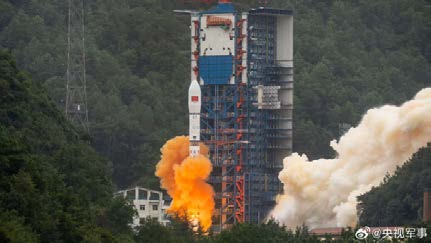
27 Sep 2025: China launched a Long March-6A from Taiyuan with the eleventh group of SatNet LEO satellites (SatNet LEO Group 11) for the Guowang constellation. The launch carried 5 satellites (65817-65821) into a new 86.5° orbital plane with a RAAN offset of ~30° west of Group 8 and east of Group 9. Launch Video.
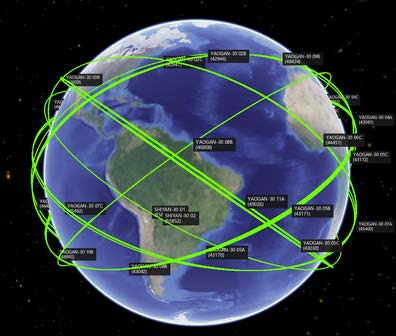
– With this launch there are now 86 satellites in the operational Guowang constellation (see graphics & tables). Additionally, China has launched 18 Guowang test satellites.
– China is building out the Guowang constellation with orbits inclined either 50.0° or 86.5°. Currently there are 36 satellites in 4 50.0° orbital planes and 50 satellites in 6 86.5° orbital planes.
– Summary of Guowang Operational Launches
- Group 1 (16 Dec 2024): 10 sats on LM-5B. Orbit inclined 86.5°
- Group 2 (11 Feb 2025): 9 sats on LM-8A. Orbit inclined 50.0°
- Group 3 (28 Apr 2025): 10 sats on LM-5B. Orbit inclined 86.5°
- Group 4 (5 Jun 2025): 5 sats on LM-6A. Orbit inclined 86.5° (co-planar with Group 9)
- Group 5 (27 Jul 2025): 5 sats on LM-6A. Orbit inclined 86.5°
- Group 6 (30 Jul 2025): 9 sats on LM-8A. Orbit inclined 50.0°
- Group 7 (4 Aug 2025): 9 sats on LM-12. Orbit inclined 50.0°.
- Group 8 (13 Aug 2025): 10 sats on LM-5B. Orbit inclined 86.5°
- Group 9 (17 Aug 2025): 5 sats on LM-6A. Orbit inclined 86.5° (co-planar with Group 4)
- Group 10 (25 Aug 2025): 9 sats on LM-8A. Orbit inclined 50.0°.
- Group 11 (27 Sep 2025): 5 sats on LM-6A. Orbit inclined 86.5°.
- For the 86.5° inclined orbits (Groups 01, 03, 04, 08, 09 & 11) the target SMA appears to be 1,167.9km. It appears the intended RAAN separation is ~30° between planes. Group 11 filled the remaining orbital plane.
- Group 09’s 5 satellites are co-planar with the 5 Group 04 satellites. China’s initial deployment appears to be 10 satellites per 86.5° orbital plane. Expect the next 86.5° launch to head to the remaining open plane or augment the Group 05 or Group 11 satellites. (see graphic)
- The 50° orbits may have a standard operating altitude of 1,149.3km, however Group 2 is the only group to reach this SMA. Groups 6, 7 & 10 continue to raise their altitudes.
- 86.5° Orbits (target SMA 1,167.9km)
- Group 1 reached operating altitude in 110 days.
- Group 3 reached operating altitude in 34 days.
- Group 4 reached operating altitude in 106 days.
- Group 5 reached operating altitude in 58 days.
- Group 8 reached operating altitude in 32 days.
- Group 9 reached operating altitude in 52 days.
- Group 11 satellites started at an altitude of ~1,003km and are now at ~1,004-1008km and continue to raise their SMAs.
- 50.0° inclined orbits (target SMA 1,149.3km)
- Group 2 reached operating altitude of 1,149.3km in 77 days
- Group 6 continue to increase their SMA. They paused at 874km for 1 month but have resumed maneuvers to increase SMA.
- Group 7 continue to increase their SMA. They paused at ~907.8km for 3 weeks but have resumed maneuvers to increase SMA.
- Group 10 started at an altitude of ~873km and are now 925.8km and continue to increase their SMAs.

LM-6A prepares for the Guowang Group 11 launch (nasaspaceflight.com).

Guowang Group 11 mission patch (nasaspaceflight.com).
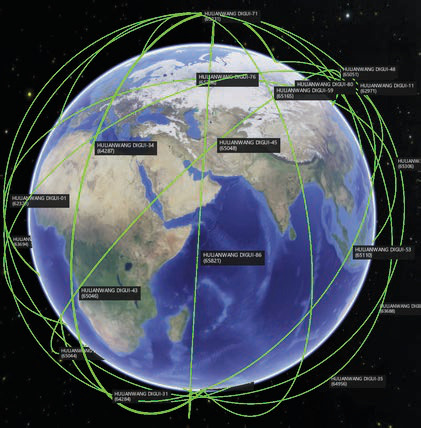
4 Oct 2025: 86-satellite operational Guowang constellation (spaceaware.io).

28 Sep 2025: five Group 11 satellites observed after launch (@s2a_systems via X).
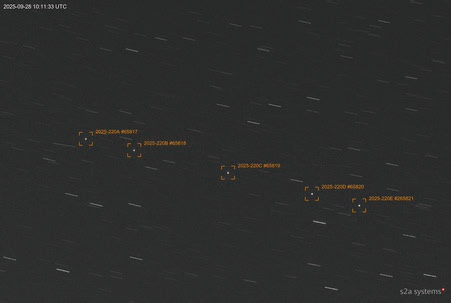
28 Sep 2025: five Group 11 satellites in their new orbital plane (@s2a_systems via X).
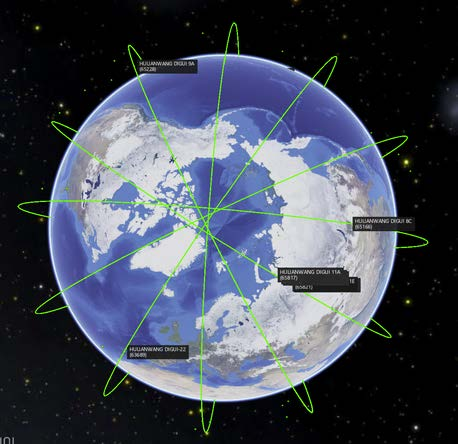
Polar view of Guowang’s six 86.5° orbital planes separated by about 30° of RAAN (spaceaware.io & saberastro.com).
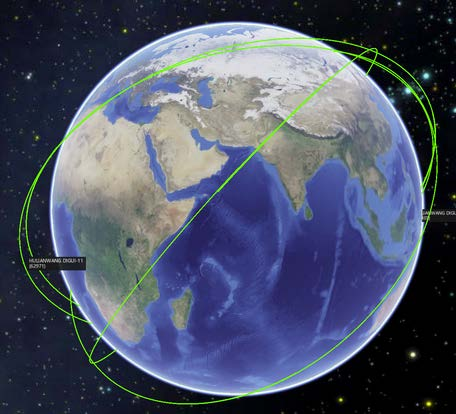
36 operational Guowang satellites in 50.0° inclined orbits across four planes (spaceaware.io & saberastro.com).