

Issue 131
01
Flash · Integrity Flash 2025 · Members Only
integrity flash job Board
Author Greg Gillinger
Published October 13, 2025
02
Flash · Integrity Flash 2025 · Members Only
ISR University provides courses and pathways for professionals
click here to get started today
Author Greg Gillinger
Published October 13, 2025

03
Flash · Integrity Flash 2025 · Members Only
China Launches Guowang Group 11 Satellites
27 Sep 2025: China launched a Long March-6A from Taiyuan with the eleventh group of SatNet LEO satellites (SatNet LEO Group 11) for the Guowang constellation. The launch carried 5 satellites (65817-65821) into a new 86.5° orbital plane with a RAAN offset of ~30° west of Group 8 and east of Group 9. Launch Video . -…
Author Greg Gillinger
Published October 13, 2025
27 Sep 2025: China launched a Long March-6A from Taiyuan with the eleventh group of SatNet LEO satellites (SatNet LEO Group 11) for the Guowang constellation. The launch carried 5 satellites (65817-65821) into a new 86.5° orbital plane with a RAAN offset of ~30° west of Group 8 and east of Group 9. Launch Video.
– With this launch there are now 86 satellites in the operational Guowang constellation (see graphics & tables). Additionally, China has launched 18 Guowang test satellites.
– China is building out the Guowang constellation with orbits inclined either 50.0° or 86.5°. Currently there are 36 satellites in 4 50.0° orbital planes and 50 satellites in 6 86.5° orbital planes.
– Summary of Guowang Operational Launches
- Group 1 (16 Dec 2024): 10 sats on LM-5B. Orbit inclined 86.5°
- Group 2 (11 Feb 2025): 9 sats on LM-8A. Orbit inclined 50.0°
- Group 3 (28 Apr 2025): 10 sats on LM-5B. Orbit inclined 86.5°
- Group 4 (5 Jun 2025): 5 sats on LM-6A. Orbit inclined 86.5° (co-planar with Group 9)
- Group 5 (27 Jul 2025): 5 sats on LM-6A. Orbit inclined 86.5°
- Group 6 (30 Jul 2025): 9 sats on LM-8A. Orbit inclined 50.0°
- Group 7 (4 Aug 2025): 9 sats on LM-12. Orbit inclined 50.0°.
- Group 8 (13 Aug 2025): 10 sats on LM-5B. Orbit inclined 86.5°
- Group 9 (17 Aug 2025): 5 sats on LM-6A. Orbit inclined 86.5° (co-planar with Group 4)
- Group 10 (25 Aug 2025): 9 sats on LM-8A. Orbit inclined 50.0°.
- Group 11 (27 Sep 2025): 5 sats on LM-6A. Orbit inclined 86.5°.


– Observations
- For the 86.5° inclined orbits (Groups 01, 03, 04, 08, 09 & 11) the target SMA appears to be 1,167.9km. It appears the intended RAAN separation is ~30° between planes. Group 11 filled the remaining orbital plane.
- Group 09’s 5 satellites are co-planar with the 5 Group 04 satellites. China’s initial deployment appears to be 10 satellites per 86.5° orbital plane. Expect the next 86.5° launch to head to the remaining open plane or augment the Group 05 or Group 11 satellites. (see graphic)
- The 50° orbits may have a standard operating altitude of 1,149.3km, however Group 2 is the only group to reach this SMA. Groups 6, 7 & 10 continue to raise their altitudes.
– Deployment Status (all data as of 3 Oct 2025)
- 86.5° Orbits (target SMA 1,167.9km)
- Group 1 reached operating altitude in 110 days.
- Group 3 reached operating altitude in 34 days.
- Group 4 reached operating altitude in 106 days.
- Group 5 reached operating altitude in 58 days.
- Group 8 reached operating altitude in 32 days.
- Group 9 reached operating altitude in 52 days.
- Group 11 satellites started at an altitude of ~1,003km and are now at ~1,004-1008km and continue to raise their SMAs.
- 50.0° inclined orbits (target SMA 1,149.3km)
- Group 2 reached operating altitude of 1,149.3km in 77 days
- Group 6 continue to increase their SMA. They paused at 874km for 1 month but have resumed maneuvers to increase SMA.
- Group 7 continue to increase their SMA. They paused at ~907.8km for 3 weeks but have resumed maneuvers to increase SMA.
- Group 10 started at an altitude of ~873km and are now 925.8km and continue to increase their SMAs.


04
Flash · Integrity Flash 2025 · Members Only
China Launches Shiyan-30 01 & 02 Satellites
29 Sep 2025: China launched a Long March-2D carrying the Shiyan-30 01-02 satellites (65851 & 65852) from Xichang. According to official sources, the satellites entered their preset orbits successfully and “will be mainly used for experimental verification of Earth observation technologies”. Launch Video . Launch…
Author Greg Gillinger
Published October 13, 2025
29 Sep 2025: China launched a Long March-2D carrying the Shiyan-30 01-02 satellites (65851 & 65852) from Xichang. According to official sources, the satellites entered their preset orbits successfully and “will be mainly used for experimental verification of Earth observation technologies”. Launch Video. Launch Preparation Video.
– This was the 100th launch of the LM-2D
- The rocket’s first flight was in 1992 and completed its first 50 launches over the course of 28 years. The second 50 launches have occurred in just 5 years.
- The LM-2D has delivered 300+ satellites to orbit over the course of its lifetime.
- China has reduced the LM-2D’s test and launch cycle to 11 working days, while also reducing test and launch personnel 50%.
– SY-30 01/02 are currently in a 594 x 588 orbit (SMA=587km) with an inclination of 35°.
- 35° is a popular inclination for Chinese reconnaissance satellites. The following Yaogan constellations are also at this inclination (SMA values are from satellite initial deployment & do not represent current values)
- YG-30: 30 satellites, SMA = 600km
- YG-35: 15 satellites, SMA = 500km
- YG-36: 15 satellites, SMA = 500km
- YG-39: 15 satellites, SMA = 500km
- YG-42: 2 satellites, SMA = 500km
- YG-43: 18 satellites, SMA = 500km
- The initial orbits for SY-30 01/02 most closely match those of the YG-30 constellation.
- YG-30 are believed to be SIGINT satellites. China launched them in triplets from 2017-2021.
- YG-30 constellation consists of 10 sets of triplets in 6 orbital planes. See next article for deep-dive into the YG-30 constellation.
Editor’s Comment: SY-30 01/02 are not co-planar with any of the previously mentioned Yaogan satellites. China typically uses their Shiyan satellites to experiment with new technologies. SY-30’s similar orbit with the YG-30 satellites may indicate a potential follow-on radio frequency/geolocation (SIGINT) mission. However, this could also be purely coincidental. Comparing imagery of the two spacecraft types would provide further evidence.

05
Flash · Integrity Flash 2025 · Members Only
Checking in on the YG-30 Constellation
9 Oct 2025: From 29 Sep 2017 through 19 July 2021 China conduced 10 launches (all LM-3C from Xichang) to deliver 30 Yaogan-30 satellites to LEO. All began with an average altitude of ~600km and an inclination of 35°. For the YG-30 constellation China has used 6 orbital planes separated by 60° RAAN. Three of the 6…
Author Greg Gillinger
Published October 13, 2025
9 Oct 2025: From 29 Sep 2017 through 19 July 2021 China conduced 10 launches (all LM-3C from Xichang) to deliver 30 Yaogan-30 satellites to LEO. All began with an average altitude of ~600km and an inclination of 35°. For the YG-30 constellation China has used 6 orbital planes separated by 60° RAAN. Three of the 6 planes have a single YG-30 triplet and two of the planes have 2 triplets. In these 5 planes China has spaced the satellites 120° apart (with the exception of YG-30 02C which appears to have suffered some anomaly and is no longer co-planar with its 02A/B siblings). The final orbital plane contains 3 triplets (YG-30 04/05/10…9 satellites). YG-30 04 triplets are also spaced 120° apart and it appears China has combined the YG-30 05 and 10 formations (I know its confusing, please see graphics).
China has allowed all of the YG-30 orbits to decay. Originally launched to nearly 600km orbit, nearly all satellites are now at 564.4km. Rather than expending fuel to maintain their higher orbits it appears China is letting the orbits decay while making minor maneuvers to maintain satellite formation. This contrasts with China’s approach to its YG-35/36/39/43 constellations where China is making frequent maneuvers to maintain both formation and SMA (again see graphic comparison).
(Note: there is a naming discrepency…some sources list YG-30 01-10 while others go with YG-30 02-11 and still others go with YG-30 A-AF. Celestrak goes with YG-30 02-11 so that’s what I’m sticking with!)
Constellation Overview:
– YG-30 02 (2017)(42945, 42946, 42947): YG-30 02C (42947) no longer co-planar with 02A and 02B. 02C orbiting ~4km lower than 02A/02B (560 vs 564km respectively). 30-02A & B are nearly co-planar with 30-09.
– YG-30 03 (2017)(43028, 43029,43030): All satellites co-planar and within 0.1km of SMA (SMA = 564.4km). Nearly co-planar with 30-11.
– YG-30 04 (2017)(43081, 43082, 43083): All satellites co-planar and within 0.1km of SMA (SMA = 564.4). Nearly co-planar with 30-05 and 30-10.
– YG-30 05 (2018)(43170, 43171, 43172): All satellites co-planar and within 0.1km of SMA (SMA = 564.4km). Nearly co-planar with 30-04 and 30-10.
– YG-30 06 (2019)(44449, 44450, 44451): All satellites co-planar and within 0.1km of SMA (SMA = 564.4km).
– YG-30 07 (2020)(45460, 45461, 45462): All satellites co-planar and within 0.1km of SMA (SMA = 564.4km).
– YG-30 08 (2020)46807, 46808, 46809): All satellites co-planar and within 0.1km of SMA (SMA = 564.4km).
– YG-30 09 (2021)(48423, 48424, 48425): All satellites co-planar and within 0.3km of SMA (SMA = 564.4km). Nearly co-planar with 30-02.
– YG-30 10 (2021)(48860, 48861, 48863): All satellites co-planar and within 0.1km of SMA (SMA = 564.4). Nearly co-planar with 30-04 and 30-05.
– YG-30 11 (2021)(49026, 49028, 49029): All satellites co-planar and within 0.1km of SMA (SMA = 564.4km). Nearly co-planar with 30-03.


06
Flash · Integrity Flash 2025 · Members Only
China: SY-29 Update
9 Oct 2025: China reduced the average altitude of its SY-29 (65486) satellite to 35,785.5km or just below GEO (35,786km). China launched SY-29 on 5 Sep 2025 and its original orbit was ~400km above the GEO graveyard orbit resulting in a westward drift of ~5.5°/day. Beginning in late September China conducted a series of…
Author Greg Gillinger
Published October 13, 2025
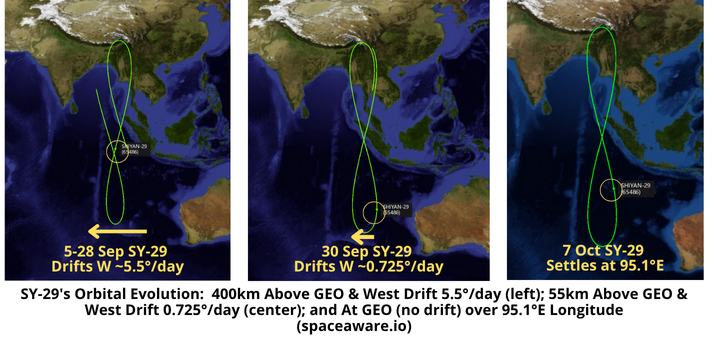
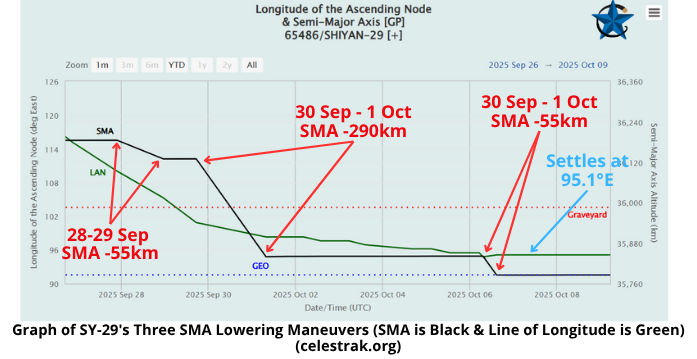
9 Oct 2025: China reduced the average altitude of its SY-29 (65486) satellite to 35,785.5km or just below GEO (35,786km). China launched SY-29 on 5 Sep 2025 and its original orbit was ~400km above the GEO graveyard orbit resulting in a westward drift of ~5.5°/day. Beginning in late September China conducted a series of three maneuvers. The first occurred 28-29 Sep when China decreased SY-29’s SMA (average altitude) ~55km. On 30 Sep, China reduced SY-29’s SMA another 290km and decreased its westward drift to 0.725°/day. The final maneuver occurred on 6 Oct when China further reduced SY-29’s SMA another ~55km. This final maneuver centered SY-29’s orbit over 95.1° E longitude with a minimal eastward drift of 0.01°/day. The satellite remains 28.5° inclined. With these maneuvers SY-29 is likely NOT some sort of GEO inspection satellite and is intended for other experimentation.
07
Flash · Integrity Flash 2025 · Members Only
Outsized Returns: Focused Debris Removal Analysis
3 Oct 2025: Stephen Clark of Ars Technica (and friend of the Flash) released an article describing how removing the 50 largest pieces of debris, as identified by Dr Darren McKnight (another friend of the Flash), would “cut danger from space junk in half.” The article also notes that countries (primarily China) are…
Author Greg Gillinger
Published October 13, 2025
3 Oct 2025: Stephen Clark of Ars Technica (and friend of the Flash) released an article describing how removing the 50 largest pieces of debris, as identified by Dr Darren McKnight (another friend of the Flash), would “cut danger from space junk in half.” The article also notes that countries (primarily China) are continuing to deposit massive spent upper stages into orbits which will be a collision threat for at least 25 years. As China fields its Guowang and other mega-constellations it will add to the debris problem. To date China has abandoned 9 Guowang related upperstages in orbits which will persist for at least 25 years. Excerpts below.
– The 50 most concerning pieces of space debris in low-Earth orbit are dominated by relics more than a quarter-century old, primarily dead rockets left to hurtle through space at the end of their missions.
– Per Dr Darren McKnight: “76% of the objects in the top 50 were deposited last century, and 88% of the objects are rocket bodies.”
– The 50 objects identified…are the ones most likely to drive the creation of more space junk in low-Earth orbit (LEO) through collisions with other debris fragments.
– Larger debris at higher altitudes pose a higher long-term risk because they could create more debris that would remain in orbit for centuries or longer.
– Russia and the Soviet Union lead the pack with 34 objects listed in McKnight’s Top 50, followed by China with 10, the US with three, Europe with two, and Japan with one. Russia’s SL-16 and SL-8 rockets are the worst offenders, combining to take 30 of the Top 50 slots.
– If someone sent missions to retrieve all 50 of the objects, the overall debris-generating potential in low-Earth orbit would be reduced by 50

percent, according to McKnight. If just the Top 10 were removed, the risk would be cut by 30%.
– More from Dr McKnight: “The bad news is, since January 1, 2024, we’ve had 26 rocket bodies abandoned in low-Earth orbit that will stay in orbit for more than 25 years.” The 25-year discriminator is important because that is the guideline promulgated by the Inter-Agency Space Debris Coordination Committee.
– US and European governments have policies requiring launch companies to deposit their spent upper stages to altitudes low enough to naturally reenter the atmosphere within 25 years, or deorbit their rockets altogether. For example, SpaceX routinely deorbits the upper stages of its Falcon 9 rocket…driving them back into the atmosphere over an unpopulated part of the ocean.
– China, on the other hand, frequently abandons upper stages in orbit. China launched 21 of the 26 hazardous new rocket bodies over the last 21 months, each averaging more than 4 metric tons (8,800 pounds)…most of the rockets used for Guowang and Thousand Sails launches have left their upper stages in orbit.
– “We know the Chinese have the capability to not leave rocket bodies,” McKnight said. One example is the Long March 5 rocket, which launched three times with batches of Guowang satellites. On those missions, the Long March 5 flew with an upper stage called the YZ-2, a high-endurance maneuvering vehicle that deorbits itself at the end of its mission. The story isn’t so good for launches using other types of rockets. With the other ones, they always leave a rocket body,” McKnight said. “So, they have the capability to do sustainable practices, but on average, they do not.”
find a job in a flash!
Advertise your jobs in the Integrity Flash
- Distributed directly to 3,000+ Professionals
- Reader Base of U.S. Military, Allied Militaries and Industry
- Highly-Targeted, Internationally-Praised Publication
Do you have a job you would like posted in the FLASH? Contact: Rhonda.Sheya@IntegrityISR.com
08
Flash · Integrity Flash 2025 · Members Only
SJ-23 Approaching Previous Turn-Around Point
9 Oct 2025: Shijian-23 (55131) is approaching its historical western boundary of 22.4° E longitude. As of 9 Oct SJ-23 was at 23.0° E and maintaining an average altitude of 35,838km (53km above GEO) resulting in a ~0.7°/day westward drift. Historically SJ-23 has reversed course between 19-22°E and I expect China will…
Author Greg Gillinger
Published October 13, 2025
9 Oct 2025: Shijian-23 (55131) is approaching its historical western boundary of 22.4° E longitude. As of 9 Oct SJ-23 was at 23.0° E and maintaining an average altitude of 35,838km (53km above GEO) resulting in a ~0.7°/day westward drift. Historically SJ-23 has reversed course between 19-22°E and I expect China will decrease its SMA in the next 10 days to initiate an eastward drift. SJ-23 began traveling west on 28 Feb 2025 when it reached 172°E over the Pacific Ocean. The last time SJ-23 was this far west was July 2024.
SJ-23 has had an interesting history. China launched the satellite on 9 Jan 2023 from Wenchang using a LM-7A. The satellite immediately exhibited unusual behaviors conducting frequent maneuvers resulting in a <4km close approach with the Chinese Tianlian-1 03 satellite in Mar 2023 and another <30km close approach with Tianlian-2 02 in Oct 2023. Beginning in Jan 2024 SJ-23’s orbit has become much more predictable, drifting east for ~225 days and then repeating the pattern going west. As it travels across the GEO belt there are numerous opportunities for SJ-23 to observe other satellites with varying lighting conditions.


09
Flash · Integrity Flash 2025 · Members Only
Russia: Cosmos 2589 and 2590 update
10 Oct 2025: Russia continues to periodically conduct rendezvous and proximity operations (RPO) with Cosmos 2589 (64467) and Cosmos 2590 (64527). The satellite pair remain in “super-GEO” elliptical orbits (0.365) with a perigee of 20,410km and apogee of 51,193km. In these orbits the two satellites remain within line of…
Author Greg Gillinger
Published October 13, 2025
10 Oct 2025: Russia continues to periodically conduct rendezvous and proximity operations (RPO) with Cosmos 2589 (64467) and Cosmos 2590 (64527). The satellite pair remain in “super-GEO” elliptical orbits (0.365) with a perigee of 20,410km and apogee of 51,193km. In these orbits the two satellites remain within line of site of the Russian landmass and cross the GEO belt 2x per day at 54.5° E and 139.0° E. Separation distances between the two Russian satellites varies greatly…<10km to >200km (see graphics).
Cosmos 2590 made several maneuvers between 29 Sep – 09 Oct. The maneuvers included both changes in SMA (in-track) and inclination/RAAN (cross-track). From the space-track.org catalog it appears Cosmos 2589 & 2590 had a 7km POCA on 1 Oct 2025 @10:16:40Z. After this point the two spacecraft separated and as of 10 Oct do not appear to be in RPO conditions; at times the two spacecraft were separated by >200km. For its part, Cosmos 2589 did not make any detectable maneuvers during this time period.


Inside this issue
Issue 131