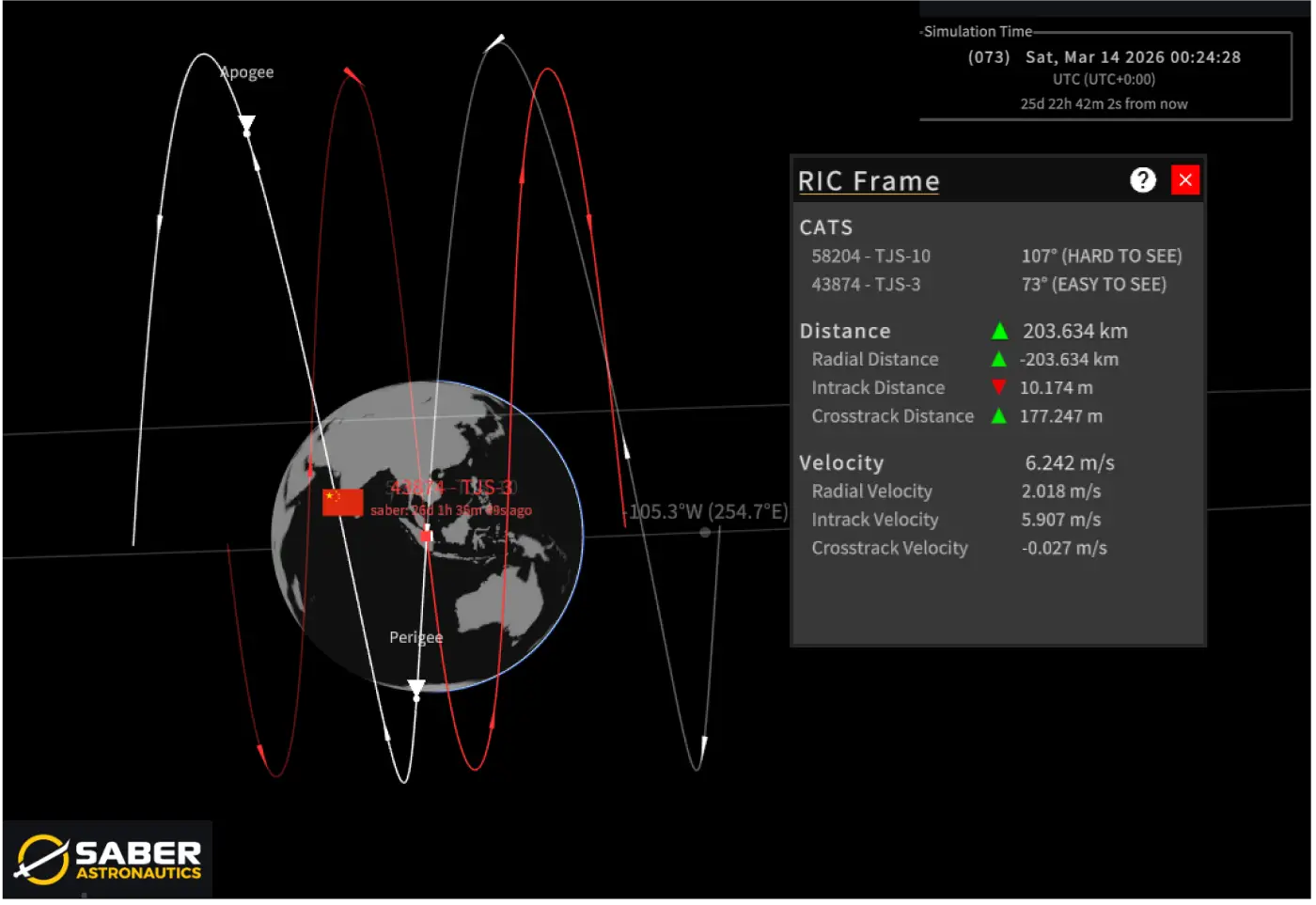
15 Feb 2026: As noted in the last edition of the Flash, on 3-4 Feb Chinese space operators increased the SMA of TJS-10 (58204) and initiated a 1.8°/day westward drift. Interestingly, on 7 Feb 2026 China decreased the SMA of TJS-3 (43874) ~122.6km to initiate an eastward drift. China subsequently increased TJS-3’s SMA ~20km, but TJS-3 remains below the GEO belt and with a ~1.3°/day eastward drift. In their current orbits TJS-10 and TJS-3 are closing with one another at a rate of 3.1°/day. Assuming they maintain their current orbits (a big assumption) the two satellites will have a point of closest approach in mid-March over 103.6°E longitude.
Recall that TJS-3 and TJS-10 operated in vicinity of one another during TJS-10’s first year on orbit from Nov 2023 – Nov 2024. It appears China purposefully launched TJS-10 into a co-planar orbit with TJS-3 (TJS-3 also conducted minor plane change maneuvers prior to TJS-10 launch). Comparing their current orbital parameters TJS-10 and TJS-3 remain nearly co-planar. Their inclination values are separated by only 0.001° and RAAN by 0.019°.
Propagating their current orbits forward to mid-March the two satellites will be separated primarily in the radial-track due to a .001 difference in orbit eccentricity (.001) and a 135.2° difference in argument of perigee values. Without adjusting either orbital element the two satellites will be separated by ~203km in the radial track, compared with <1km in-track (SMA) and cross-track (inclination/RAAN) separation distances. If (and apologies for all of the assumptions here) China intends to conduct RPO between TJS-3 and TJS-10 they will likely follow the RPO playbook described by Jack Anthony and begin to “shape-match” the two orbits between now and mid-March.
I’ll be watching for adjustments in the eccentricity values (radial track maneuvers) for both TJS-3 and TJS-10 should they continue on their current trajectories. Timed correctly these maneuvers will shrink the argument of perigee differences and effectively match the orbit shapes of TJS-3 and TJS-10.
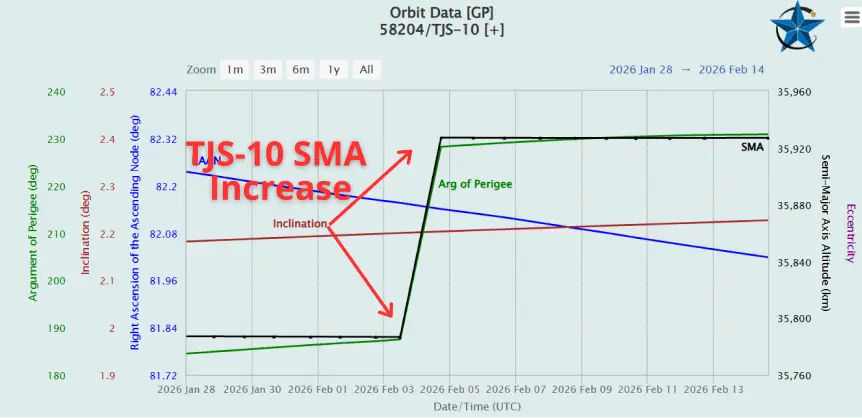
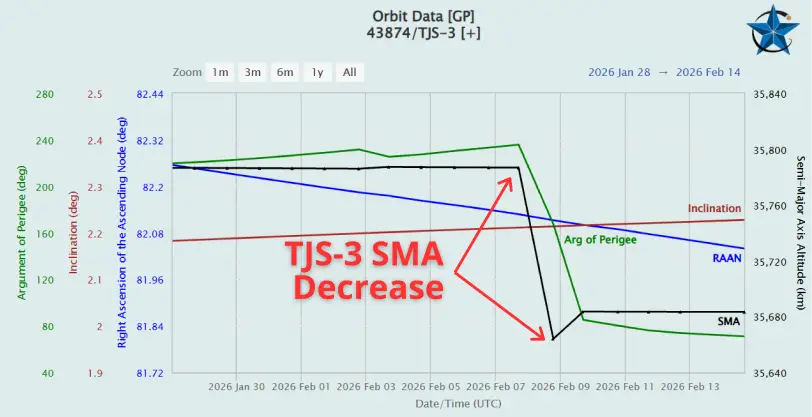
28 Jan -14 Feb Orbital History of TJS-10 (Left) and TJS-3 (Right)
TJS-10 Increased SMA 3-4 Feb and TJS-3 Decreased SMA 7-8 Feb 2026
Inclination and RAAN Values Are Nearly Identical
China will need to adjust Arg of Perigee to Conduct RPO
(celestrak.org)
Ides of March? TJS-3 & TJS-10 Head Toward One Another
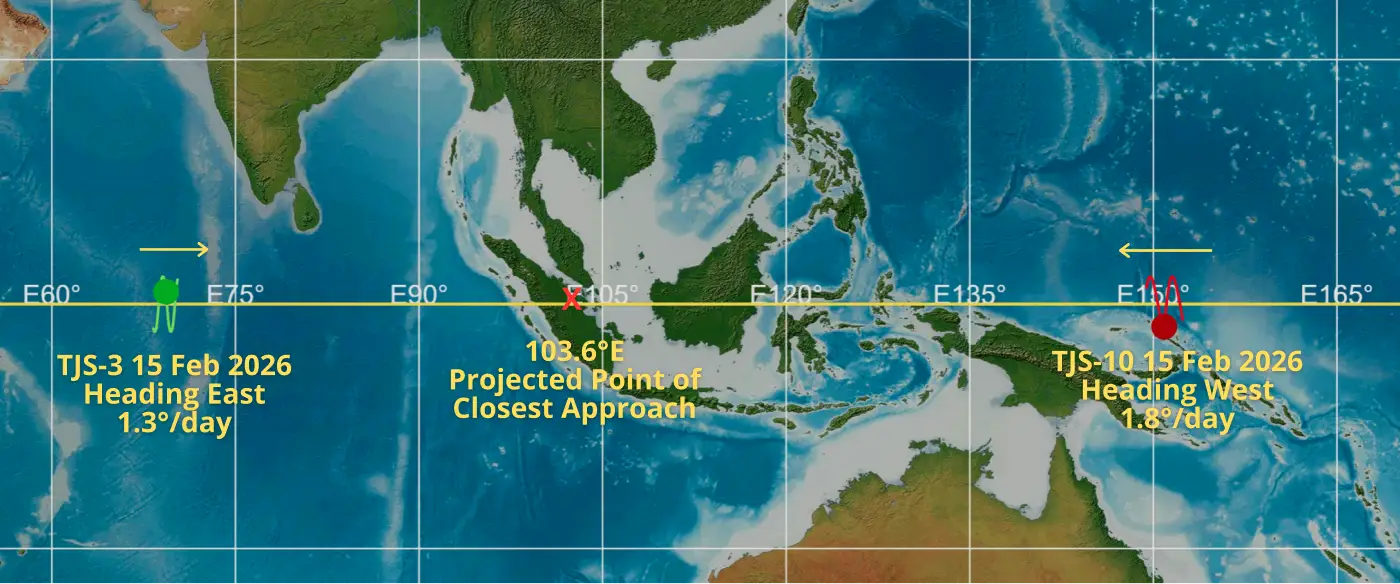
15 Feb: TJS-3 and TJS-10 Heading Toward One Another
(spacemap42.com)