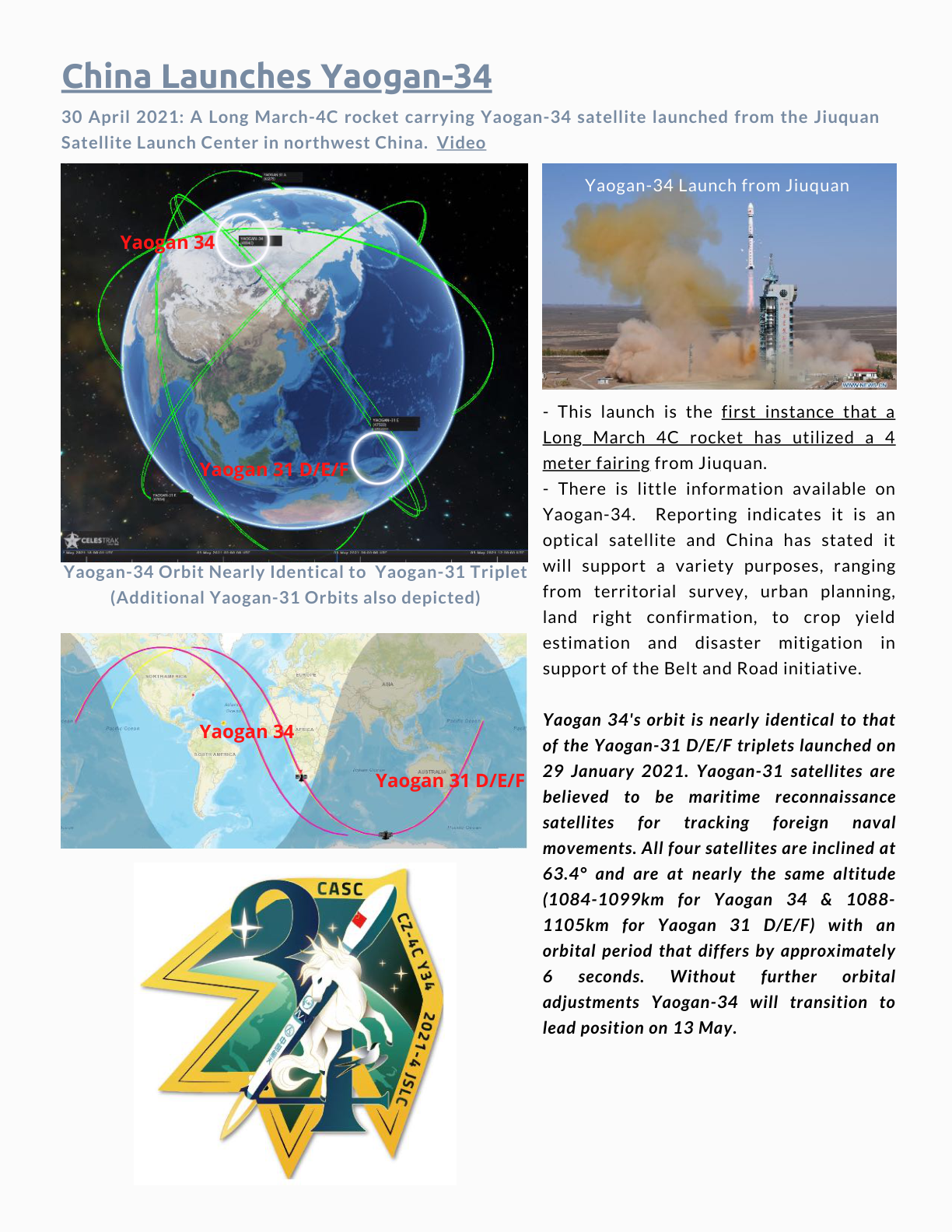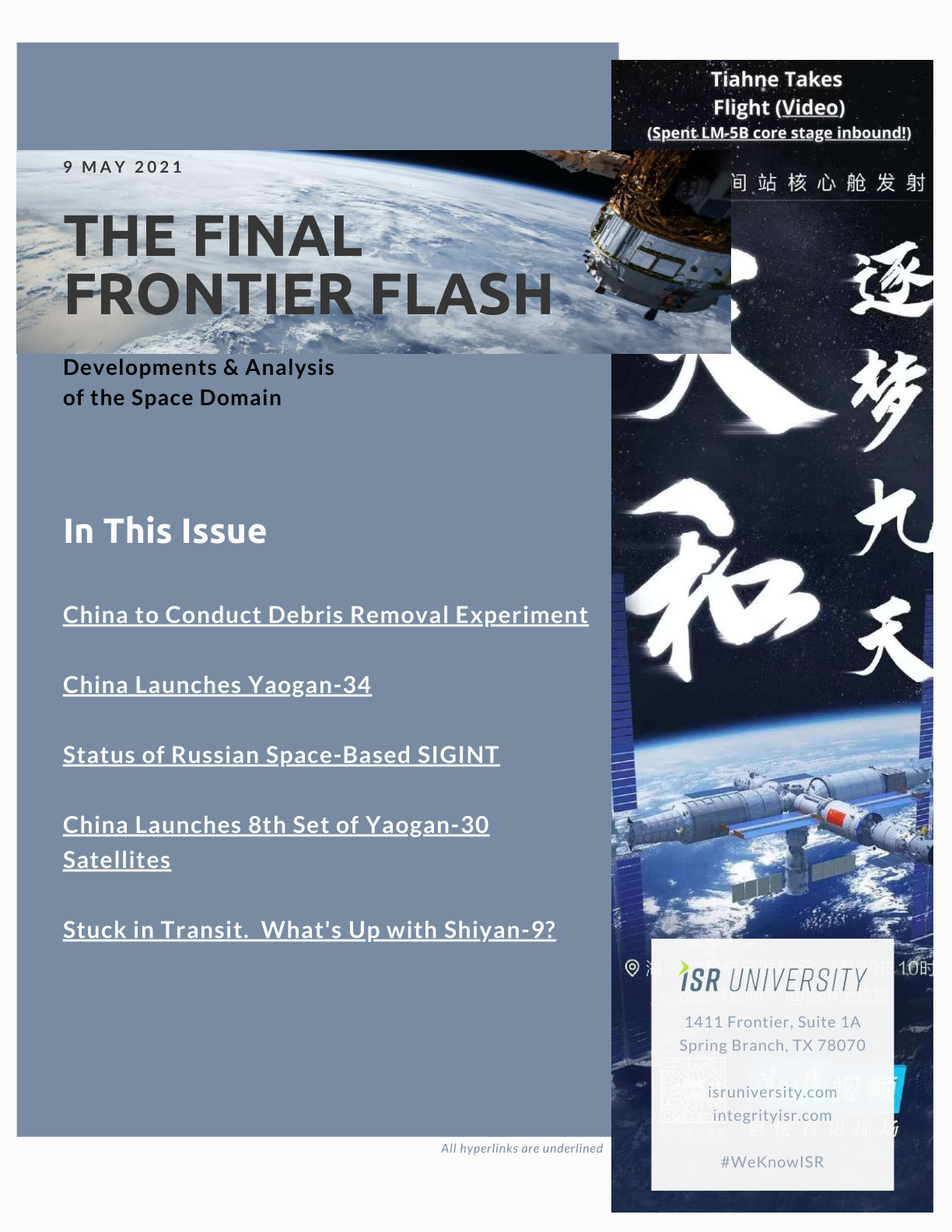
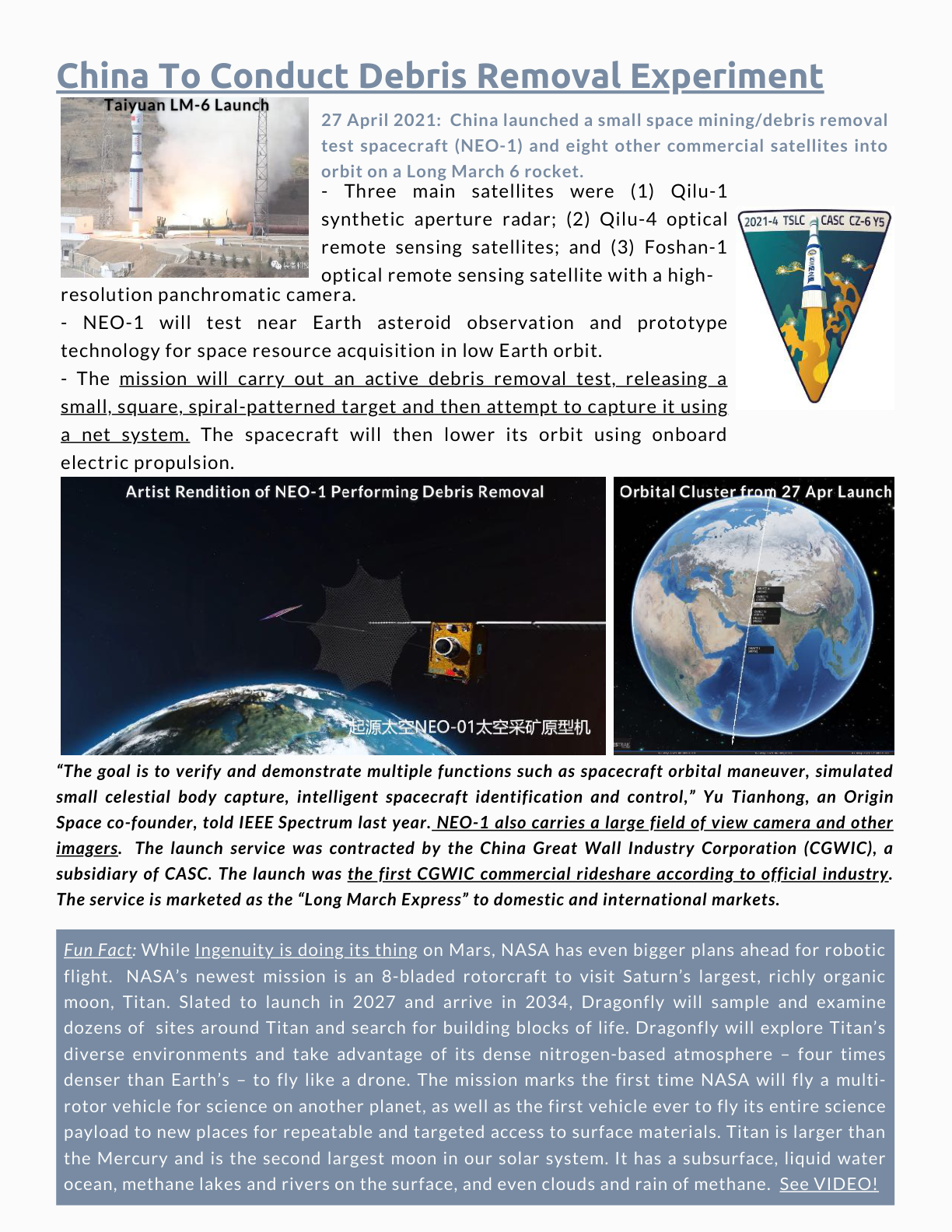
27 April 2021: China launched a small space mining/debris removal test spacecraft (NEO-1) and eight other commercial satellites into orbit on a Long March 6 rocket.
– Three main satellites were (1) Qilu-1 synthetic aperture radar; (2) Qilu-4 optical remote sensing satellites; and (3) Foshan-1 optical remote sensing satellite with a high-resolution panchromatic camera.
– NEO-1 will test near Earth asteroid observation and prototype technology for space resource acquisition in low Earth orbit.
– The mission will carry out an active debris removal test, releasing a small, square, spiral-patterned target and then attempt to capture it using a net system. The spacecraft will then lower its orbit using onboard electric propulsion.
“The goal is to verify and demonstrate multiple functions such as spacecraft orbital maneuver, simulated small celestial body capture, intelligent spacecraft identification and control,” Yu Tianhong, an Origin Space co-founder, told IEEE Spectrum last year. NEO-1 also carries a large field of view camera and other imagers. The launch service was contracted by the China Great Wall Industry Corporation (CGWIC), a subsidiary of CASC. The launch was the first CGWIC commercial rideshare according to official industry. The service is marketed as the “Long March Express” to domestic and international markets.
Fun Fact: While Ingenuity is doing its thing on Mars, NASA has even bigger plans ahead for robotic flight. NASA’s newest mission is an 8-bladed rotorcraft to visit Saturn’s largest, richly organic moon, Titan. Slated to launch in 2027 and arrive in 2034, Dragonfly will sample and examine dozens of sites around Titan and search for building blocks of life. Dragonfly will explore Titan’s diverse environments and take advantage of its dense nitrogen-based atmosphere — four times denser than Earth’s — to fly like a drone. The mission marks the first time NASA will fly a multi-rotor vehicle for science on another planet, as well as the first vehicle ever to fly its entire science payload to new places for repeatable and targeted access to surface materials. Titan is larger than Mercury and is the second largest moon in our solar system. It has a subsurface, liquid water ocean, methane lakes and rivers on the surface, and even clouds and rain of methane. See VIDEO!
Source links: SpaceNews · IEEE Spectrum