A mid-course ballistic missile intercept test conducted on 4 February 2021 may have been an Anti-Satellite (ASAT) test. China’s Ministry of Defense announced the test achieved all of its goals, but offered no additional details.
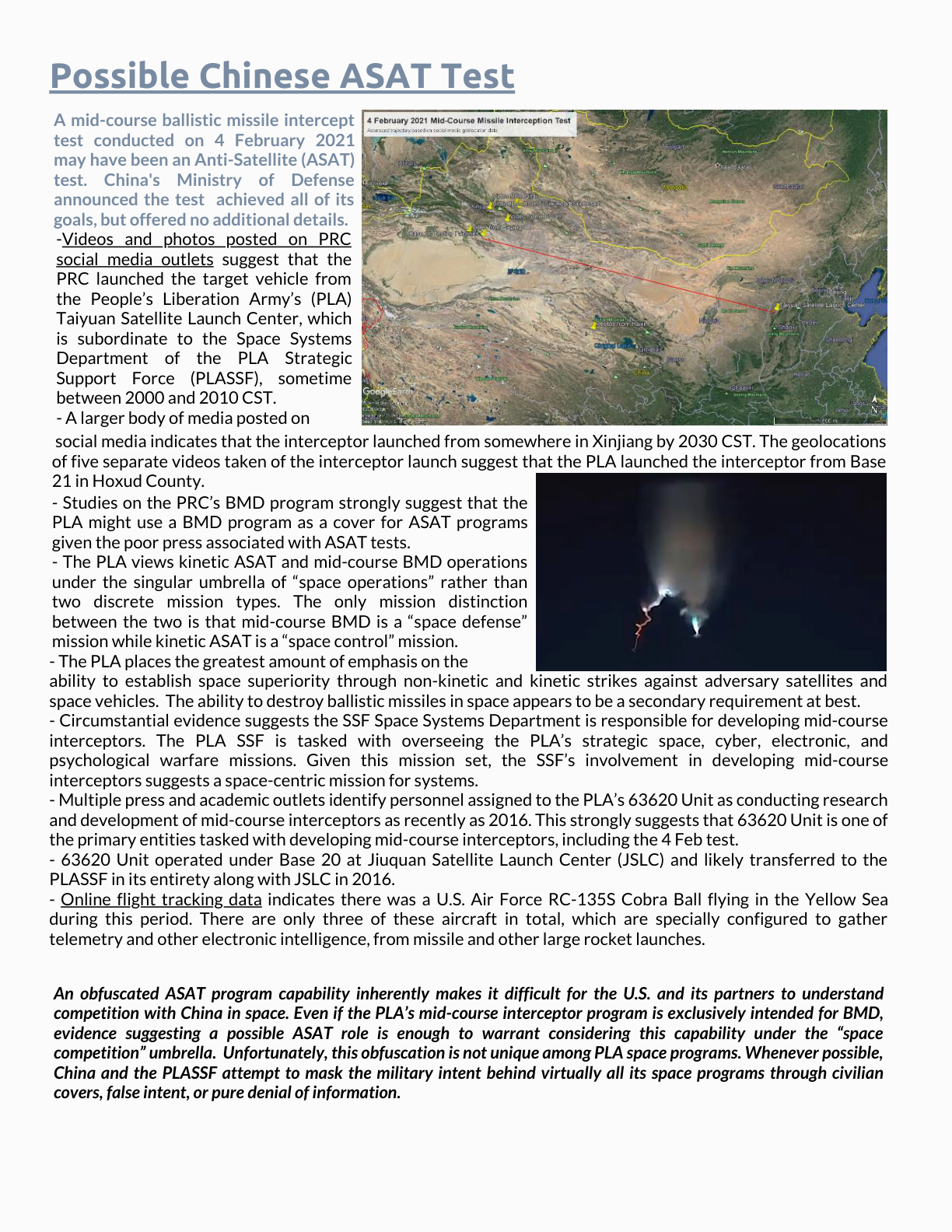
–Videos and photos posted on PRC social media outlets suggest that the PRC launched the target vehicle from the People’s Liberation Army’s (PLA) Taiyuan Satellite Launch Center, which is subordinate to the Space Systems Department of the PLA Strategic Support Force (PLASSF), sometime between 2000 and 2010 CST.
– A larger body of media posted on social media indicates that the interceptor launched from somewhere in Xinjiang by 2030 CST. The geolocations of five separate videos taken of the interceptor launch suggest that the PLA launched the interceptor from Base 21 in Hoxud County.
– Studies on the PRC’s BMD program strongly suggest that the PLA might use a BMD program as a cover for ASAT programs given the poor press associated with ASAT tests.
– The PLA views kinetic ASAT and mid-course BMD operations under the singular umbrella of “space operations” rather than two discrete mission types. The only mission distinction between the two is that mid-course BMD is a “space defense” mission while kinetic ASAT is a “space control” mission.
– The PLA places the greatest amount of emphasis on the
ability to establish space superiority through non-kinetic and kinetic strikes against adversary satellites and space vehicles. The ability to destroy ballistic missiles in space appears to be a secondary requirement at best.
– Circumstantial evidence suggests the SSF Space Systems Department is responsible for developing mid-course interceptors. The PLA SSF is tasked with overseeing the PLA’s strategic space, cyber, electronic, and psychological warfare missions. Given this mission set, the SSF’s involvement in developing mid-course interceptors suggests a space-centric mission for systems.
– Multiple press and academic outlets identify personnel assigned to the PLA’s 63620 Unit as conducting research and development of mid-course interceptors as recently as 2016. This strongly suggests that 63620 Unit is one of the primary entities tasked with developing mid-course interceptors, including the 4 Feb test.
– 63620 Unit operated under Base 20 at Jiuquan Satellite Launch Center (JSLC) and likely transferred to the PLASSF in its entirety along with JSLC in 2016.
– Online flight tracking data indicates there was a U.S. Air Force RC-135S Cobra Ball flying in the Yellow Sea during this period. There are only three of these aircraft in total, which are specially configured to gather telemetry and other electronic intelligence, from missile and other large rocket launches.
Source links: China Ministry of Defense · The Drive · CASI report