19 October 2021: Nearly three weeks after suffering an anomaly during launch that appeared to result in the loss of the spacecraft, Shiyan-10 now appears to be active and has increased its altitude at perigee from 177km to nearly 1100km.
– China launched the experimental Shiyan-10 satellite on a Long March 3B from Xichang Satellite Launch Center Sept. 27 but the usual declaration of success did not follow.
– New orbital elements published by 18 SPCS indicate that Shiyan-10 has performed small burns to raise the perigee of the orbit. Latest update has SY-10 in a 1100km x 40100km orbit inclined at 51 degrees.
– The incremental increases suggest smaller, backup engines are being used instead of a larger burn by a main engine to circularize the orbit.
– The health and operational status of the satellite-along with its intended purposes-remain unknown.
– Neither Chinese state media nor the country’s main space contractor, the China Aerospace Science and Technology Corp. (CASC) has commented on the development.
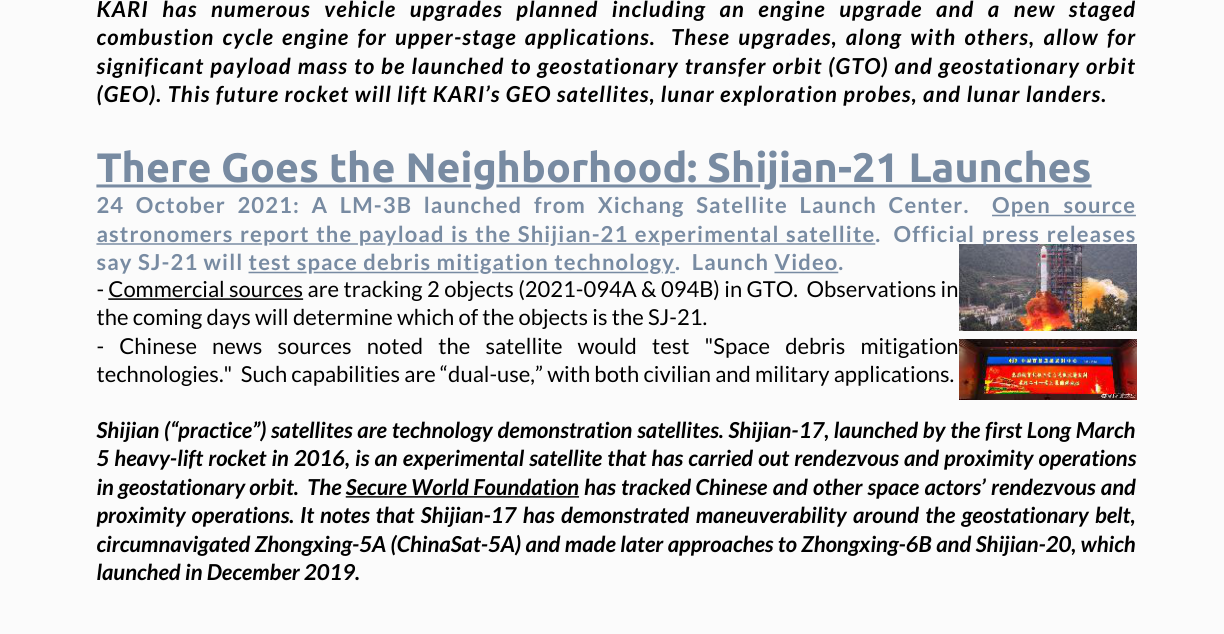
– A social media post of an apparent Shiyan-10 ‘big red screen’
-which are displayed at Chinese mission control centers
following launch success-appeared briefly on social media before being swiftly deleted.
Shiyan spacecraft are technology test satellites that are built by different providers as a pathfinder for new satellite technologies. The last orbital adjustment for SY-10 occurred on 21 October 2021. An announcement of launch success may be made if and when the satellite reaches its intended orbit.

Original PDF links: Source 1 · Source 2 · Source 3 · Source 4 · Source 5