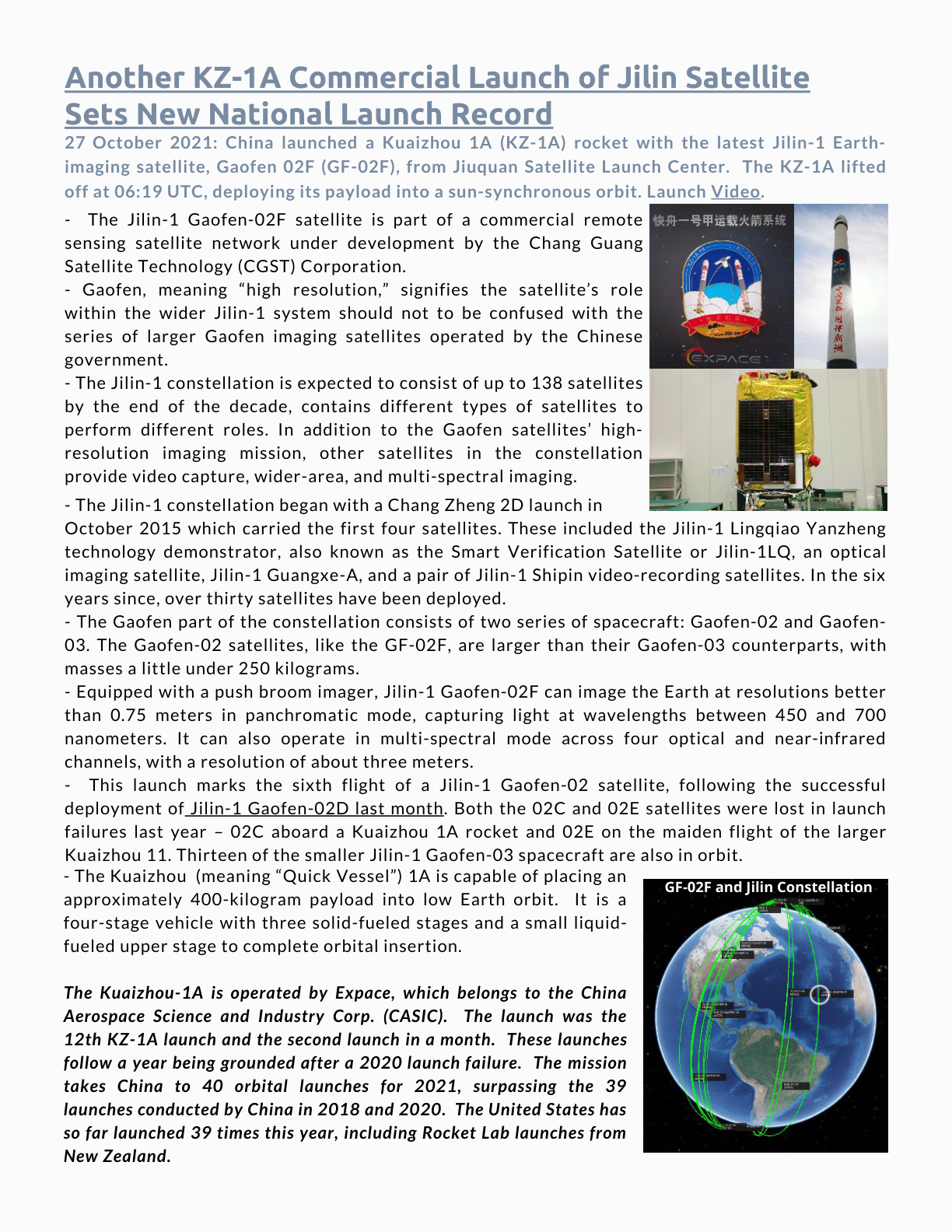
27 October 2021: China launched a Kuaizhou 1A (KZ-1A) rocket with the latest Jilin-1 Earth-imaging satellite, Gaofen 02F (GF-02F), from Jiuquan Satellite Launch Center. The KZ-1A lifted off at 06:19 UTC, deploying its payload into a sun-synchronous orbit. Launch Video.
– The Jilin-1 Gaofen-02F satellite is part of a commercial remote sensing satellite network under development by the Chang Guang Satellite Technology (CGST) Corporation.
– Gaofen, meaning “high resolution,” signifies the satellite’s role within the wider Jilin-1 system should not to be confused with the series of larger Gaofen imaging satellites operated by the Chinese government.
– The Jilin-1 constellation is expected to consist of up to 138 satellites by the end of the decade, contains different types of satellites to perform different roles. In addition to the Gaofen satellites’ high-resolution imaging mission, other satellites in the constellation provide video capture, wider-area, and multi-spectral imaging.
– The Jilin-1 constellation began with a Chang Zheng 2D launch in
October 2015 which carried the first four satellites. These included the Jilin-1 Lingqiao Yanzheng technology demonstrator, also known as the Smart Verification Satellite or Jilin-1LQ, an optical imaging satellite, Jilin-1 Guangxe-A, and a pair of Jilin-1 Shipin video-recording satellites. In the six years since, over thirty satellites have been deployed.
– The Gaofen part of the constellation consists of two series of spacecraft: Gaofen-02 and Gaofen-03. The Gaofen-02 satellites, like the GF-02F, are larger than their Gaofen-03 counterparts, with masses a little under 250 kilograms.
– Equipped with a push broom imager, Jilin-1 Gaofen-02F can image the Earth at resolutions better than 0.75 meters in panchromatic mode, capturing light at wavelengths between 450 and 700 nanometers. It can also operate in multi-spectral mode across four optical and near-infrared channels, with a resolution of about three meters.
– This launch marks the sixth flight of a Jilin-1 Gaofen-02 satellite, following the successful deployment of Jilin-1 Gaofen-02D last month. Both the 02C and 02E satellites were lost in launch failures last year — 02C aboard a Kuaizhou 1A rocket and 02E on the maiden flight of the larger Kuaizhou 11. Thirteen of the smaller Jilin-1 Gaofen-03 spacecraft are also in orbit.
– The Kuaizhou (meaning “Quick Vessel”) 1A is capable of placing an approximately 400-kilogram payload into low Earth orbit. It is a four-stage vehicle with three solid-fueled stages and a small liquid-fueled upper stage to complete orbital insertion.
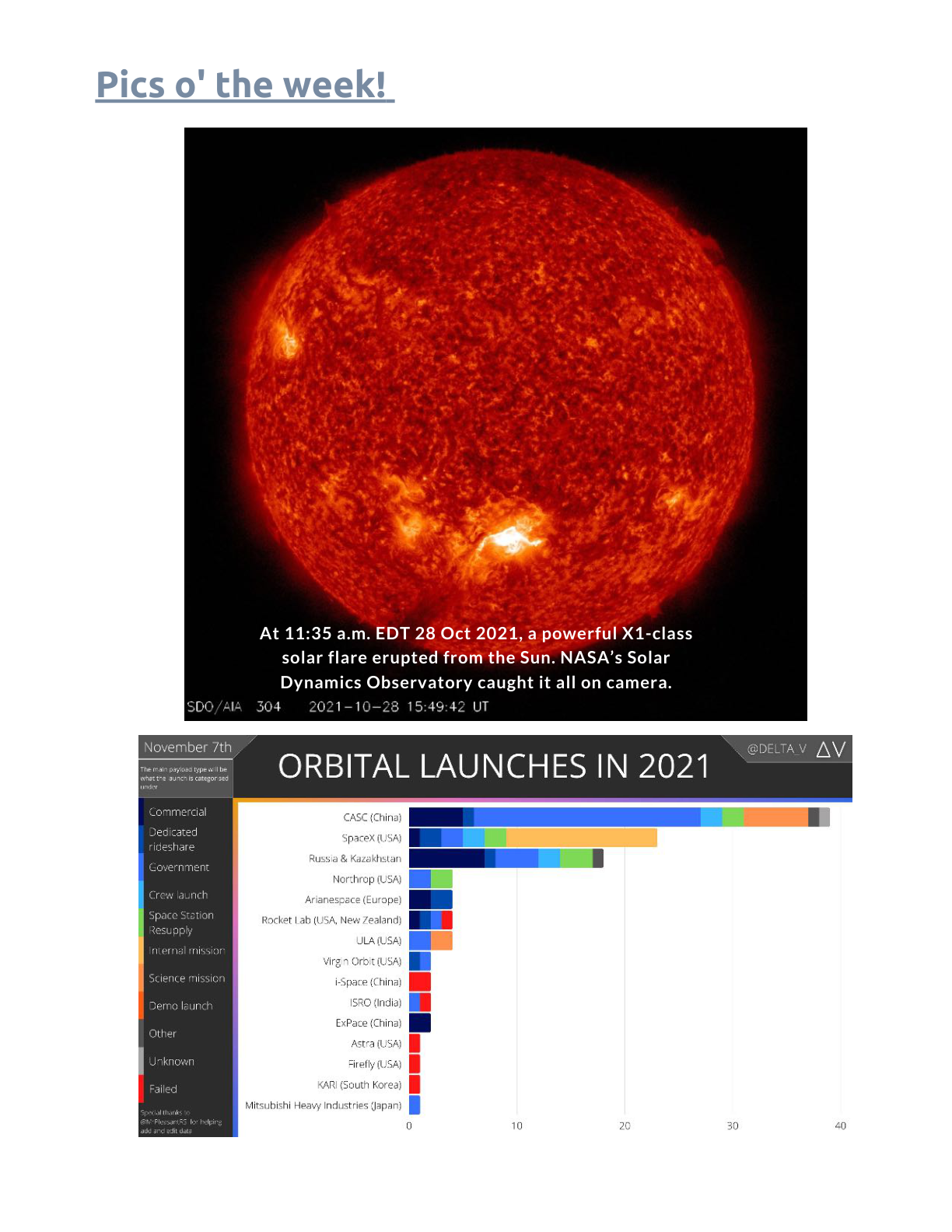
The Kuaizhou-1A is operated by Expace, which belongs to the China Aerospace Science and Industry Corp. (CASIC). The launch was the 12th KZ-1A launch and the second launch in a month. These launches follow a year being grounded after a 2020 launch failure. The mission takes China to 40 orbital launches for 2021, surpassing the 39 launches conducted by China in 2018 and 2020. The United States has so far launched 39 times this year, including Rocket Lab launches from New Zealand.
Original PDF links: Source 1 · Source 2 · Source 3 · Source 4 · Source 5 · Source 6 · Source 7 · Source 8 · Source 9 · Source 10