

23 Feb 2023: China sent the Zhongxing-26 (ChinaSat-26) communications satellite into orbit on
a Long March 3B rocket from Xichang. It was China's first launch after a 39-day pause for the
Chinese New Year. ChinaSat-26 is in geosynchronous transfer orbit (GTO). Launch Video.
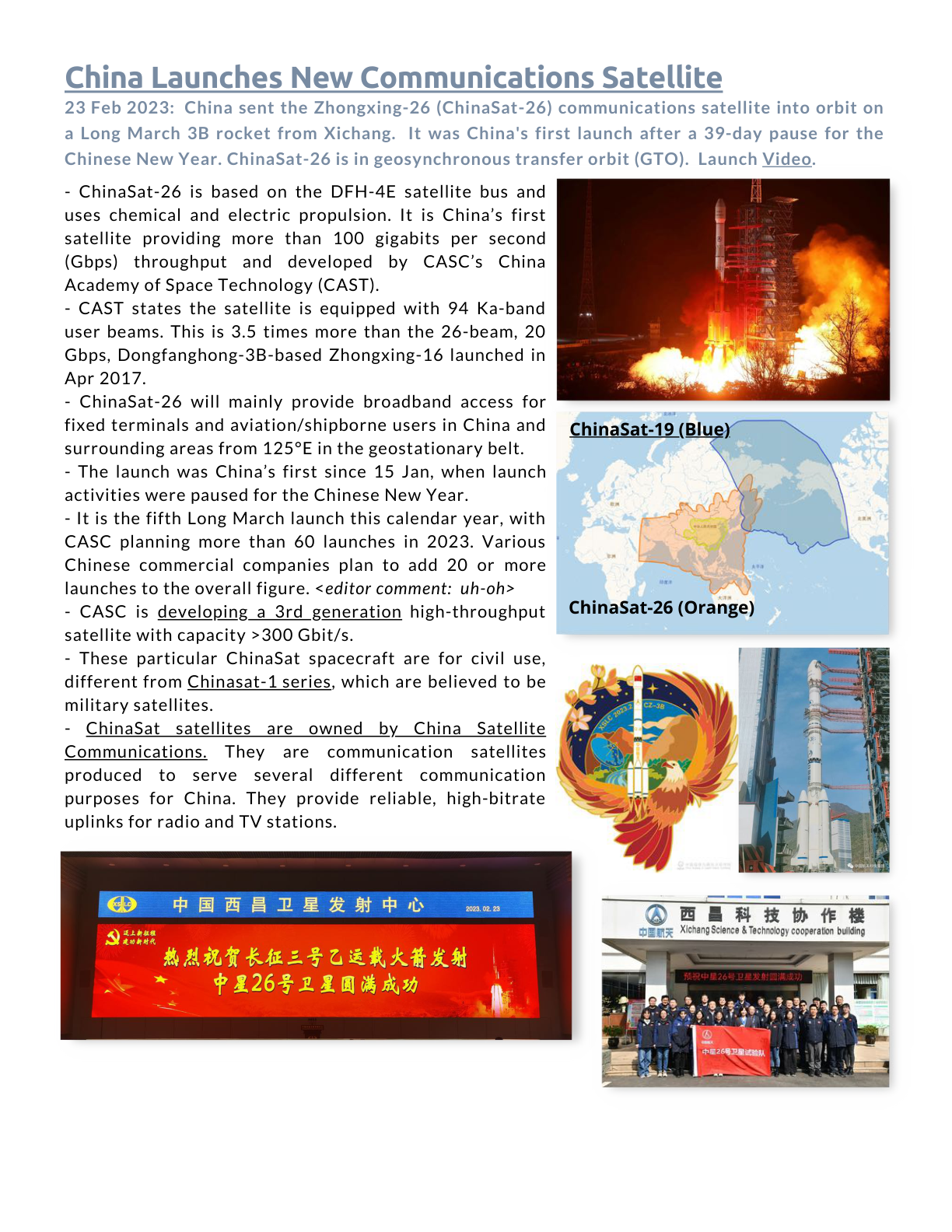
– ChinaSat-26 is based on the DFH-4E satellite bus and uses chemical and electric propulsion. It is China’s first satellite providing more than 100 gigabits per second (Gbps) throughput and developed by CASC’s China Academy of Space Technology (CAST). – CAST states the satellite is equipped with 94 Ka-band user beams. This is 3.5 times more than the 26-beam, 20 Gbps, Dongfanghong-3B-based Zhongxing-16 launched in Apr 2017. – ChinaSat-26 will mainly provide broadband access for fixed terminals and aviation/shipborne users in China and surrounding areas from 125°E in the geostationary belt. – The launch was China’s first since 15 Jan, when launch activities were paused for the Chinese New Year. – It is the fifth Long March launch this calendar year, with CASC planning more than 60 launches in 2023. Various Chinese commercial companies plan to add 20 or more launches to the overall figure. <editor comment: uh-oh> – CASC is developing a 3rd generation high-throughput satellite with capacity >300 Gbit/s. – These particular ChinaSat spacecraft are for civil use, different from Chinasat-1 series, which are believed to be military satellites. – ChinaSat satellites are owned by China Satellite Communications. They are communication satellites produced to serve several different communication purposes for China. They provide reliable, high-bitrate uplinks for radio and TV stations.
ChinaSat-19 (Blue)
ChinaSat-26 (Orange)
Original PDF links: Source 1 · Source 2 · Source 3 · Source 4 · Source 5 · Source 6 · Source 7 · Source 8 · Source 9 · Source 10 · Source 11 · Source 12 · Source 13


