12 May 2024: China launched a Long March-4C from Jiuquan with the Shiyan-23 (SY-23) experimentation satellite. China released very little mission information, saying only that the satellite successfully entered the planned orbit and “will mainly be used for space environment monitoring.” The wording could indicate a space-centric mission rather than Earth remote sensing. SY-23 is in a sun-synchronous orbit and appears to be co-planar with four Chinese SAR satellites launched between 2022 and 2024. Being co-planar with other SAR imagery satellites may allow China to conduct SAR or counter-SAR related tests while removing orbital variables. Launch Video.
– The LM-4C is a three-stage space launch vehicle capable of delivering 2,800kg objects to sun-synchronous orbit. China used the LM-4C to launch Shiyan-20A/B satellites into an 800km / 60° orbit on 19 Dec 2022. See previous FFF coverage.
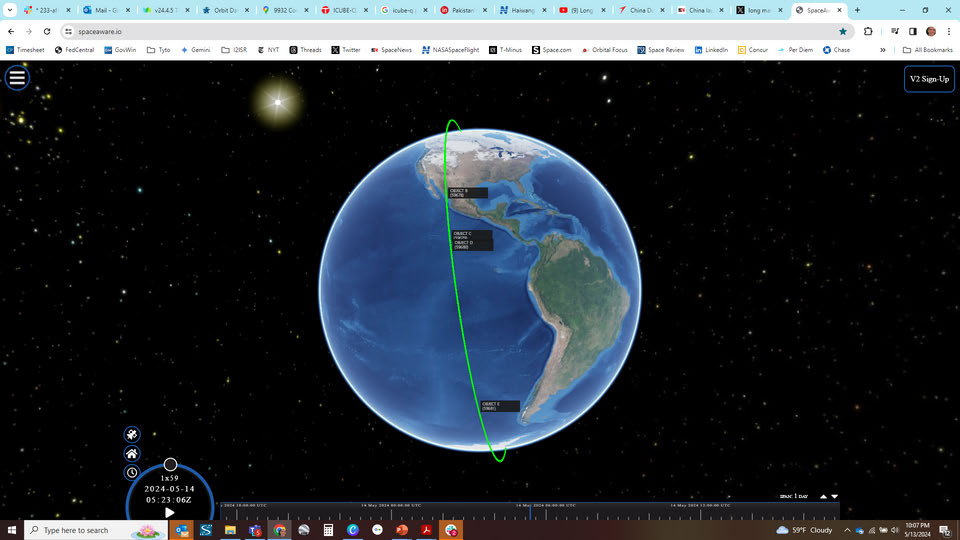
– SY-23 is currently in a 598.6 x 589.8km orbit with 97.8° inclination. This orbit is nearly co-planar with four recently launched Chinese SAR satellites.
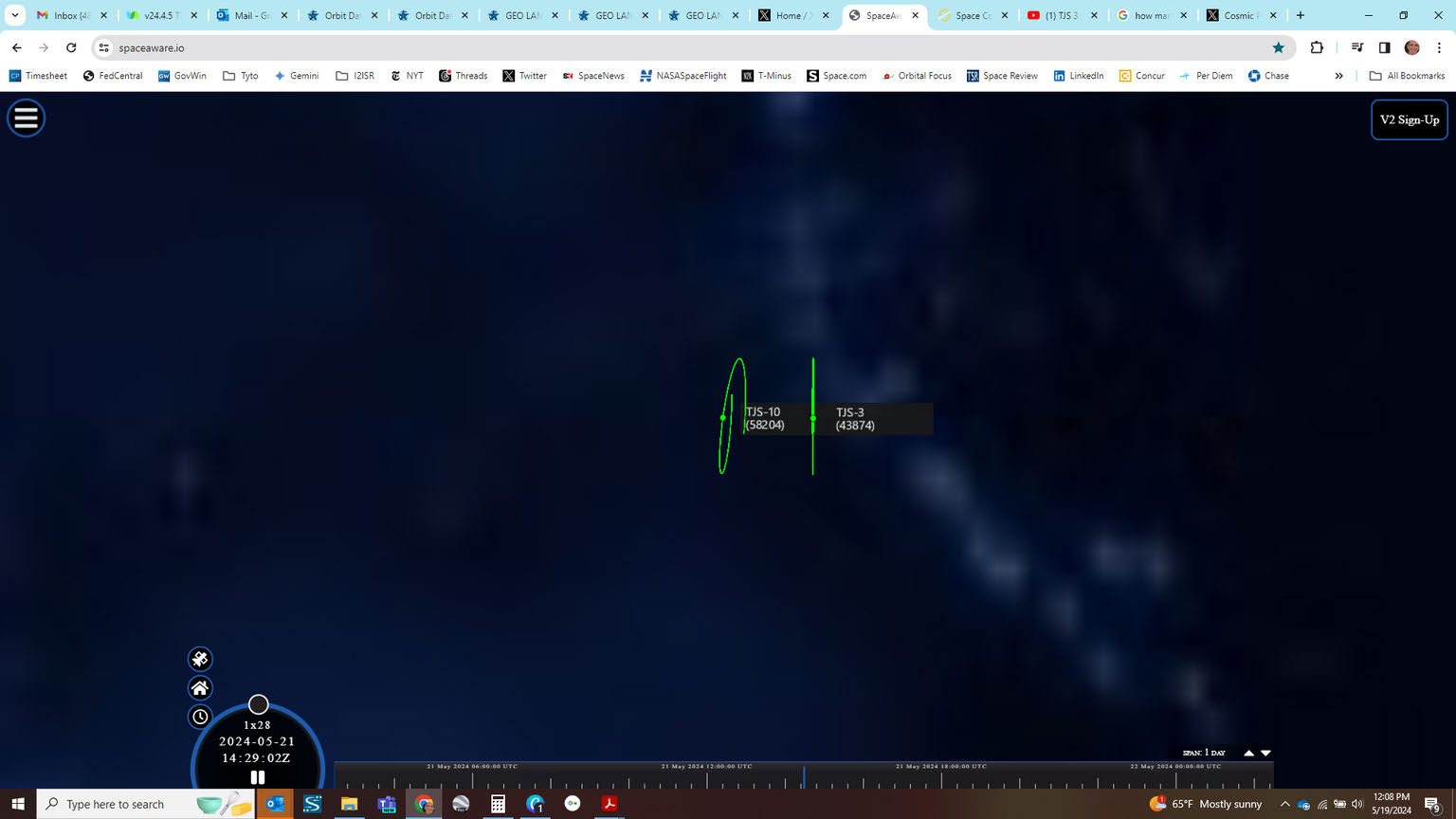
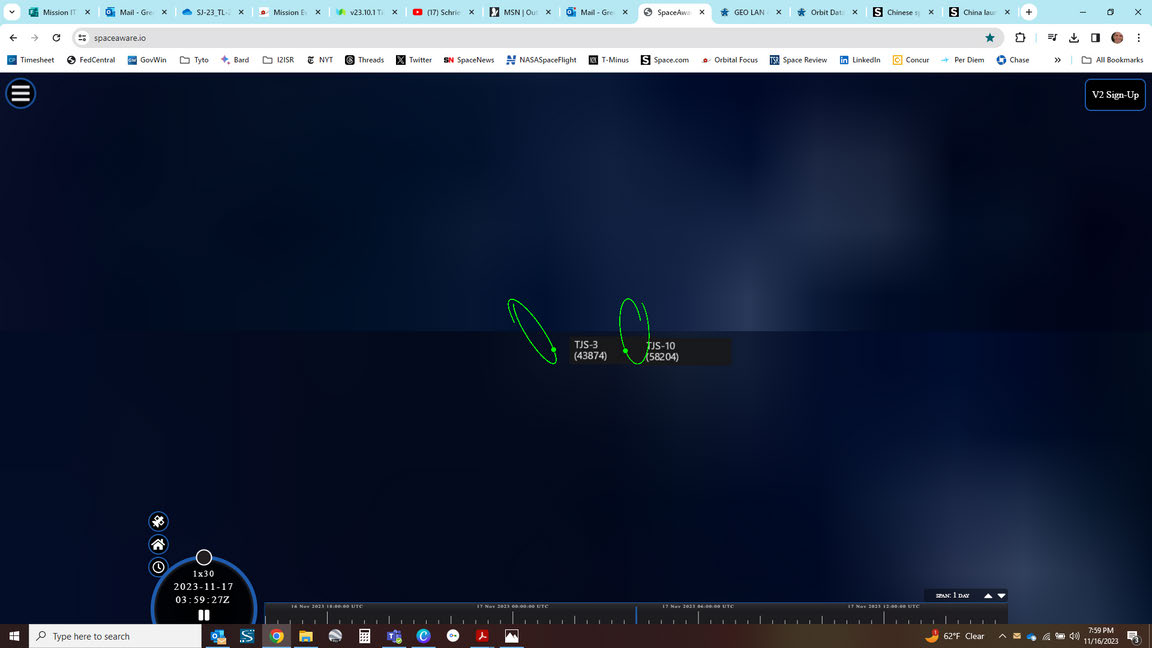
– Specifically, SY-23 is co-planar with L-SAR 01A (51284), L-SAR 01B (51822), and Tianhui-5A/B (58199, 58201).
– China launched SY-23 to a slightly lower semi-major axis than L-SAR 01B. Over its first few days on orbit, SY-23 slowly passed L-SAR 01B, resulting in a point of closest approach of about 7.8km.
– SY-23 is also lower than L-SAR 01A and Tianhui-5A/B and, based on the issue’s analysis, would pass these satellites over the following weeks.
– L-SAR 01A/B is a distributed SAR satellite system composed of two L-band SAR satellites with the same design parameters. In orbit, the pair has two formation-flight modes described as “follow-up flight” and “around flight.” See earlier FFF coverage.
– The Tianhui constellation includes optical and SAR imaging satellites and supports cartography. Tianhui-4A/B, 5A/B and 6A/B operate in formations of two and are also likely SAR capable.
– SY-23 is also in a similar orbit, but not co-planar, with the mysterious Shiyan-24 A/B/C triplets. The issue notes that SY-24 exhibited suspicious behavior earlier in 2024. See previous Flash coverage.
– SY-23 has a semi-major axis 13km greater than the SY-24A/B/C triplets; its inclination and RAAN are also about 0.5° and 6° greater, respectively. The issue cautions that the orbital similarities may be coincidental.
– With the orbital parameters described in the issue, the SY-24 triplets would pass SY-23 about every 22 days; the first pass occurred on 17 May 2024.
– The official SY-23 statement, “will mainly be used for space environment monitoring,” differs from wording used for other classified Chinese missions. The issue compares this with statements for YG-40, SY-24 and Yaogan-35 missions.
The issue assesses that China’s SY-23 statement hints at a space-centric mission rather than an Earth-observation mission. Operating in a sun-synchronous/polar orbit will also provide frequent conjunction opportunities.

SY-23 and L-SAR 01B orbital-proximity visualization.

SY-23 co-planar with L-SAR 01A/B and Tianhui-5A/B.

SY-23 corkscrew orbit around L-SAR 01B, 14 May 2024.

SY-23 launched in close proximity with L-SAR 01B.

SY-23 orbit compared with the SY-24C 01/02/03 triplets.

SY-23 / L-SAR 01B close-approach analysis, less than two days after launch.