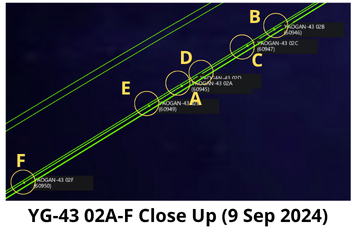
3 Sep: China launched a Long March-4B with 6 Yaogan-43 Group 2 (YG-43 02) remote sensing satellites from the Xichang. According to official sources, the satellites entered the preset orbit and will be “mainly used for carrying out tests on new technologies of low-orbit constellations”. This was the second YG-43 launch in less than 3 weeks as China launched 9 YG-43 01 satellites on 16 Aug 2024 (more on them later). The YG-43 02 satellites (60945-60950) are orbiting at 500km altitude with 35° inclination. YG-43 02 is also nearly co-planar with the three sets of YG-35 03, YG-36 04 and YG-39 02 triplets. Launch Video.
– As of 9 Sep 2024 none of the satellites has maneuvered. This is similar to the initial batch of YG-43 01 satellites which began to maneuver 1-2 weeks after launch.
– As with the YG-43 01 launch, the LM-4B carrying YG-43 02 used a 4.2m fairing (typical is 3.7m.)
– Per Andrew Jones: “The Yaogan-43 (02) satellites were developed by CASC’s Shanghai Academy of Spaceflight Technology (SAST). Official social media posts suggest that GalaxySpace, a commercial satellite manufacturer and operator, and HITSAT, under the Harbin Institute of Technology, may have been involved in the mission. IAMCAS under the Chinese Academy of Sciences, and MinoSpace, a commercial spacecraft maker, were believed to be involved in the prior mission (YG-43 01).”
– China launched the 6 YG-43 02 satellites into a nearly co-planar orbit with 8 other Yaogan satellites with very similar altitude, inclination and RAAN (orbit twist).
- YG-35 03 consists of only 2 satellites (B & C) as it’s original Trail2 satellite (A) last maneuvered in January 2024 and is no longer part of the trio.
- YG-36 04 consists of all three satellites. Its Trail2 satellite (B) will likely rejoin the Lead and Trail1 satellites (C & A) in formation later this month.
- YG-39 02 consists of all three satellites and appears to have been operating in nominal condition maintaining its formation since its launch on 17 Sep 2023.
– China launched the 9 YG-43 01 satellites into a unique plane. More details to follow in the coming weeks.