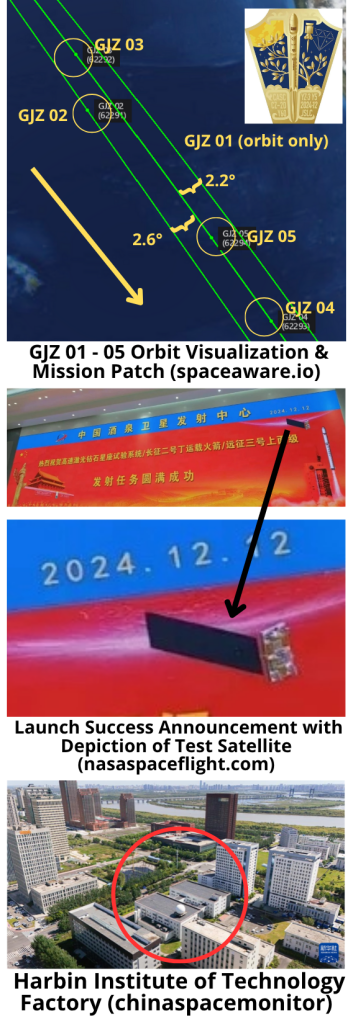
12 Dec: China launched a Long March-2D with 5 satellites for the High-speed Laser Diamond Constellation Test System (62290-62294) from Jiuquan. According to official sources, the five satellites entered the planned orbits. The launch included the Yuanzheng-3 restartable upper stage which China used to deploy the satellites into 3 orbital planes. Launch Video.
– The YZ-3 upper stage fired multiple times to put these 5 satellites into 3 different orbital planes. All are inclined 59.9° but have different RAAN (orbit twist) values.
- GJZ 01 (62290) deployed to an ~1,160.6 x 1,142.5km altitude with 59.9° inclination. RAAN is 114.5°.
- GJZ 02 (62291) is deployed to an ~ 812 x 799km altitude with 59.9° inclination. RAAN is 109.7°.
- GJZ 03, 04 & 05 (62292-94) are co-planar. Altitudes vary slightly and relative positions are evolving. Altitudes are ~988 x 973km with a 59.9° inclination. These satellites are higher than GJZ 02 and lower than GJZ 01. RAAN is 112.3°, which places the satellites 2.2° west of GJZ 01 and 2.6° to the east of GJZ 02.
– Chinese media announced that the satellites were of flat-panel design: “The…high-speed laser Diamond Constellation Test System is another…application of the Gongda satellite flat-panel satellite platform.” The rendering on the Mission Success board seemed to confirm this assessment.
– Blaine Curcio’s China Space Monitor:
- The 5 “High Speed Laser Diamond Constellation” satellites (were) built by Harbin Institute of Technology (HIT) commercial spinoff HITSat.
- HITSat (was) founded in December 2020, and has now built ~15 satellites at an industrial base in Harbin, in China’s Northeast.
- As a manufacturer HITSat is emerging as a highly competent and relevant player, having built and launched 12 satellites this year for multiple customers including the AirSat constellation (based in Shandong) and the Xi’an Aerospace
Per Andrew Jones: Inter-satellite laser link capabilities would be highly applicable to China’s megaconstellation projects, the national Guowang constellation, and the Shanghai-backed Qianfan/Thousand sails constellation. Inter-satellite laser links could mitigate China’s limited global ground station coverage – an issue that is apparent in its reliance on onboard space situational awareness capabilities.