5-20 July: SJ-21 (49330) and SJ-25 (62485) likely docked with one another on 2 July. As noted previously the two satellites entered into merge conditions on 2 July and remain in that condition through the time of this report (20 July). The Joint Commercial Operations Cell (JCO) has noted the two docked satellites have made slight maneuvers over the past 2 weeks. The timeline for China’s refueling experiment is unknown. In the near future I’ll be looking for separation of the two satellites and subsequent maneuvers. To conduct future operations with either satellite will likely require China to make fuel-intensive plane change maneuvers to service/observe other satellites in the GEO belt. Conversely, if China has no future plans for either satellite they would be able to increase the average altitude of both to place them into a “graveyard” orbit.
Issue 125
Cosmos 2589 & Obj D Conduct Rendezvous & Prox Ops
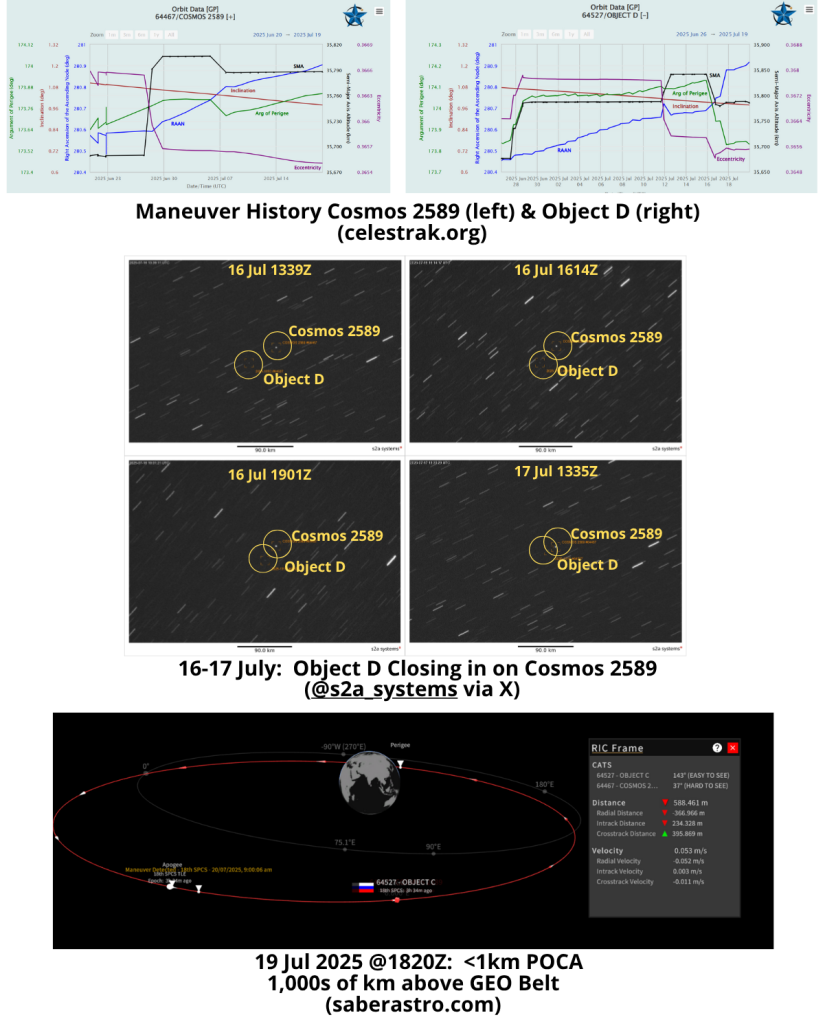
5-20 Jul: Russia has conducted Rendezvous & Proximity Operations (RPO) between Cosmos 2589 (64467) and its Object D (64527) sub-satellite. It appears Object D conducted the majority of the maneuvers which resulted in a point of closes approach of <5km (may have been <1km) on 18-19 July. The two objects were close…
5-20 Jul: Russia has conducted Rendezvous & Proximity Operations (RPO) between Cosmos 2589 (64467) and its Object D (64527) sub-satellite. It appears Object D conducted the majority of the maneuvers which resulted in a point of closes approach of <5km (may have been <1km) on 18-19 July. The two objects were close enough that ground based observers were no longer able to discriminate between them. Watch Video from s2a systems.
– Background:
- As noted in the 23 June Flash, Russia launched an Cosmos 2589 from Plesetsk on an Angara-5 rocket equipped with a Briz-M upper-stage on 19 June. The launch placed Cosmos 2589 into a highly eccentric orbit with an apogee of 51,200km and a perigee of 20,374km. The orbit is oriented to ensure that the spacecraft remains over Russian territory. (see graphic)
- On 26 June Cosmos 2589 released a sub-satellite, Object D. As noted in the 8 July Flash, Russia has maneuvered both Cosmos 2589 and Object D. Cosmos 2589 is suspected to be an inspector satellite with links to the same Russian companies responsible for the Nivelir inspection satellites (see previous Cosmos 2558 article).
– Recent Maneuvers
- 5-7 July: Cosmos 2589 last observed maneuver. Decreased its average altitude ~19km.
- 11-12 July: Object D increases average altitude 53.6km. Maneuvers also affect RAAN and Argument of Perigee.
- 15-16 July: Object D decreases average altitude 59.5km. Maneuvers also affect RAAN and Argument of Perigee.
- 16-20 July: Object D conducts several minor maneuvers to close distance with Cosmos 2589. Observations note Point of Closest Approach of <1km on 19 July.
Editor’s Note: There is some confusion over the naming convention of 64527. I’m calling it “Object D” as this is the name listed in Celestrak.org and in spaceaware.io. However, other sources refer to 64527 as “Object C.”
– More Notes:
- There was some excellent analysis of the advantages of what some are calling “super Geosynchronous Transfer Orbit” (super-GTO). Cosmos 2589 and Object D are currently in super-GTO. Here are some excerpts from Meidad Pariente. Read his full explanation here.
- Regular GTO (Geostationary Transfer Orbit) has an apogee around 35,786 km, which is the altitude of geostationary orbit (GEO).
- Super-GTO pushes the apogee higher, often above 60,000 km. (Cosmos 2589/Obj D are at 51,200km)
- Why is Super-GTO more efficient?
- Inclination changes are cheaper at higher altitudes!
- Inclination changes are made at the orbit nodes (Ascending – crossing the equator from south to north, or Descending – crossing the equator from north to south). At higher altitudes, satellites move more slowly. This slower speed means changing their direction (inclination) requires less energy. So, by placing a satellite into a Super-GTO, we can perform inclination changes more efficiently, saving fuel.
- Lower Delta-V for Final Orbit Insertion
- When a satellite is in a Super-GTO, its velocity at apogee is lower (~800 m/sec slower). This slower speed means that when the satellite performs its final burn to reach GEO, it requires less energy (delta-V), which translates to reduced fuel consumption.
- Reduced Radiation Exposure & Extended Satellite Lifespan
- All-electric satellites take months to reach GEO. By starting from a higher orbit, they spend less time passing through the Earth’s radiation belts, reducing exposure and potential damage.
- The reduced radiation exposure protects the satellite and extends its operational life. For instance, SES-8 saved about 6 years’ worth of station-keeping fuel by using a Super-GTO.
- In Summary: Launching a satellite into a Super-GTO allows for more efficient orbital maneuvers, reduces fuel consumption, and protects the satellite from harmful radiation, leading to a longer operational lifespan. It’s a smart strategy, especially for missions where fuel efficiency and satellite longevity are priorities.
Â
Editor’s Comment: Privacy might be another advantage for Russia to operate Cosmos 2589 and Object D in “Super-GTO”. Performing RPO outside of the GEO belt also means being thousands of kilometers away from Chinese and American GEO inspector satellites the vast majority of the time. Cosmos 2589/Obj D do cross the GEO belt twice a day but the imagery collection opportunities will be short-lived and potentially more challenging to obtain favorable lighting conditions.
Â
Final Thoughts: This story continues to evolve. We can safely say that Cosmos 2589 is, in-fact, some sort of satellite inspector (at the very least). It remains to be seen if Cosmos 2589 will eventually maneuver to join the GEO belt or remain in super-GTO indefinitely (my guess is the former). Russia may intend to conduct its RPO experiments with Object D for the first few months and then transition to a new phase of operations targeting other satellites for inspection. We do not know if Object D is the only sub-satellite on-board Cosmos 2589. We live in interesting times.