Issue 137

Russia: Orbit Decay of Missile Warning Satellites?

5 Jan 2026: Russia appears to be struggling to maintain its 4-satellite missile warning constellation. The Tundra/Kupol constellation was meant to consist of 8-10 satellites (as it had in the 1980s under the Soviet Union) however only 6 have launched: 1) Cosmos 2510 (2015/41032); 2) Cosmos 2518 (2017/42719); 3) Cosmos…

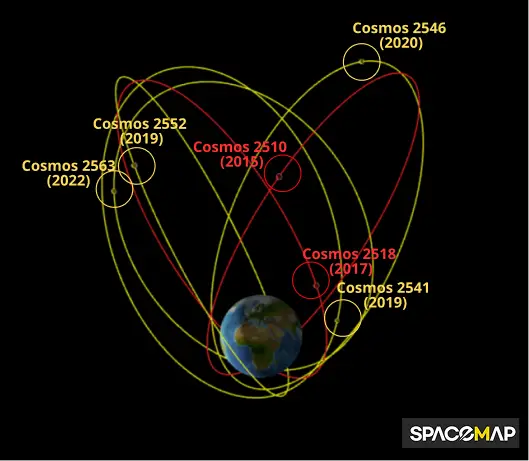
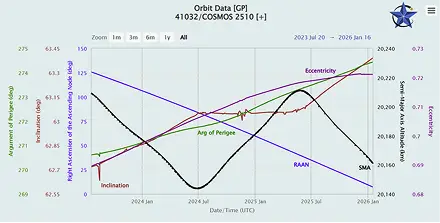
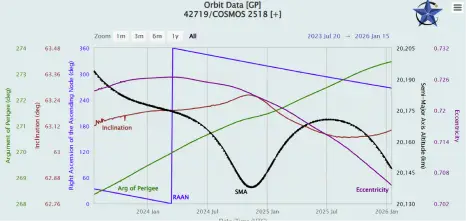
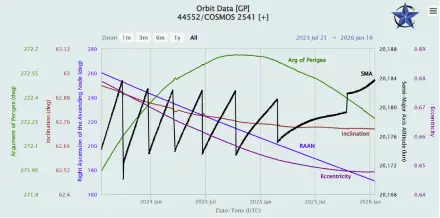
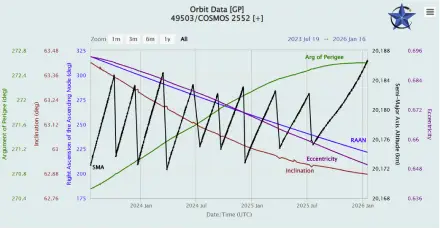
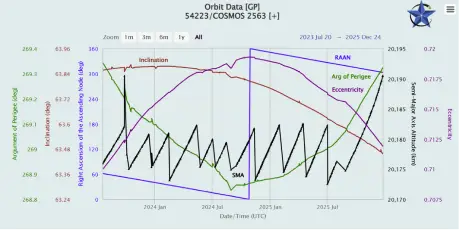
5 Jan 2026: Russia appears to be struggling to maintain its 4-satellite missile warning constellation. The Tundra/Kupol constellation was meant to consist of 8-10 satellites (as it had in the 1980s under the Soviet Union) however only 6 have launched: 1) Cosmos 2510 (2015/41032); 2) Cosmos 2518 (2017/42719); 3) Cosmos 2541 (2019/44552); 4) Cosmos 2546 (2020/45608); 5) Cosmos 2552 (2021/49503); and 6) Cosmos 2563 (2022/54223). Cosmos 2510/2518 have not maneuvered in the past 30 months. Cosmos 2541/2546 both last maneuvered in mid-October 2025 (slight deviation from norm). Cosmos 2552 has also deviated from its pattern of life having last maneuvered in July 2025. The newest satellite, Cosmos 2563, last maneuvered in Aug 2025, another pattern of life deviation. There have been suggestions that all 6 satellites have become non-operational, however Cosmos 2541/2546/2552/2563 continue to emit radio signals and appear in stable condition (Cosmos 2510/2518 are most likely non-operational). Thankfully (for me) there has been some excellent analysis from Pavel Podvig, Anatoly Zak, Scott Tilley and Jonathan McDowell to explain what might be happening.

– From Anatoly Zak:

  • “Russia’s full-scale invasion of Ukraine in February 2022, seemingly coincided with the quick decay of the space assets complementing Russia’s early warning system about missile launches, which the Kremlin spent decades trying to rebuilt after the fall of the USSR.”
  • “After the launch of the 6th Tundra satellite in 2022, the Russian military seemingly gave up on the effort to deploy the EKS early warning constellation or, possibly, the industry was simply unable to build new satellites due to technical problems associated with Western sanctions and/or financial problems.”
  • Zak Quoting Scott Tilley: “Given the fact that the entire quartet of still-surviving satellites, including Kosmos-2541, -2546, -2552 and -2563, started its westward shift around September 2025, it could be a coordinated constellation-wide move, while the overall system could still perform its duties.”


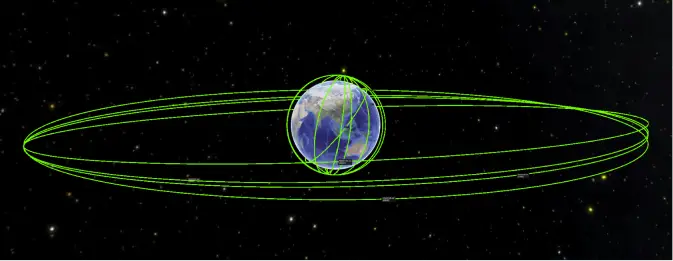
Russian Missile Warning Constellation 3D (top) and 2D (below) Overview (
(spacemap42.com)
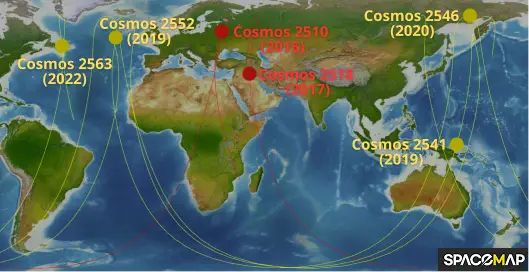
  • “That hypothesis was supported by the fact that the four satellites continued transmitting the usual radio signals in X-band, associated with active satellites, while the optical observations detected no flares often associated with tumbling objects having lost their attitude control, thus indicating that all the satellites remained in stable position.”
  • “One possible explanation for this odd behavior might be orbit-maintenance operations switching from traditional hypergolic thrusters to the more fuel-efficient but lower-thrust SPD-100 electric engines in an effort to conserve propulsion capabilities and thus extend the life-span of the satellites. It should be noted that such an approach would be particularly logical if no replenishments were expected to be launched into the system in the immediate future. As a result, the flight controllers might have decided to tolerate considerably wider East-West deviations of the satellites from their operational positions, while still maintaining the general arrangement of the constellation in orbit.”

Editor’s Comment: Russia likely maintains 4 operational missile warning satellites. For the missile warning mission it is desirable to have “dual ball” coverage, that is having two satellites near apogee at around the same time in order to improve detection confidence and missile trajectory prediction (we saw this recently with China’s recent missile warning launches). Cosmos 2546 and 2552 appear to be paired up as do Cosmos 2541 and 2563. Due the orbital stability resulting from the 63.5° inclined Molniya orbit (slow RAAN and Argument of Perigee changes) Russia will likely be able to maintain functionality (at least from being in a useful orbit) for the near-medium term.
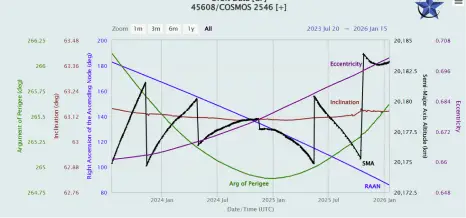

Cosmos 2510: No Maneuvers 2.5yrs
(celestrak.org)


Cosmos 2518: No Maneuvers 2.5yrs (celestrak.org)


Cosmos 2541 Orbital History
Maneuver Pattern Change
(celestrak.org)


Cosmos 2546 Orbital History
Maneuver Pattern Change
(celestrak.org)


Cosmos 2552 Orbital History
Maneuver Pattern Change
(celestrak.org)


Cosmos 2563 Orbital History
Maneuver Pattern Change
(celestrak.org)