Issue 49

Hypervelocity Collisions in Space – Let me explain the “what happens”

In 2021 Jack Anthony wrote one of his many “learn space stuff” essays entitled, The “Weird Science” of Hypervelocity Collisions in Space. In it, Jack describes the physics of objects in space colliding at hypervelocity speeds. Â BLUF: At extremely high relative speeds of impact, solids act like liquids for a brief…

In 2021 Jack Anthony wrote one of his many “learn space stuff” essays entitled, The “Weird Science” of Hypervelocity Collisions in Space. In it, Jack describes the physics of objects in space colliding at hypervelocity speeds.

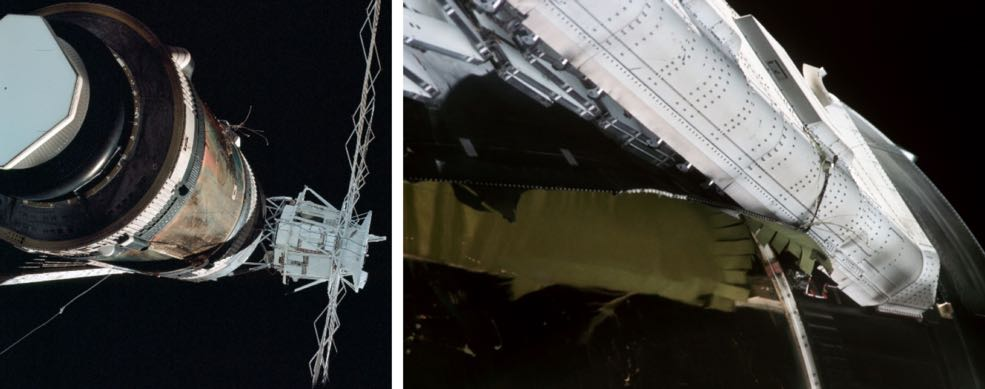
BLUF: At extremely high relative speeds of impact, solids act like liquids for a brief instant during the collision, the strength effects of materials can be neglected and the physics of hydrodynamics dominates. The result is a huge release of energy ejecting debris in all directions. There is little if any appreciable momentum exchange. You might say they blow through each other vice bounce off and change direction. Events like the F15/ASAT test of 1985, the Iridium-Cosmos on-orbit collision of 2009 and the direct ascent tests of China in 2007 and Russia in 2021 involved hypervelocity hits.

Why does Jack emphasize no or negligible momentum exchange? Well, our intuition leads to believing that hitting “down” on a target object it will deflect the resultant debris it towards earth for a more rapid decay and de-orbit — OR, hitting up will push the debris out into space and make it last longer. NOT TRUE says Jack. It’s all because of what’s hitting, the relative speed, and where we enter “the Hyper-Hydro Zone!”

– Hypervelocity is related to the speed of sound in the material being hit, in this context, the spacecraft. It can vary based on materials and can range from 3 to 6 km/sec. Yup, the specific material characteristics reveals a speed of sound of that material.

– If the impacting projectile is moving faster that the speed of sound of the materiel it is colliding with, you get a hypervelocity impact zone of hydro flow…the wave-front or shock wave of the collision energy literally shatters the material of the satellite long after the two objects have passed through each other.

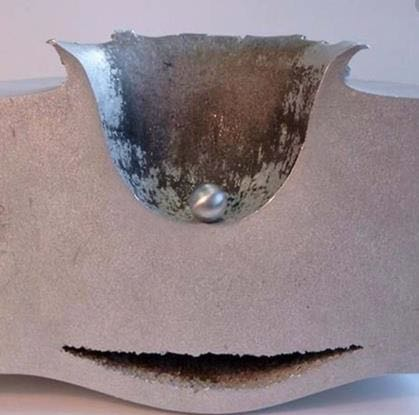
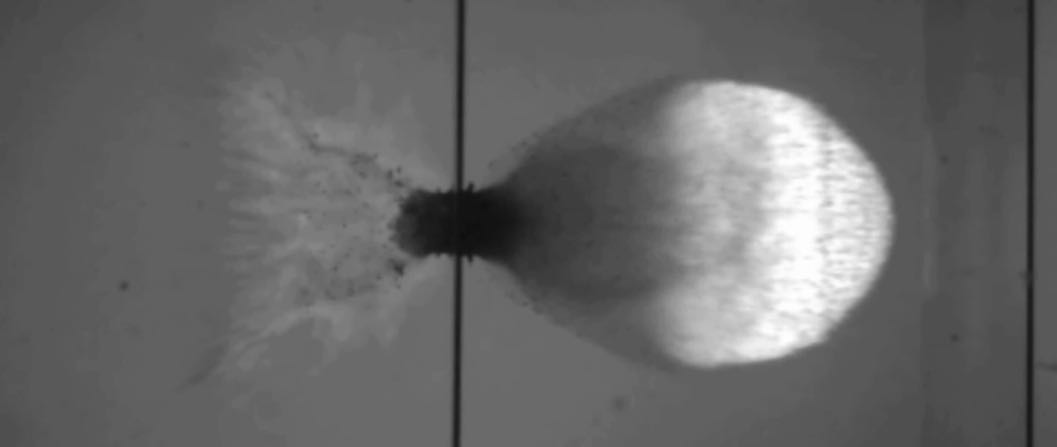
– At hypervelocity speeds, an impact between two objects causes the materials to behave like fluids or liquids for a very, very short period of time.

– In the collision, there is a vaporization of the two objects, whether it be two satellites, a rocket body or a projectile.

– Analogy: Instead of water balloons hitting each other and bouncing off or sticking together, if that collision occurred at hypervelocity speeds, they would essentially “go through each other” fragmenting with the clouds of water droplets continuing along their original path, no longer contained by the balloon.

– At hypervelocity, there is a negligible momentum exchange and … the blobs of water continue on the path they were on, but now there is no balloon to contain them.

– For these reasons if you hit “down” on the target satellite or object it will NOT be deflected down for rapid de-orbit. Rather the majority of debris will continue along its original path and gradually evolve into an expanding debris cloud.

– There are rare exceptions in what engineers’ call “corner cases” where a little more momentum may be exchanged, but effectively the two objects are “flowing” through each other without influencing their original orbit paths.

– The higher the relative velocity at “hit”, the greater the velocity of the ejected debris in all directions (radial, in-track and cross track).

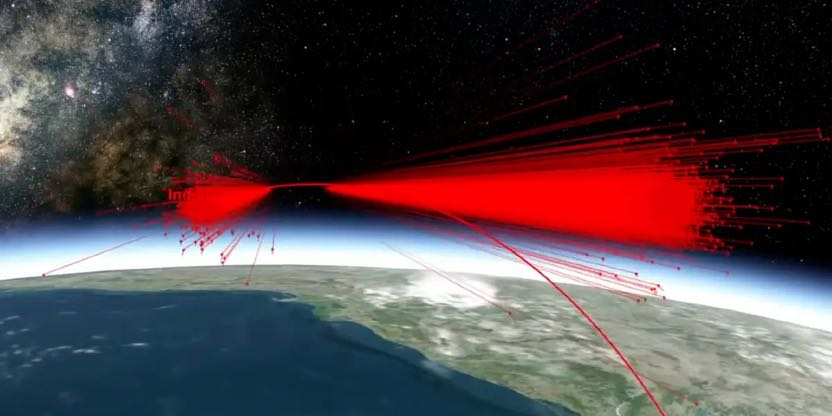
– This debris cloud is an evolving and dynamic entity; it is not a “field” which implies a static situation. It’s density at first is high, many particles in a small “ellipsoid” that over a few orbits expands and becomes less dense. It’s like a hot dog shape but ever increasing in length. There’s a lot more to the evolving of a debris cloud in space.

Jack is happy to send you his entire paper, he can be reached via jackfanthony78@gmail.com. He is also available to teach you the Orbit Element Dance in person or via Zoom – have your family and friends watch this unique astrodynamics lesson.

Jack wanted to give a shout all his mentors as far back as 1986. These folks who took time to teach him and help him explain include Don Kessler, Nick Johnson, Bob Morris, Felix Hoots, Darren McKnight, Andrew Abraham and Marlon Sorge. They helped Jack understand and convey the “weird science” of phenomenon like hypervelocity collisions and space debris.

Evidence of a brief liquid-like phase from a NASA hypervelocity impact test.

Hypervelocity impact test imagery showing shock-wave and material behavior.

Visualization of debris dispersal after a hypervelocity collision in low Earth orbit.

Examples illustrating the expanding debris cloud produced by hypervelocity impacts.

Jack Anthony's explainer graphic: what happens when objects collide in space at hypervelocity.