Issue 58

Jack’s Astro Corner: Cislunar Explained

I've been teaching astrodynamics formally and informally since 1982. From Generals and Astronauts to great military folks to school kids who were curious. I would often speak of the 4 “Orbit” siblings. They are LEO, MEO, HEO and GEO. Low, medium, highly elliptical and geosynchronous orbits. Well, recently they learned…

I’ve been teaching astrodynamics formally and informally since 1982. From Generals and Astronauts to great military folks to school kids who were curious. I would often speak of the 4 “Orbit” siblings. They are LEO, MEO, HEO and GEO. Low, medium, highly elliptical and geosynchronous orbits. Well, recently they learned their long-lost brother showed up…this sibling’s name is Cislunar. If you’ve been following space news and chatter amongst our leaders and the astro experts you’ll find ole Cislunar is getting A LOT of attention. This article will introduce you to this 5th “orbit sibling” and do so in a manner you’ll be confident enough to stop your neighbor or colleague and say “let me tell you about Cislunar orbits.” Maybe even do a group Cislunar demo…read on!

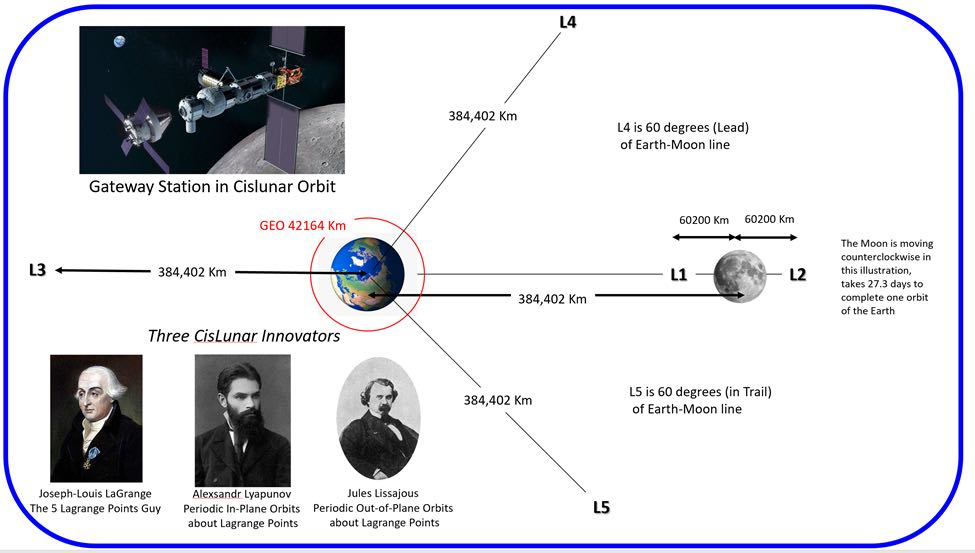
Let’s start with a video. A video I made earlier this year thanks to the willingness of 7 Advanced RPO astrodynamics students in a 2022 Palski & Associates course. Here is a human demonstration of the FIVE Joseph-Louis LaGrange points in the Earth-Moon rotating coordinate frame. I’ll orient you. We have a person as the Earth and another as the Moon. It just so happens the earth is a Space Force Major (yay William) and the Moon is a Space Force Captain (yay for Peyton). They form the primary axis of the Earth-Moon rotating frame. The Moon orbits the Earth every “how many?” days…” Bueller, Bueller, Bueller” ……27.3 days. OK, look closely, you’ll see the Moon person has two colleagues pretty darn close to the Moon. These are L1. I call that point the Earthside Lagrange point. L2 is on the other side and I call that the Far Side Lagrange point. Leading them is the L4 person, about 60 degrees of arc ahead. I’ll call this point “Lead.” L5 is trailing 60 degrees behind and I call it “Trail.” Hope these nifty call signs helps you remember the FIVE Lagrange Points of Cislunar. L4 and L5 are at Moon radius from the Earth. There’s one more, that’s L3. It is on the opposite side and at Moon radius. I call it “Opposite.” OK, so, watch this awesome Cislunar video by 7 RPO students. Be sure to watch it to completion, because this Cislunar 7 send a greeting to a great leader who is soon to retire after an amazing AF and Space Force career!

OK, maybe watch it a few times, its riveting and I hope you saw how the 5 LaGrange people stayed in the formation. As the Moon orbited the Earth, they all held their relative positions. That’s the magic of this Three-body problem that Joseph-Louis LaGrange figured out in the 1700’s It’s not magic, but with the Earth and Moon’s gravity and the third body, a satellite, there is a balancing act of ther BIG Earth gravity, the pretty big Moon gravity and the “ain’t got no gravity” satellite. So, you now have a handle on these 5 points in the Earth-Moon rotating system: L1-Earthside, L2-Farside, L3-Opposite, L4-Lead, and L5-Trail.

Let’s take a moment to look at these points and put some distances to it. In fact, the next illustration that I made for you gives some distances to give you scale. It also would make an excellent placemat for the dining table or your desk at work. Yes indeed, you will peg the “you are so cool” meter with friends and family. Simply save it as a pdf or jpeg, size it to 8 ½ by 11 inches and print it out…maybe go to a print shop since it might drain your ink cartridge, or use the General’s printer! Then laminate it, in case you spill on it. Let’s look at my “Cislunar Placemat” and see what we got.

Lagrange kicked all this off with his award-winning mathematical work. He addressed the “General Three-Body Problem” in his prize-winning paper (Essai sur le Problème des Trois Corps, 1772). Way to go Joe Lagrange. Two other math smarties took it further. That is Alexandre Lyapunov, a Russian math and physics legend, and Jules Lissajous, a French mathematician. Lyapunov determines there are “orbits” around a Lagrange point in repetitive curved paths that lie entirely in the plane of the Earth-Moon system. He did this work in the late 1880’s. In the mid 1800’s Lissajous discovered orbits about the Lagrange points that are out of this Earth-Moon plane. These include the popular Halo orbits. In all cases, they are natural and periodic, they repeat.They are also unstable, but not like a train out of control, they simply need a little nudging to stay on course, not a lot of Delta-V, just a periodic maneuver. These Lyapunov and Lissajous orbits about the Lagrange points are so very useful. I see our astro neophyte Barney Fife looking a little perplexed. He understood the five Lagrange points that our Palski students so superbly demonstrated, but now we’re talking periodic orbits about those points. Yes, that’s what we are talking about. Let’s look closer at this concept.
Dr George Pollock and Dr James Vedda of The Aerospace Corporation authored an excellent paper that I am going to cite as “you got to read this reference #1 of 2.” It’s called “Cislunar Stewardship” and in it they provide two excellent illustrations that help us visualize the periodic orbits about the Lagrange points in the rotating Earth-Moon system. Add this link for an excellent Cislunar reference!

Below is the Pollock-Vedda illustration of the periodic orbits in the Earth-Moon orbit plane (Reference Page 2 of Cislunar Stewardship). You see these “bean shaped” orbit trajectories about the Lagrange point.These are orbit paths about the point and their period can be as fast as 7 days or up to a month. So, think of the human demo and imagine an 8th participant circling their Lagrange point classmate in one of these bean-shaped orbits. That would really jazz up the demo, and perhaps lead to a collision of some sorts. The explanation Pollock and Vedda provide is succinct, informative and sums it up nicely.

Now, in the next illustration (page 3 of Cislunar Stewardship) they provide is for the out of plane periodic orbits about L1 and L2. This out of plane motion makes for a pogo type motion up and down relative to the Earth-Moon orbit plane. I am not going to steal all their Cislunar “thunder”, you must take time to read their paper and see more illustrations and learn more about the challenges we face internationally as nation’s take advantage of these unique Cislunar orbits about the Lagrange points.

I said we have 2 awesome references, the second one is the AFRL’s “A Primer on Cislunar Space” by Holtzinger, Chow and Garretson. Here is the link.

What I like about this “primer” is they use the GEO orbit radius as a distance reference and also discuss many of the “how do we represent these orbits” discussions. Then the second half of their booklet goes into the Space Domain Awareness challenges of detecting and tracking and determining the orbits of Cislunar objects.

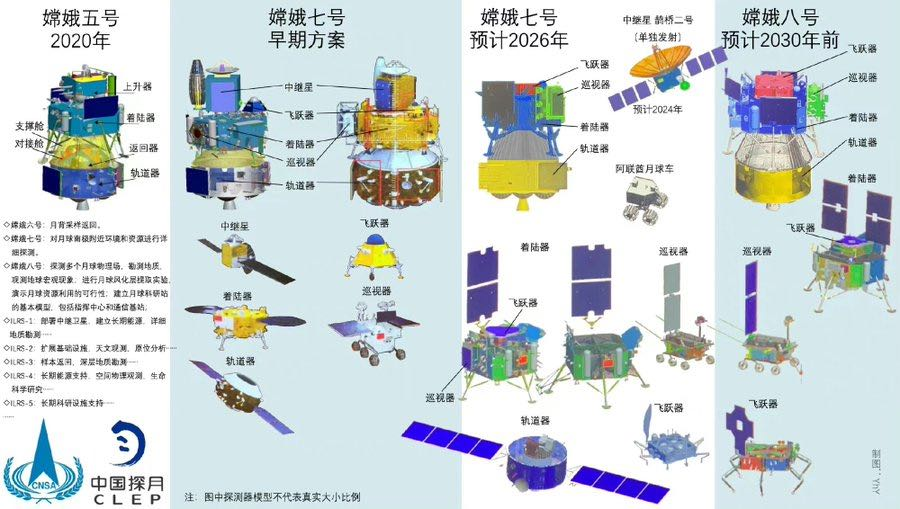
Let’s look at a few satellites that reside in the L1 and L2 area. The Chinese Queqiao relay satellite is in the vicinity of L2 responsible for communication with the Chinese Rover and Lander on the far side of the Moon. The satellite is not positioned directly at the Earth-Moon L2 point, but rather orbits around this point in a halo orbit. The Artemis Gateway station will reside in the vicinity of the L1 Earth-Moon area. Guess what? The Sun-Earth LaGrange points host many space vehicles too. My favorite is the Advanced Composition Explorer that is in L1. NASA’s Advanced Composition Explorer spacecraft has been operational for 25 years and is designed to study solar energetic particles from the Sun-Earth L1 Lagrange point 1.4 million kilometers) from Earth. Here’s why it is my favorite. In the late 1990’s NASA asked for Air Force help supporting communications with the ACE. “Who ya gonna call?” … the 1st Space Operations Squadron. We used AF Satellite Control Network assets to do communications relay to help NASA when needed a helping hand. What an honor.

Well, are you ready to organize a group activity to demo the Cislunar concepts? I bet you plus six colleagues could do this at a Commander’s call or in your cul-de-sac and what a hit it will be. On a serious note, understand the Cislunar orbits, environment and challenges is a must for all space professionals. I hope this Jack’s Astro Corner article ignites your interest and initial knowledge and that you check out the two excellent references. The references I cite are among the best I have seen, look them over. Then dive deeper, the 5th orbit sibling is a NEED-TO-KNOW topic. “Failure is not an Option” — let us “up our game” on Cislunar knowledge and comprehension.

Cislunar overview showing Earth-Moon geometry, L1-L5, Gateway, and three historical Lagrange-point innovators.

Pollock-Vedda illustration of planar Lyapunov and distant retrograde orbits around the Earth-Moon Lagrange points.

Illustration of halo orbits above and below the Earth-Moon orbital plane, including L1 and L2 examples.