

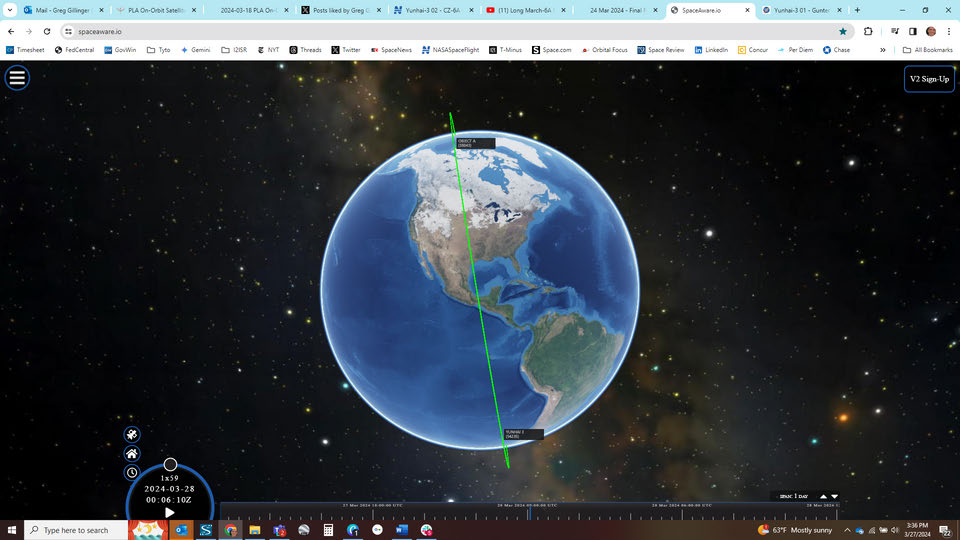
26 Mar: China launched a Long March-6A from Taiyuan carrying the second Yunhai-3 satellite. The Yunhai-3 02 satellite joins the 6 Yunhai-2 satellites launched on a LM-2D on 21 Mar 2024. Yunhai satellites are used for Environmental Monitoring, and this launch brings the constellation total to 18 satellites. As the name…
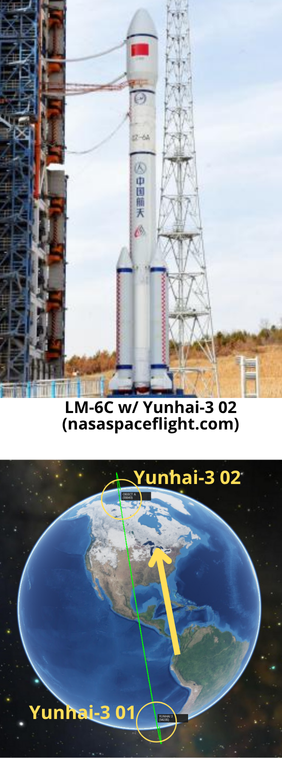
26 Mar: China launched a Long March-6A from Taiyuan carrying the second Yunhai-3 satellite. The Yunhai-3 02 satellite joins the 6 Yunhai-2 satellites launched on a LM-2D on 21 Mar 2024. Yunhai satellites are used for Environmental Monitoring, and this launch brings the constellation total to 18 satellites. As the name implies, this is the second Yunhai-3 satellite, both are co-planar and in sun-synchronous orbit. Launch Video.
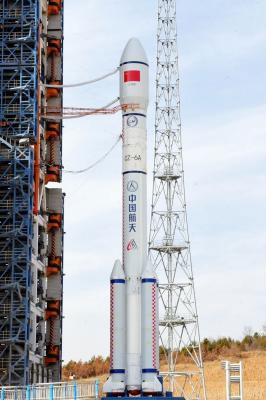
– China used a LM-6 to launch both Yunhai-3 satellites, and both were launched from Taiyuan. Yunhai-3 01 launched on 11 Nov 2022.
– The altitude of both Yunhai-3 satellites are identical as both have a Semi-Major Axis of 848km.
– China has not released any additional information regarding the mission of the Yunhai satellite constellation. A recent Space Review article maintained the constellation has a military purpose.
– This is the second Yunhai satellite launch in less than a week. On 21 Mar 2024 China launched a LM-2D from Jiuquan carrying 6 Yunhai-2 satellites into orbit. The launch was similar to the previous Yunhai-2 satellite launch in Dec 2018.
– Very little is known about the two Yunhai-3 satellites.
– There are four Yunhai-1 satellites and they are assessed to complement the information provided by the civil Fengyun meteorological satellites.
– Yunhai 1-01 (2016), 02 (2019) , 03 (2022) and 04 (2023) were all launched from Jiuquan using LM-2Ds.
– Yunhai 1-02 was struck by Russian debris in Mar 2018, likely from the Zenit-2 rocket that launched Russia’s Tselina-2 spy satellite in Sep 1996. The collision spawned at least 37 debris objects.
– Yunhai 1-02 apparently survived the violent encounter as amateur radio trackers have continued to detect signals from the satellite, it is unclear if Yunhai 1-02 remains operational.
– There are 12 Yunhai-2 satellites on orbit. Per the Space Review article: “The satellites reportedly use Global Navigation Satellite System radio occultation to collect atmospheric data for weather forecasting and for ionosphere, climate, and gravity research.”
– In Dec 2018 and Mar 2024 China simultaneously launched 6 Yunhai 2 satellites from Jiuquan using a LM-2D.
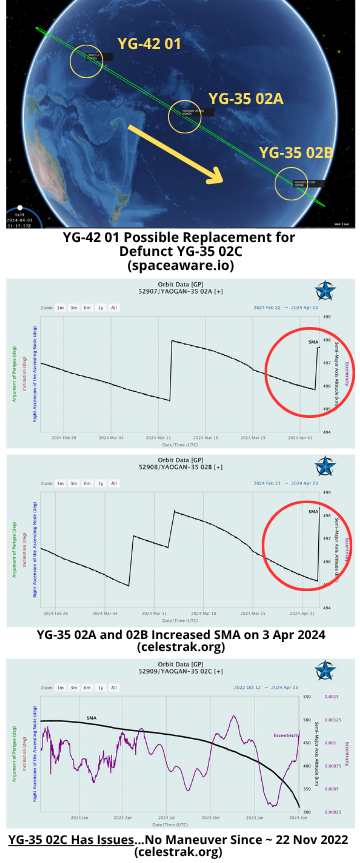
2 Apr 2024: China launched a LM-2D from Xichang carrying the Yaogan-42 01 remote sensing satellite. YG-42 01 appears to be nearly co-planar with Yaogan-35 02A and 02B and is a possible replacement for the Yaogan-35 02C which likely failed back in November 2022. China provided few details of YG-42 01's mission. Launch…
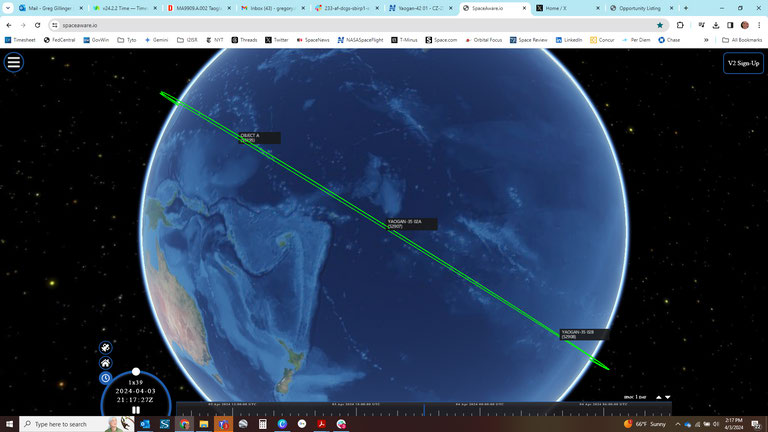
2 Apr 2024: China launched a LM-2D from Xichang carrying the Yaogan-42 01 remote sensing satellite. YG-42 01 appears to be nearly co-planar with Yaogan-35 02A and 02B and is a possible replacement for the Yaogan-35 02C which likely failed back in November 2022. China provided few details of YG-42 01’s mission. Launch Video.
– YG-42 01 is currently in a 504.9 x 494.3km orbit and is inclined 35°. The altitude and inclination match the Yaogan-35/36/39 45 satellite constellation China launched between 2021 and 2023.
– YG-42 01 is nearly co-planar with the YG-35 02A and 02B satellites which China launched on 23 June 2022. The YG-36 02 and YG-39 01 triplets are also in the same orbital plane.
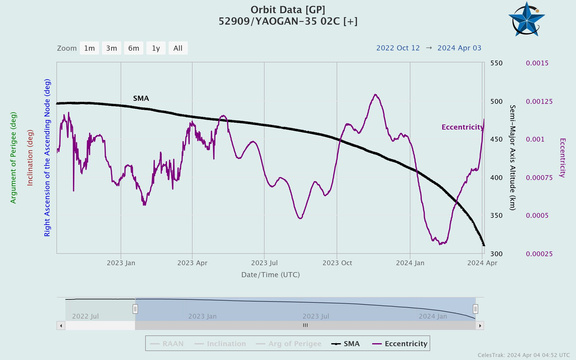
– For the YG-35 02 triplets specifically, YG-35 02B is the “Lead” and YG-35 02A is “Trail1.” YG-35 02C was in the “Trail2” position, however it has not maneuvered since November 2022.
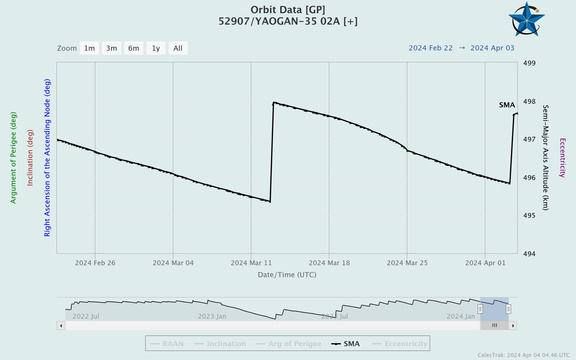
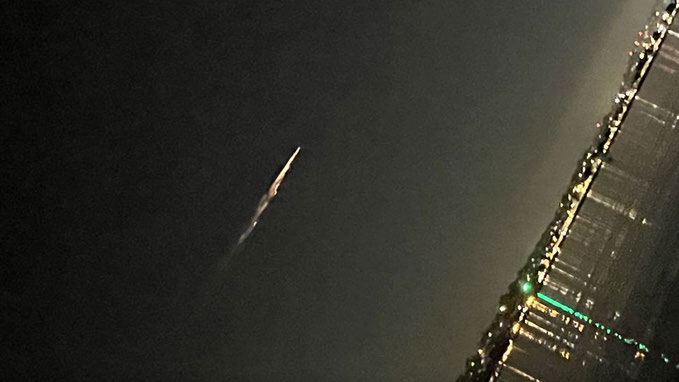
– YG-35 02’s orbit has gradually deteriorated over the past 16 months and its altitude is now just over 300km. It is likely to re-enter over the South Pacific in the near term.
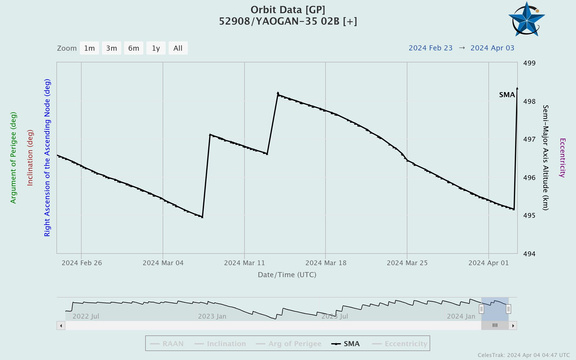
– On the same day of the YG-42 01 launch, both YG-35 02A and 02B increased their altitudes.
– The coming days/weeks will reveal if YG-42 01 joins the YG-35 02 formation as the “Trail2” satellite replacing the failed YG-35 02C.
– Another of the “Trail2” satellites, YG-36 01B also appears to have failed and has not maneuvered since ~ 22 Jan 2023. Its SMA has decreased over 100km and is now 395.1km and is likely headed for a similar fate as YG-35 02C. If there is a YG-42 02 and it joins the YG-36 01 formation then it is likely the YG-42 satellite is a new “Trail2” variant.
– On 29 Jan 2024, 7 other “Trail2” satellites began decreasing their SMAs. As of 7 April 2024 all of their altitudes have continued to decline. China appears to have done similar maneuvers with some of the
Trail2 satellites from Jan-Mar
2023.


18 Mar: China Aerospace Studies Institute (CASI) released an article from researcher Kristin Burke highlighting the People's Liberation Army (PLA)'s interest and investment in developing on-orbit servicing capabilities. The PLA is preparing its satellite operators to perform on-orbit satellite refueling, for peacetime…
18 Mar: China Aerospace Studies Institute (CASI) released an article from researcher Kristin Burke highlighting the People’s Liberation Army (PLA)’s interest and investment in developing on-orbit servicing capabilities. The PLA is preparing its satellite operators to perform on-orbit satellite refueling, for peacetime and wartime space logistics. They are also already integrating lessons learned into corresponding military doctrine and training tools. More excerpts below. Full Article.
– The Chinese Communist Party (CCP) has approved new commercial players to enter the field to provide, not only technology, but also frameworks to shape international norms.
– In 2018, a Beijing based Strategic Support Force (SSF) unit under the Space Systems Department (SSD) published a comprehensive article on the PLA’s requirements for a simulation tool to train military satellite operators in space-based refueling.
– In 2022 the PLA’s National University for Defense Technology (NUDT) recommended adding specific fuel and time requirements for five anticipated mission sets: 1) on-orbit refueling and repair; 2) auxiliary position maintenance; 3) adjusting inclination; 4) deorbiting a defunct satellite; and 5) rescuing a failed satellite.
– The PLA has been developing policy and doctrine for on-orbit logistics.
– The PLA’s Academy of Military Sciences (AMS) published the Lectures on the Science of Space Operations in 2013, which described the importance of having a military unit capable of supporting space equipment sustainment with on-orbit logistics. The book specifically mentions refueling and repair.
– The PLA’s broader doctrine covering all military operations, not just space operations, mentions in-space servicing. The PLA National Defense University’s 2020 Science of Military Strategy stated that “orbital services” are an important development trend, and that the PLA needs to play a role in the international legal debates on debris disposal.
– PLA experts are writing books to deepen operational planning. In 2021, key PLA satellite servicing experts from the SSF SSD, together with the AMS Joint Operations Experimental Center wrote a dedicated textbook on scheduling satellite servicing and related mission planning.
– Since at least 2016, China’s civilian Ministry of Science and Technology has included on-orbit servicing in its technology development plans.
– One Chinese province and two Chinese cities have published 14th Five Year Plans (2021-2025) including technology development support for on-orbit servicing.
China’s last and most recent versions of its national space plan have included debris mitigation and significantly expanded the section listing on-orbit servicing plans, to include goals for international cooperation and influencing international norms…a Chinese official document in English describing their plans for international cooperation and negotiation on in-space servicing is a strong signal they are interested in discussing their plans


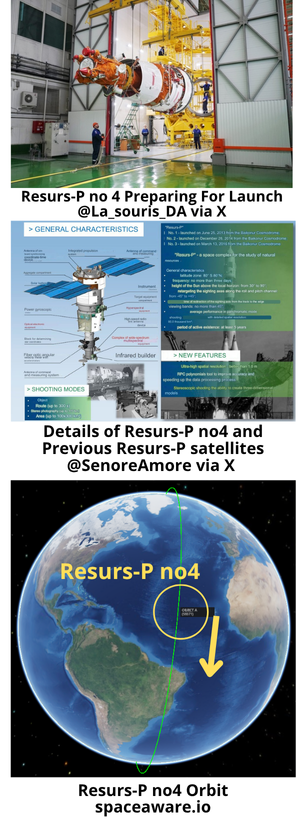
31 Mar: Russia launched a Soyuz-2-1b rocket, carrying the Resurs-P no4 satellite from Baikonur Cosmodrome. It is believed the Resurs-P no 4 & 5 have been significantly modified from the previous 3 Resurs-P satellites (the last of which launched in 2016 and failed to deploy one of its solar panels and was intentionally…
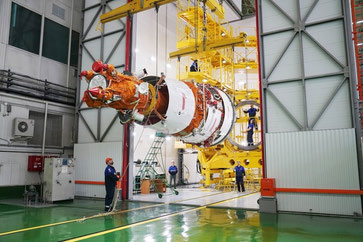
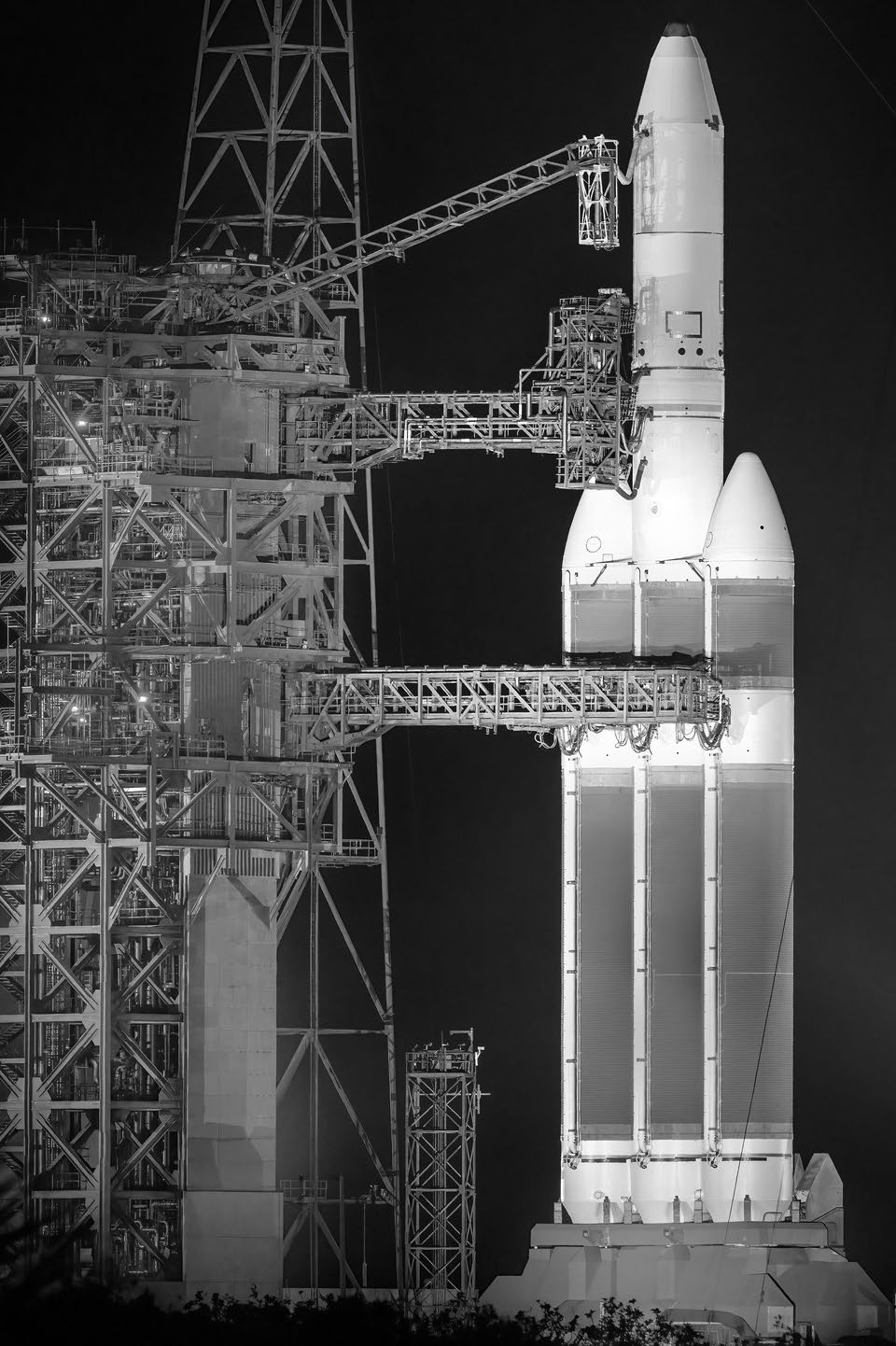
31 Mar: Russia launched a Soyuz-2-1b rocket, carrying the Resurs-P no4 satellite from Baikonur Cosmodrome. It is believed the Resurs-P no 4 & 5 have been significantly modified from the previous 3 Resurs-P satellites (the last of which launched in 2016 and failed to deploy one of its solar panels and was intentionally de-orbited in October 2023.) Launch Video.
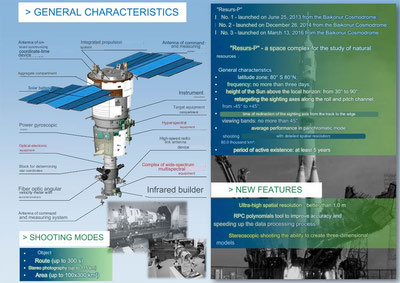
– Per Russian News Release: The Resurs-P No. 4 spacecraft is designed for highly detailed, wide-area and hyperspectral optical-electronic observation of the Earth’s surface.
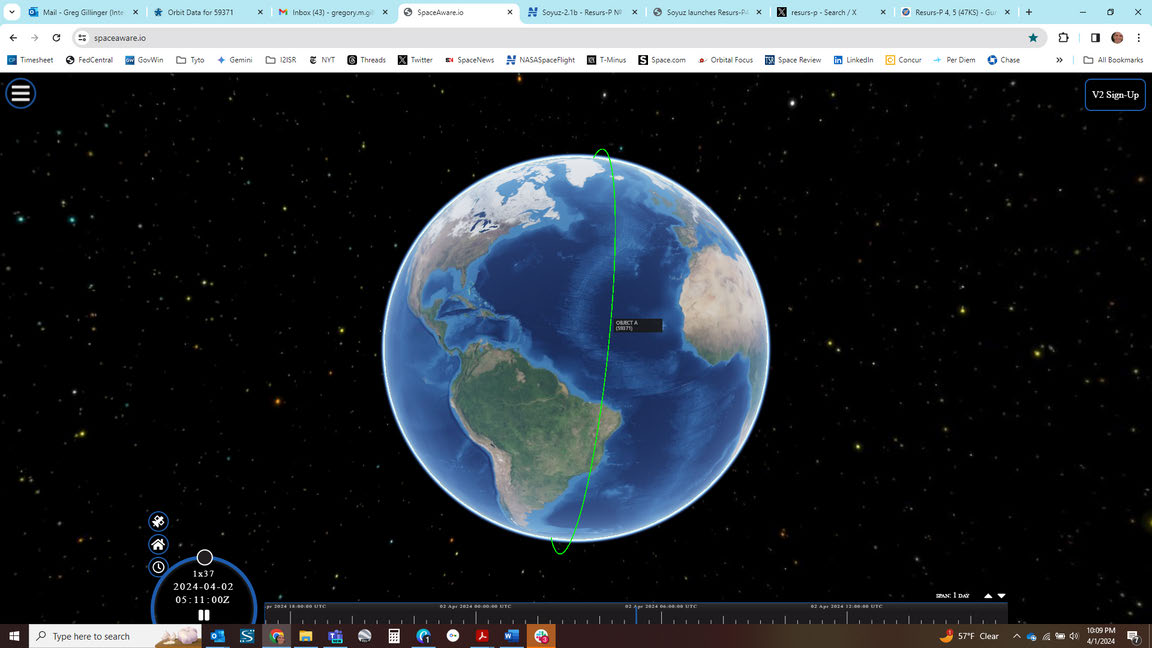
-Resurs-P no 4 is in a sun-synchronous orbit with a 462km apogee and 290km perigee and 97.2° inclination. As predicted by er Russianspaceweb.com, Resurs-P4 fired its own propulsion system during on 4 Apr to enter a near-circular Sun-synchronous orbit with an altitude of 470km.
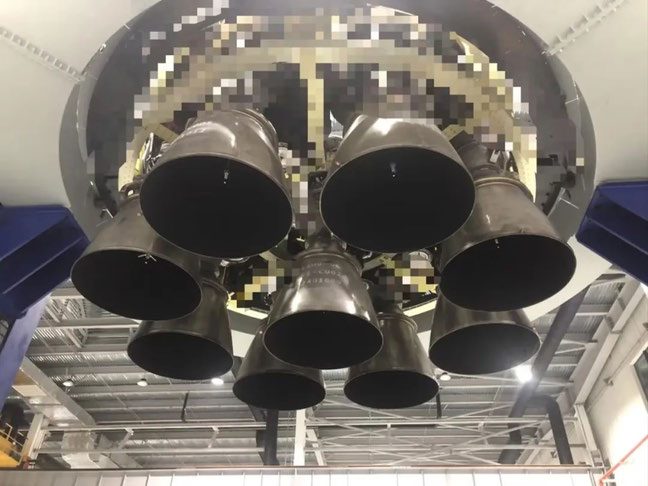
–Resurs-P no 4 and <eventually> P no 5 have significant upgrades compared with their three predecessors (Resurs-P 1, 2, 3). The expected maximum resolution is 1.0m.
-The improvements include a second high-resolution camera which will nearly doubles the amount of Earth’s surface that the satellite can image.
-Data downlink rates have also been in increased to 600 megabytes/second.
-Finally, Resures-P no4 no longer carries a AIS ship identification system hitchhiker payload.
-All Resurs-P satellites have been launched from Baikonur and used the Soyuz 2-1b launch vehicle.
-Western sanctions appear to have significantly delayed Resurs-P no4 (and no5) as #4 was originally scheduled to be launch in 2018 and #5 in 2019, but both were postponed due to the unavailability of certain components.
-Resurs-P no4 is the only operational Resurs-P satellite. Per Russianspaceweb.com “Resurs-P2 failed prematurely in 2017, while Resurs-P3 was seriously crippled by technical problems in the same year. The original Resurs-P1 lasted the longest, before going out of business in the Fall of 2021, thus leaving Roskosmos and its customers without a spacecraft in this class.”
– Russia intentionally de-orbited Resurs-P no3 in October 2023. It had been paired with the experimental Russian satellite, Kosmos-2562 fromOct 2022 – Jul 2023.
-Resurs-P no5 is expected to launch in 2025.
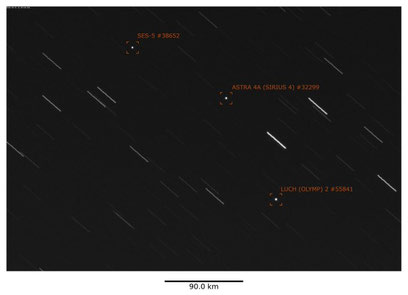

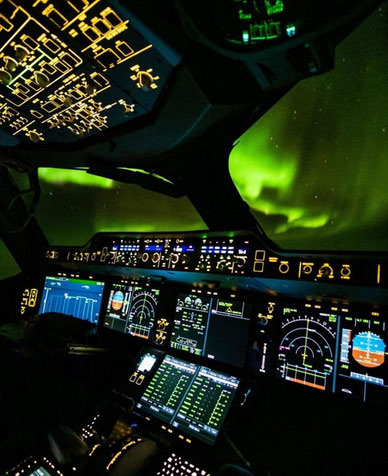

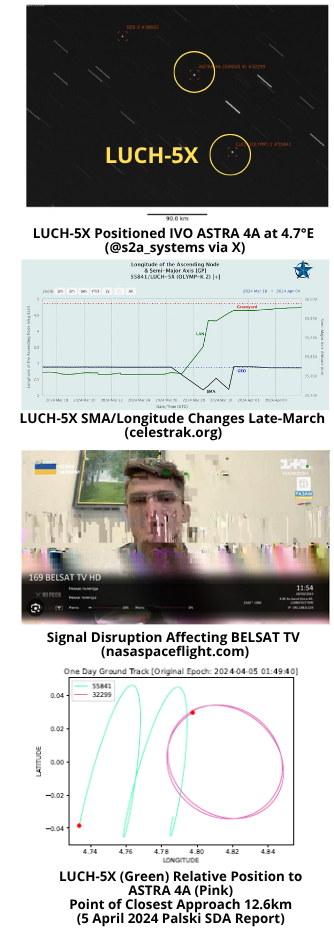
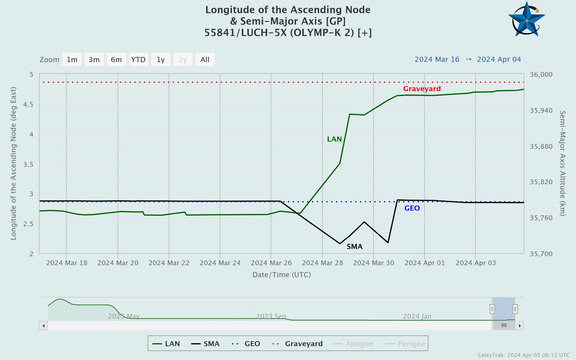
5 Apr 2024: After maintaining its orbit at 2.63°E from 5 Dec 2023 - 26 Mar 2024 (and in vicinity of EUTE KONNECT VHTS), Russia decreased LUCH-5X altitude ~47km on 27 Mar, drifted east for 2-3 days, and rejoined the GEO belt on 30 Mar at 4.7°E. LUCH-5X is now in vicinity of ASTRA 4A which carries broadcast television…
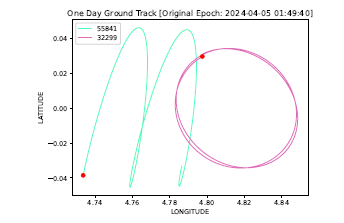
5 Apr 2024: After maintaining its orbit at 2.63°E from 5 Dec 2023 – 26 Mar 2024 (and in vicinity of EUTE KONNECT VHTS), Russia decreased LUCH-5X altitude ~47km on 27 Mar, drifted east for 2-3 days, and rejoined the GEO belt on 30 Mar at 4.7°E. LUCH-5X is now in vicinity of ASTRA 4A which carries broadcast television for Ukraine. ASTRA 4A was jammed by Russian sources (likely from the ground) on 28 March. It appears Russia was able to temporarily disrupt a Ukrainian United News telethon and content from other broadcasters and replace with Russian propaganda content.
-Since arriving in GEO in mid-March 2023 LUCH-5X has operated IVO the following satellites:
– Additional information from Bart Hendrickx:
“There are at least 3 reasons to believe that Luch-5X is not directly involved in the jamming of ASTRA 4A on 28 March:
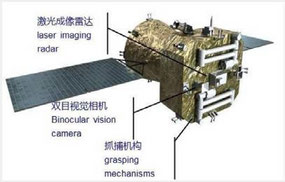



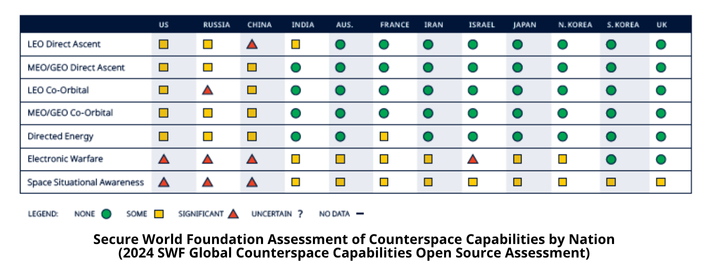
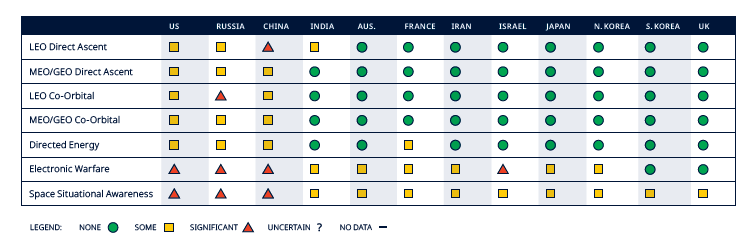
2 Apr 2024: Secure World Foundation (SWF) released their annual open source assessment of Global Counterspace Capabilities. In general, an increasing number of countries are looking to use space to enhance their military capabilities and national security which in turn incentivizes more nations to invest in developing…
2 Apr 2024: Secure World Foundation (SWF) released their annual open source assessment of Global Counterspace Capabilities. In general, an increasing number of countries are looking to use space to enhance their military capabilities and national security which in turn incentivizes more nations to invest in developing counterspace capabilities. While evidence shows “significant research and development of a broad range of destructive and non-destructive counterspace capabilities in multiple countries, only non-destructive capabilities are actively being used against satellites in current military operations.” Executive Summary excerpts below.
-Russia:
-China




Flash Insider
Subscribe to unlock full access to this Issue and the complete Flash archive.
Subscribe Now Already Subscribed? Log In