Issue 120

A Closer Look: Guowang Support to Long Range Strike
Doing research for this launch I came across a very interesting press report from Taiwan. The report was published in April 2024 and discussed some activity involving Chinese Coast Guard vessels operating near (or in) Taiwanese territorial waters. The report alleges that the Coast Guard vessels were involved with some…

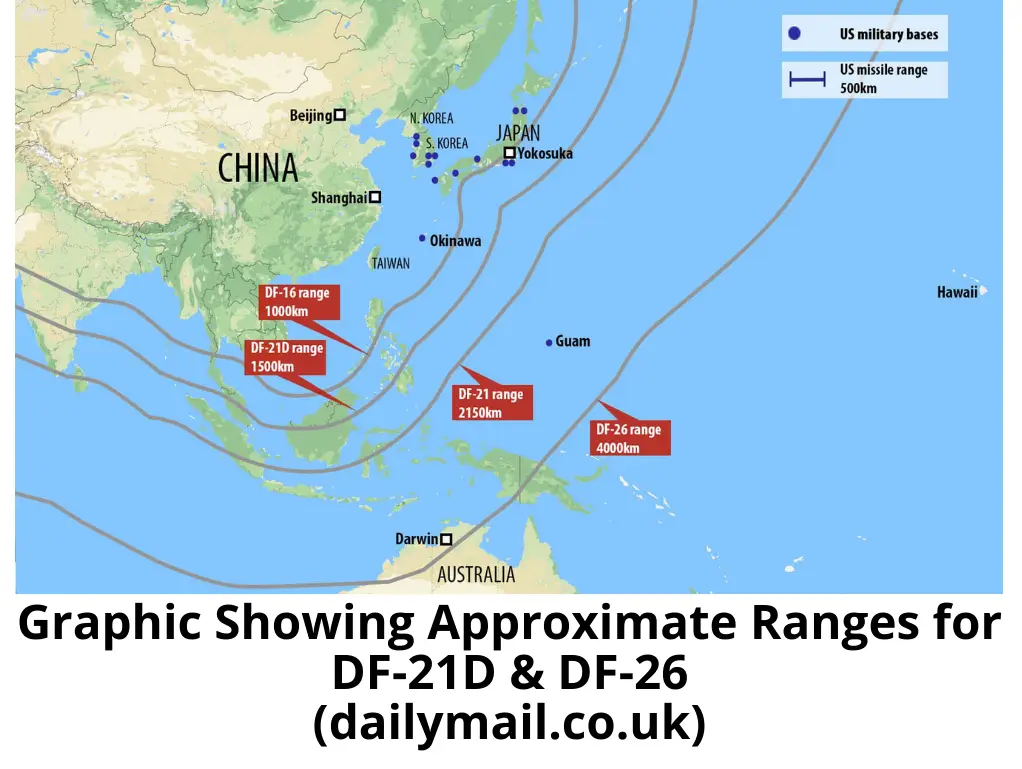
Doing research for this launch I came across a very interesting press report from Taiwan. The report was published in April 2024 and discussed some activity involving Chinese Coast Guard vessels operating near (or in) Taiwanese territorial waters. The report alleges that the Coast Guard vessels were involved with some sort of testing involving the Guowang constellation and China’s DF-21D & DF-26B missiles. The DF-21D is known as a “carrier killer” designed to target US aircraft carriers in the Western Pacific and South China Sea while the DF-26B is known as the “Guam Killer” and is China’s first conventionally-armed ballistic missile capable of striking Guam. My assessment below.

The Report:

  • In April 2024 Taiwanese media reported: “On the afternoon of 27 February (2024), three Chinese coast guard ships No. 2303, 2304 and 2305 raided the waters adjacent to (Taiwan’s) eastern 24 km (territorial waters) at a high speed of close to 20 km/hr…According to people familiar with the matter…the Chinese coast guard ships sailed at high speed in a ‘full silence’ mode, and after the analysis of electronic signals detected by friendly forces, it was judged that it should be helping the PLA test China’s version of Starlink’s “State Grid” (Guowang) to provide information on future precision strikes by the Rocket Force.”

Â

  • “According to a person familiar with the matter, the three (Chinese) coast guard ships are testing the Dongfeng-21D and Dongfeng-26B missiles of the Chinese State Grid (Guowang) and providing information to the Chinese Rocket Force to achieve precision strikes. It was not until the southernmost point of the Miyako Strait that the three coast guard ships were detected by friendly forces, and it cannot be ruled out that they were linked to low-orbit satellites launched by China.”


Taking a Closer Look:

  • This event occurred 10 months prior to China’s launch of Guowang Group 1 satellites in December 2024.
  • However, China launched 9 “internet technology test” satellites in 2023 which could have supported this operation. China conducted 4 launches: 1) 9 Jul: LM-2C with 2 satellites (57288, 57289) 86.5° inclined; 2) 23 Nov: LM-2D with 3 satellites (58425, 58426, 58427) 50° inclined; 3) 5 Dec: Jielong-3 (sea-based launch) with 1 satellite (58505) 86.5° inclined; and 4) 30 Dec: LM-2C with 3 satellites (58691, 58692, 58693) 50° inclined.
  • The orbital parameters for the 9 test satellites are nearly identical to those observed with the first three operational Guowang Groups; all are inclined at 50° or 86.5° and have an average altitude of ~1,100km. All of the satellite groups are in separate orbital planes.
  • At the time of the incident with the Chinese Coast Guard all test satellites had been launched, however only the satellites launched in July and Nov were at their operational altitudes. While the 4 satellites launched in December were at lower altitudes, it is possible they could have supported the operation/demonstration.
  • For 3 of the 4 launches China publicly stated an incorrect number of satellites. Seems like a deliberate (and rudimentary) obfuscation.


– Potential coverage area:

  • Based only on the orbital information available on 27 Feb 2024 it appears China would have had Guowang coverage of the Miyako Strait for ~7 hours and 50 minutes on that day.
  • There were several instances where the Guowang satellites provided ~30 min of consecutive coverage. (see graph below)

-Comparison with Western Constellations

  • In terms of average altitude and inclination, China has placed their satellites into orbits which are similar to those used by the OneWeb constellation.
  • OneWeb satellites orbit ~100km higher than Guowang (1,200km vs 1,100km average altitude respectively). All of OneWeb’s satellites are in orbits inclined at 87.5°. China appears to be using 2 inclinations, one of which is 86.5°. Inclination does not factor into the size of the satellite footprint.
  • OneWeb is able to provide global coverage with its 654-satellite constellation. If China is able to field a 13,000 satellite constellation with many of the satellites at 1,100km it will provide extremely redundant/resilient connectivity.
  • In contrast, Starlink satellites operate at ~550km or half the average altitude of Guowang and OneWeb. Starlink has previously announced its final constellation would be about 12,000 satellites, but that number has been revised several times. As of late March there are 7,135 Starlink satellites in orbit, of which 7,105 are working.

Conclusion: While we do not know the specific support the Guowang test satellites may have provided the Chinese Coast Guard vessels during this exercise/demonstration/operation, we do know there were 9 satellites on orbit and China could have used them in some capacity and in a way which was difficult for the Taiwanese to track. With these test satellites Guowang could provide sporadic coverage to the Miyako Strait. Coverage limitations would constrain testing to ~30 consecutive minutes at specific times of the day. However, testing would still be possible (see example of US military testing of Starlink in 2020 when Starlink had ~10% of its current number of satellites on orbit). The 10-month gap between the test near Taiwan and the first operational launch may have provided China with time to incorporate lessons learned into the operational satellites or just confirmed the performance of existing technologies and weapon system compatibility.