Issue 120

Article Review: Project Nivelir

28 Apr: The Space Review published another tremendous article from Bart Hendrickx in which Bart takes a look at the history of the Russian inspector/anti-satellite Nivilir development and testing. I've included excerpts below to capture Bart's description of Nivilir flight history. As is the norm for Bart's articles…

28 Apr: The Space Review published another tremendous article from Bart Hendrickx in which Bart takes a look at the history of the Russian inspector/anti-satellite Nivilir development and testing. I’ve included excerpts below to capture Bart’s description of Nivilir flight history. As is the norm for Bart’s articles, there is a ton of additional details in the article which you should read in its entirety.

History of Russian inspection satellites

  • The first Russian satellites categorized in the West as “inspection satellites” were three objects launched between December 2013 and March 2015 aboard the Rokot launch vehicle (Cosmos 2491 and 2499)…the satellites performed rendezvous and proximity operations with the Briz-KM upper stage that had delivered them to orbit.
  • In June 2017 Russia launched Cosmos-2519 aboard a Soyuz-2.1v rocket…the Ministry of Defense gave the mission objectives as remote sensing of the Earth and photography of other objects in space. Orbit parameters showed that the satellite had been placed into the same plane as Kosmos-2486, a Russian optical reconnaissance satellite of the Persona type launched in 2013…About two months after launch, Kosmos-2519 deployed a subsatellite that was later designated Kosmos-2521. In late October 2017, when Kosmos-2521 itself released an object that later got the name Kosmos-2523. This immediately performed a single maneuver that lowered its perigee by about 100 kilometers.
  • In July 2019 Russia launched Cosmos 2535 & 2536, which…soon started a long series of mutual encounters. The first of those, in August 2019, was the subject of another Ministry of Defense press release, which described one satellite as an “inspection satellite” and the other as a “registering satellite.” Later in the mission, one of the two satellites generated about two dozen pieces of space debris that ended up in widely scattered orbits, indicating they were the result of some kind of energetic event. The satellites themselves remained operational after these debris-shedding events.
  • In November 2019, Russia launched a mission that was a near carbon copy of the one flown in 2017. It again involved a “parent satellite” (Cosmos 2542), which released a small subsatellite (Cosmos 2543) several days after launch. Tracking data showed that both were in the same orbital plane as the US electro-optical reconnaissance satellite USA 245. In July 2020, Cosmos 2543 approached Cosmos 2535 and ejected an object that significantly changed its perigee (by about 100 kilometers) and apogee (by almost 170 kilometers.)
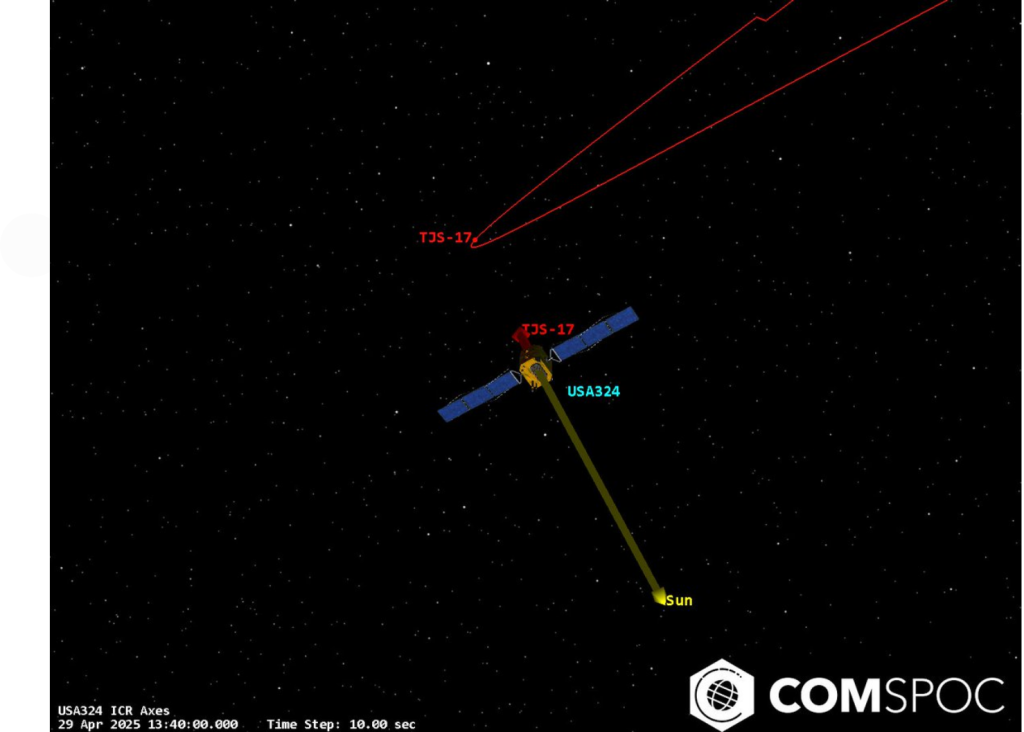
  • In August 2022 and May 2024, Russia orbited two more satellites (Cosmos 2558 & 2576) that were inserted into the same orbital plane as US reconnaissance satellites (USA 326 and USA 314, respectively.)
    • Russia has not provided any details about Cosmos 2558 & 2576, but all indications are that they are of the same type as Cosmos 2519 & 2542, the only difference with the two earlier missions being that they have so far not released any subsatellites. They have been conducting maneuvers on a regular basis to ensure that their orbits remain synchronized with those of the American satellites, although a new series of orbit corrections by Cosmos-2576 in February are reported to have moved it out of plane with USA 314.
  • Small subsatellites with likely inspection missions were launched attached to two electronic intelligence satellites of the Lotos-S type (Cosmos 2565 & 2570) in November 2022 and October 2023. Several weeks after being detached from the parent satellites, they split into two pieces, one of which was presumably an inspection satellite and the other a rendezvous target. While the first mission seems to have failed, the second one saw the inspection satellite (labeled Kosmos-2571) performing rendezvous and proximity operations with the target in December 2024.
  • Small subsatellites with likely inspection missions were launched attached to two electronic intelligence satellites of the Lotos-S type (Cosmos 2565 & 2570) in November 2022 and October 2023. Several weeks after being detached from the parent satellites, they split into two pieces, one of which was presumably an inspection satellite and the other a rendezvous target. While the first mission seems to have failed, the second one saw the inspection satellite (labeled Kosmos-2571) performing rendezvous and proximity operations with the target in December 2024.
  • Finally, three satellites (Cosmos 2581, 2582, and 2583) launched together this February also have all the hallmarks of being on some type of inspection mission. The Cosmos-2581/2582 pair has been flying in tandem since early March, coming as close as about 50 meters. Cosmos 2583 passed very close to them in early March and is now flying well ahead of them. It released an object, so far unidentified, on March 18.
    • Russia has not provided any details about Cosmos 2558 & 2576, but all indications are that they are of the same type as Cosmos 2519 & 2542, the only difference with the two earlier missions being that they have so far not released any subsatellites. They have been conducting maneuvers on a regular basis to ensure that their orbits remain synchronized with those of thecond one saw the inspection satellite (labeled Kosmos-2571) performing rendezvous and proximity operations with the target in December 2024.
  • Finally, three satellites (Cosmos 2581, 2582, and 2583) launched together this February also have all the hallmarks of being on some type of inspection mission. The Cosmos-2581/2582 pair has been flying in tandem since early March, coming as close as about 50 meters. Cosmos 2583 passed very close to them in early March and is now flying well ahead of them. It released an object, so far unidentified, on March 18.
  • Â