Issue 120

Tumbled: Cosmos 2553 Update

25 Apr: Various news sources reported that the Russian Cosmos 2553 (51511) satellite appeared to become unstable in November 2024. Russia launched Cosmos 2553 on 5 Feb 2022 (editor's note: this was less than 3 weeks prior to Russia's invasion of Ukraine and 82 days after Russia's destructive Nudol ASAT test) and…

25 Apr: Various news sources reported that the Russian Cosmos 2553 (51511) satellite appeared to become unstable in November 2024. Russia launched Cosmos 2553 on 5 Feb 2022 (editor’s note: this was less than 3 weeks prior to Russia’s invasion of Ukraine and 82 days after Russia’s destructive Nudol ASAT test) and soon-after there were rumors that the satellite was potentially a test of a nuclear armed anti-satellite weapon (although there have been no reports that Cosmos 2553 actually has a nuclear weapon on board.) Secure World Foundation did an excellent article which you should read. LeoLabs recently released data indicating its (LeoLabs) space tracking radars had detected Cosmos 2553 had become unstable in November 2024. In mid-December the LeoLabs hypothesis was confirmed with optical imagery from Maxar satellites.

LeoLabs Senior Technical Fellow (and friend of the Flash), Dr Darren McKnight was nice enough to provide some insight on what LeoLabs was able to observe.

– LeoLabs provides persistent orbital intelligence on nearly 24,000 objects in LEO by providing not only updated state vectors six to eight times a day but also object characteristics to include radar cross-section, maneuverability, area-to-mass ratio, proximity operations characterization, attitude instability, etc.

– LeoLabs monitored Cosmos 2553 since its launch in Feb 2022. LeoLabs has developed and conducted doppler

residuals tests to determine satellite instability. In the Fall of 2024 LeoLabs examined Cosmos 2553 and the results initially found the satellite stable. However, through continuous monitoring it was shown to have become unstable around 15 November 2024.

– In object characterization tradecraft, we (LeoLabs) do not assign an object with a certain state with high confidence from a single feature, so we considered the fact that Cosmos 2553 had an unstable attitude (i.e., tumbling) as of 15 November 2024 with moderate confidence.

– LeoLabs then pursued verification through a non-Earth imaging (NEI) partner and in mid-December a sequence of images showed a clear instability (i.e., tumbling). At that time, LeoLabs concluded that Cosmos 2553 was tumbling with high confidence.

– Over the past few months, the doppler residuals plot has shown a slight reduction in magnitude hinting that either the tumble is slowing, or the orientation of the spacecraft tumble relative to the ground is changing slightly.

I also spoke to Stephen Hannah, the SSA/SDA Product Manager for Maxar Intelligence. Stephen provided some great insights into the Non-Earth Imaging support Maxar provided to confirm Cosmos 2553 tumbling status.
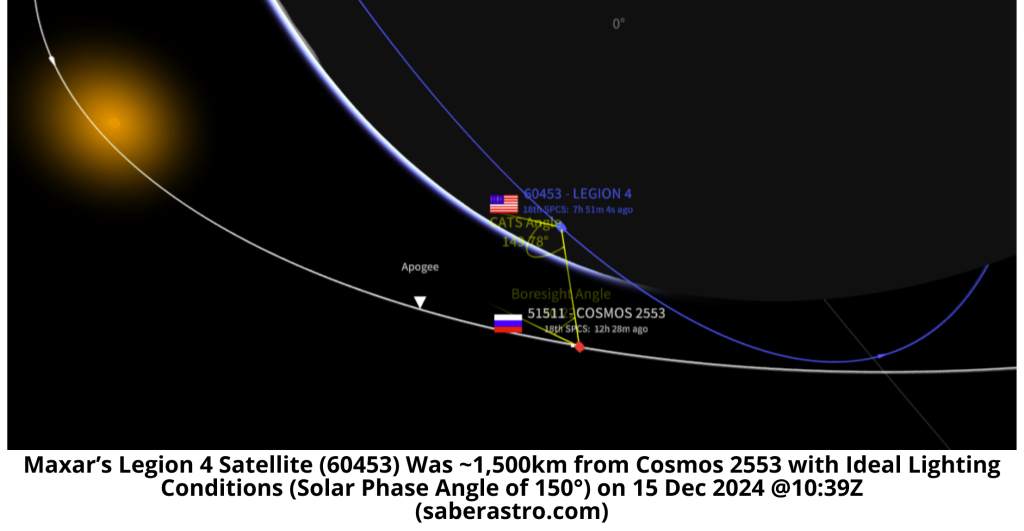
– Maxar imaged Cosmos 2553 in January 2024 (pre-tumble). Using its Worldview Legion satellites, Maxar collected a 3 image sequence at a range of 1380-1587km at 52.1-79.5 cm Space Sample Distance (or resolution). Maxar’s Non Earth Imagine (NEI) analytics showed a fully stable to possibly a ~0.5° slew; perfectly within expected range for a stable satellite.

– Following a conversation with LeoLabs, Maxar collected 9 image sequence at a range of 1421km — 1686km at 71.2 – 84.5 cm SSD/resolution on 15 Dec 2024. Maxar’s NEI analytics showed a rotation rate of around ~2.3-2.4°/sec, appearing to be close to a flat spin about the payload line of sight.

Â

Bottom line: Maxar imagery showed a stable Cosmos 2553 in Jan 2024 and a tumbling (and likely non-operational) Cosmos 2553 in December 2024.

(editor’s note: Thanks for the inputs Dr McKnight & Stephen Hannah! This is the way.)

Â

– It appears the story of Cosmos 2553 may not have ended. A spokesperson from Slingshot Aerospace (another space domain monitoring company that operates 150+ optical telescopes), initially noted Cosmos 2553’s brightness became variable, indicating a potential tumble.” However, according to Slingshot’s latest observations, Cosmos 2553 appears to have stabilized, according to Belinda Marchand, the company’s Chief Science Officer.