Issue 122

Bonus Jack’s Astro Corner: How To Rendezvous With Another Satellite

This essay will introduce the process of a “chaser” spacecraft (maybe a refueler servicing vehicle) goes through to arrive at the “target” spacecraft (the one who ordered the refueling). The terms chaser and target have been used by NASA way back as they planned and executed rendezvous, then loitered around the other…

This essay will introduce the process of a “chaser” spacecraft (maybe a refueler servicing vehicle) goes through to arrive at the “target” spacecraft (the one who ordered the refueling). The terms chaser and target have been used by NASA way back as they planned and executed rendezvous, then loitered around the other spacecraft, that’s called proximity operations, and then they would dock. Some call this ZPO, zero prox ops. This process involves maneuvering the chaser and hopefully the target is cooperative and not maneuvering without telling you.

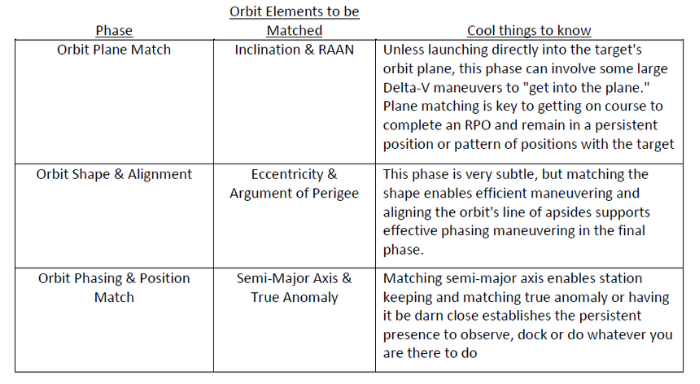
The chaser’s orbital elements provide information into how the rendezvous mission progressing If you are not aware of the target, following this trend will help resolve that. It’s the change and matching of the chaser’s elements to the target’s elements that give insight into how the process is moving along. In the end, if the chaser is to dock with the target, then the orbital elements must match. There are three phases to completing a RPO and then ZPO. While the chaser’s maneuvers may not always follow the expected flow of these phases, they provide a framework to follow along. Here below is a table that summarizes the 3 phases. Give it a review and study before reading on, it will be helpful.

Let’s look at each phase and go a little deeper to give you insight into what’s going on.

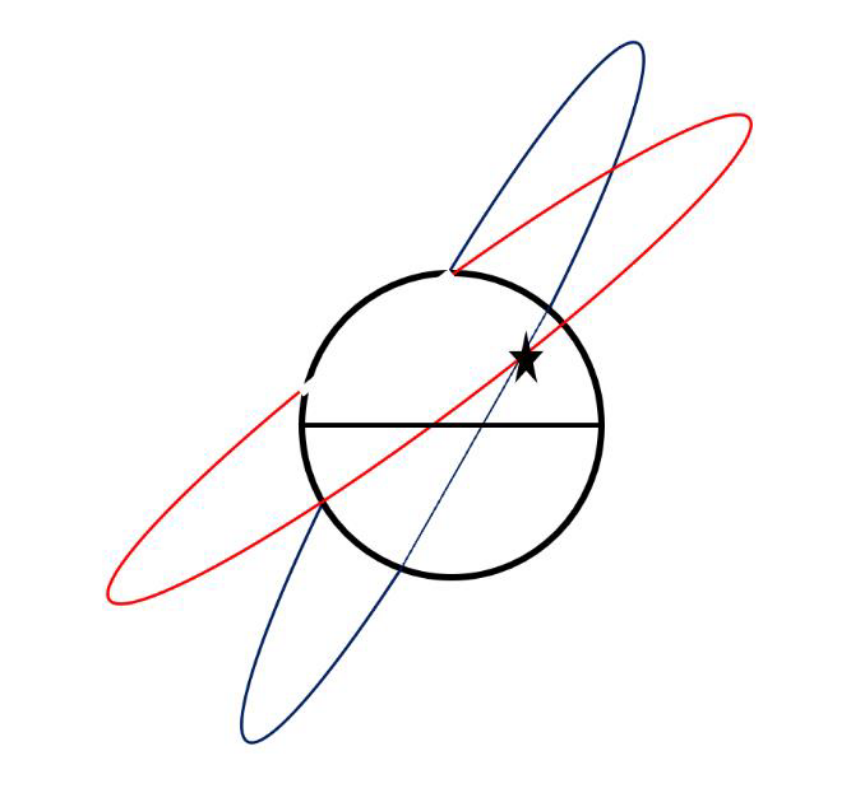
Orbit Plane Matching: Plane matching usually occurs early in planning and executing a mission. The launch vehicle usually does it all, you launch right into the orbit plane of the target (see Russia’s Kosmos 2558 and 2576). But there can be errors in that insertion and thus orbit plane matching maneuvers are needed. Below is a simple illustration (all my drawings are simple😁) that shows the red and blue orbits have different inclinations and RAANs. So, the task at hand to match orbit planes would be to execute a Delta V where that star is and get the orbit planes matched to have same inclination and RAAN. A really important step to ensure when you get close for proximity operations you are not zig zagging back and forth.

The chaser can do a series of small orbit plane adjust maneuvers to incrementally get the orbit planes aligned. As you all remember from the Orbital Element Series of articles I wrote, the orbit plane is characterized by the inclination and RAAN. The amount of Delta-V to align inclination only gives us some basic rules of thumb. In GEO, 53 m/s of Delta-V is needed to change or correct 1 degrees of inclination, for LEO it’s about 115 m/s. But remember, you got to also get the RAAN lined up. That can be costly in propellant. Here’s an example: You launched into a 97.4 degrees incline LEO orbit. Nailed the inclination. But, the RAAN is not aligned, it’s off by 1.5 degrees. How much Delta-V do you think is needed to fix that? Hummmm? Well, its 197.5 m/s, wow! Now, get ready for some learning, what if the inclination was 28 degrees. Is there a difference in what’s needed to fix the 1.5-degree error in RAAN? Yup, it’s only 97 m/s. Still, a lot. So, orbit plane matching usually is the launch vehicles chore, but if you need to tweak things to get the orbit planes aligned, that can cost you fuel (and time making PowerPoints to explain what’s going on…LOL).

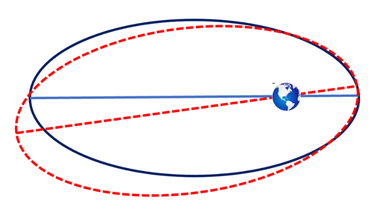
Orbit Shaping & Alignment: Normally mission planners like to have the long axis of the orbits matched, this is called the line of apsides. It enables efficient maneuvering. This can be a very subtle stage, usually the orbits are so near circular this phase may not occur. Orbit shaping is reflected in the eccentricity and argument of perigee matching. Hopefully the launch vehicle did its job getting things properly inserted into orbit. Of course, if the target starts playing games and maneuvering, then this problem gets tougher. The illustration on the next page shows that the red dashed orbit and the blue orbit do not have their lines of apsides lined up. Some planners would want to execute a maneuver to get them aligned to support more efficient maneuvering.

Orbit Phasing: This is my favorite phase. This is where you get to close in on the target and hang out with them or better yet, dock and refuel them. This phase is usually seen as where the chaser orbit is being adjusted and we see changes in its orbit’s apogee and perigee. They are fiddling with the semi-major axis and getting the approach going, perhaps slowing down the relative closer rate. As semi-major axis getting close to a match, chances are the true anomaly is also closing in. Match them up and you can reach out and shake hands or get set for the dock and refueling. Here’s a cool rule of thumb I think you’ll enjoy knowing and sort of relates to phasing. For LEO Earth orbits, there is a 10:1 rule, my friend James Oberg at NASA/JSC came up with it. Here’s what it means. If you are 1 Km below your target orbit and you are plane matched and circularized, then you will advance 10Km forward each orbit period. Thus 10:1. So, let’s say you are 5 Km below and 150 Km behind. Let’s say your orbit periods are really close and 90 minutes. OK, so when will you be right underneath the target? Well, use the 10:1 rule. Each orbit you scoot ahead relative to the target 50 Km (5 Km times 10). So, we are 150 Km behind, and guess what? In 3 orbit or 4.5 hours we can look “up” and see the target. Pretty cool, the 1- to 1 rule of thumb by James Oberg. Yay for him!

Â

Well, there you have it. The 3 phases of RPO and some details as to what’s going on. You may ask, how does Jack know this stuff? Well, two folks play a BIG role in helping me understand and get all enthusiastic about RPO. Dr Chirold Epp helped me in the early 1980’s. While at Johnson Space Center I’d meet with Dr Epp and he’d tell me all the cool things Shuttle would be doing with regard to RPO. He helped me understand the math and art to all this. Then Mr. A. Clark Keith III came along in 1989 as my Aerospace Corporation advisor for the famous TAOS space mission that flew 1994-2000. I got to know Clark and one of his finest hours (or years) was the XSS-11 RPO test mission that flew 2005-2007. Clark was the Flight Director and he wrote up notes that comprised a “how to” handbook for RPO. Just before his battle with cancer took him from us in 2013, Clark wrote up his notes and gave them to his colleague Jim Baker to publish. I met with Clark just before he passed and he said “Jack’s I’m writing everything down, make sure you read and live it.” Clark’s experience, insight, and ability to explain things was awesome and helped all of us know the ways to achieve RPO. He is the Father of Military RPO. He played a huge role in planning the ANGELS mission and many more space test missions. I miss Clark and thank him. DO YOU HAVE A MENTOR HELPING YOU UNDERSTAND YOUR AREA OF RESPONSIBILITY? I BET YOU DO.

Â

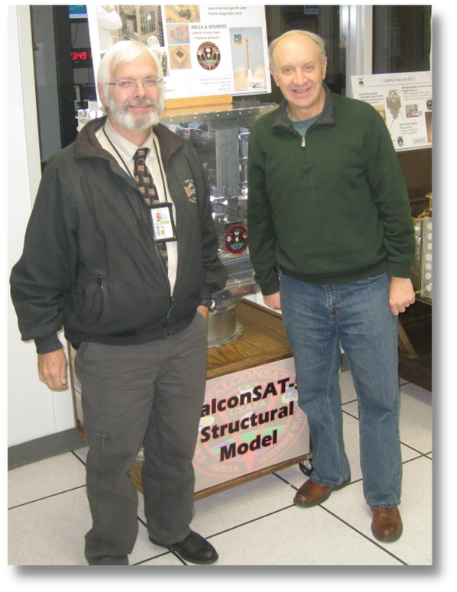
Here’s a photo of Clark and I in 2011 at the USAF Academy FalconSAT Operations Center. He loved coming to meet with the cadet’s and talk spaceflight!