
16 Apr 2023: The China Meteorological Administration (CMA) launched a Long March-4B with the Fengyun-3G (FY-3G) meteorological satellite from the Jiuquan Satellite Launch Center in northwest China. The FY-3G will act as a vital component in global precipitation detection under the WMO framework. Launch Video . - FY-3G…
16 Apr 2023: The China Meteorological Administration (CMA) launched a Long March-4B with the Fengyun-3G (FY-3G) meteorological satellite from the Jiuquan Satellite Launch Center in northwest China. The FY-3G will act as a vital component in global precipitation detection under the WMO framework. Launch Video.
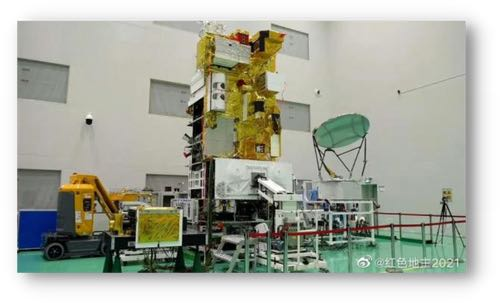
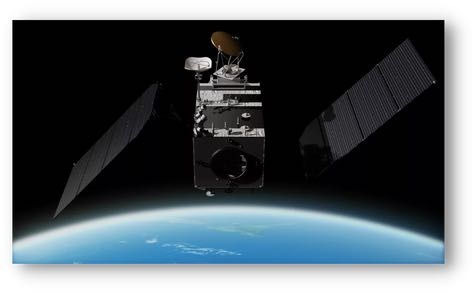
– FY-3G is equipped with a Ku/Ka-band dual-frequency precipitation measurement radar, microwave imager, optical imager and near-infrared multi-angle polarization imager. The precipitation measurement radar is a first-of-its-kind instrument, developed independently by China.
– FY-3G is the 20th Fengyun meteorological satellite in the series and will help improve early warning capabilities for monitoring weather- and climate-related disasters.
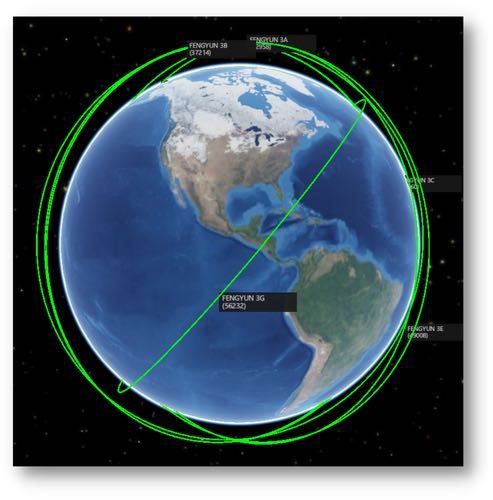
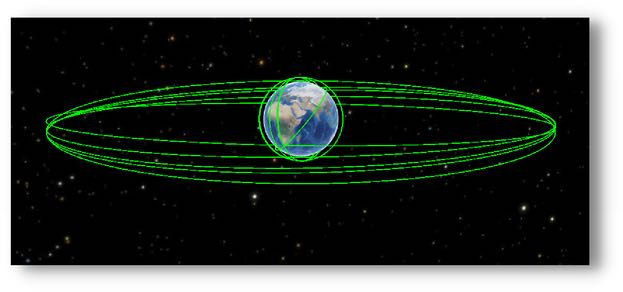
– FY-3G is in a much lower orbit than other FY-3 satellites likely to support its radar. FY-3G is in a 416.4x408km orbit and is inclined at 50°. The other FY-3 satellites are all in orbits at >820km and are inclined 97° (sun synchronous orbit).
– All previous FY-3 used CZ-4C and all but FY-3E and now FY-3G were launched from Tiayuan. 3E/3G were both launched from Jiuquan.
-FY-3G will carry out in-orbit testing over the next six months, with China set to launch another FY-3 meteorological satellite in Aug 2023. China has eight FY meteorological satellites in orbit, providing data products and services for 126 countries and regions.
China has launched 6 Fengyun satellites since 2016, FY 2H, 3D, 4A, 4B, 3E and 3G. The China Meteorological Administration plans to launch Fengyun-3F to Fengyun-3J, as well as Fengyun-4C to Fengyun-4G in the upcoming years and decades, covering their need for meteorology satellites until 2040, with the last satellites planned to launch in 2030 and 2033 respectively.
15 Apr 2023: SpaceX launched from Vandenberg SFB with more than 50 satellites on the latest in a series of dedicated Falcon 9 small-sat rideshare missions. Most of the payloads were deployed starting an hour after liftoff, following a second burn of the upper stage. Those payloads were released over a span of about 20…
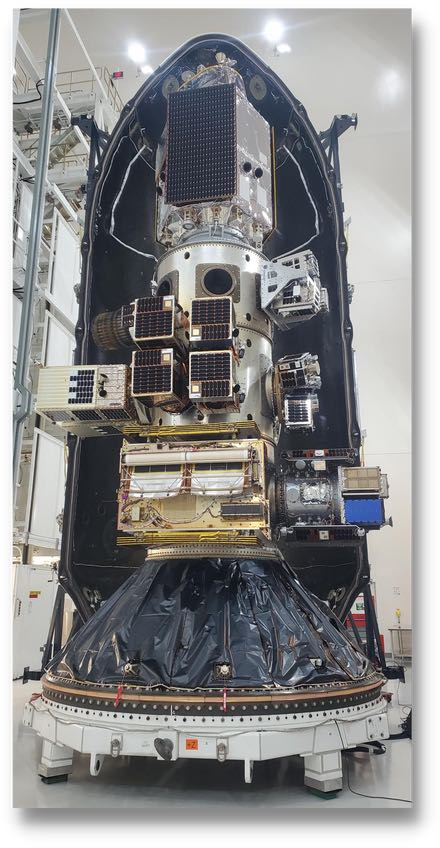
15 Apr 2023: SpaceX launched from Vandenberg SFB with more than 50 satellites on the latest in a series of dedicated Falcon 9 small-sat rideshare missions. Most of the payloads were deployed starting an hour after liftoff, following a second burn of the upper stage. Those payloads were released over a span of about 20 minutes. The upper stage then performed two more maneuvers before deploying the final, and largest, payload, the 800-kilogram IMECE imaging satellite built by Turkish research institute Tübitak Uzay 2 hours and 35 minutes after liftoff. Launch Video.
– The launch carried 51 payloads, but SpaceX did not release a full list of the satellites on board. This was the first in SpaceX’s series of Transporter dedicated smallsat rideshare missions to launch from Vandenberg, after the first six launched from Cape Canaveral, Florida.
– Fifty of the Transporter 7 payloads were deployed into a sun-synchronous polar orbit roughly 310 miles (500km) in altitude, at an inclination of 97.4° to the equator, followed by two more short firings by the upper stage engine to raise the rocket’s altitude to more than 420 miles (about 680km). The orbit adjustment also slightly changed the inclination to 98.2°, setting up for separation of the largest payload on the Transporter 7 mission – Turkey’s IMECE Earth observation satellite – more than two-and-a-half hours into the mission.
-The 1,543lb (700kg) IMECE satellite is the first high-resolution Earth-imaging satellite to be built entirely by domestic Turkish industry. IMECE was mounted to the top of the multi-satellite adapter structure inside the Falcon 9’s payload fairing for launch.
– Satellogic had four imaging satellites onboard while GHGSat had three satellites for greenhouse gas monitoring. HawkEye 360 launched its seventh cluster of three satellites for radiofrequency (RF) monitoring and Unseenlabs launched its BRO-9 satellite, also for RF monitoring. Umbra launched another synthetic aperture radar imaging satellite.
– This was the first Falcon 9 launch to use a shorter nozzle on the rocket’s upper-stage engine. SpaceX representatives said on the launch webcast that they will use the shorter nozzle to save money on missions that do not require as much performance, but retain the longer nozzle for higher-performance missions.
-SpaceX says that demand for Transporter missions remains high even as the company has increased prices: a 200-kilogram satellite that would have cost $1 million to launch at the beginning of 2022 now costs $1.3 million.
21 Apr 2023: Indian Space Research Organization (ISRO) launched a 4-stage PSLV rocket to deploy a pair of Singaporean satellites in a commercial launch contracted by its subsidiary NewSpace India Limited. The launch carried the TeLEOS-2 radar-imaging satellite, to be operated in partnership between the government of…
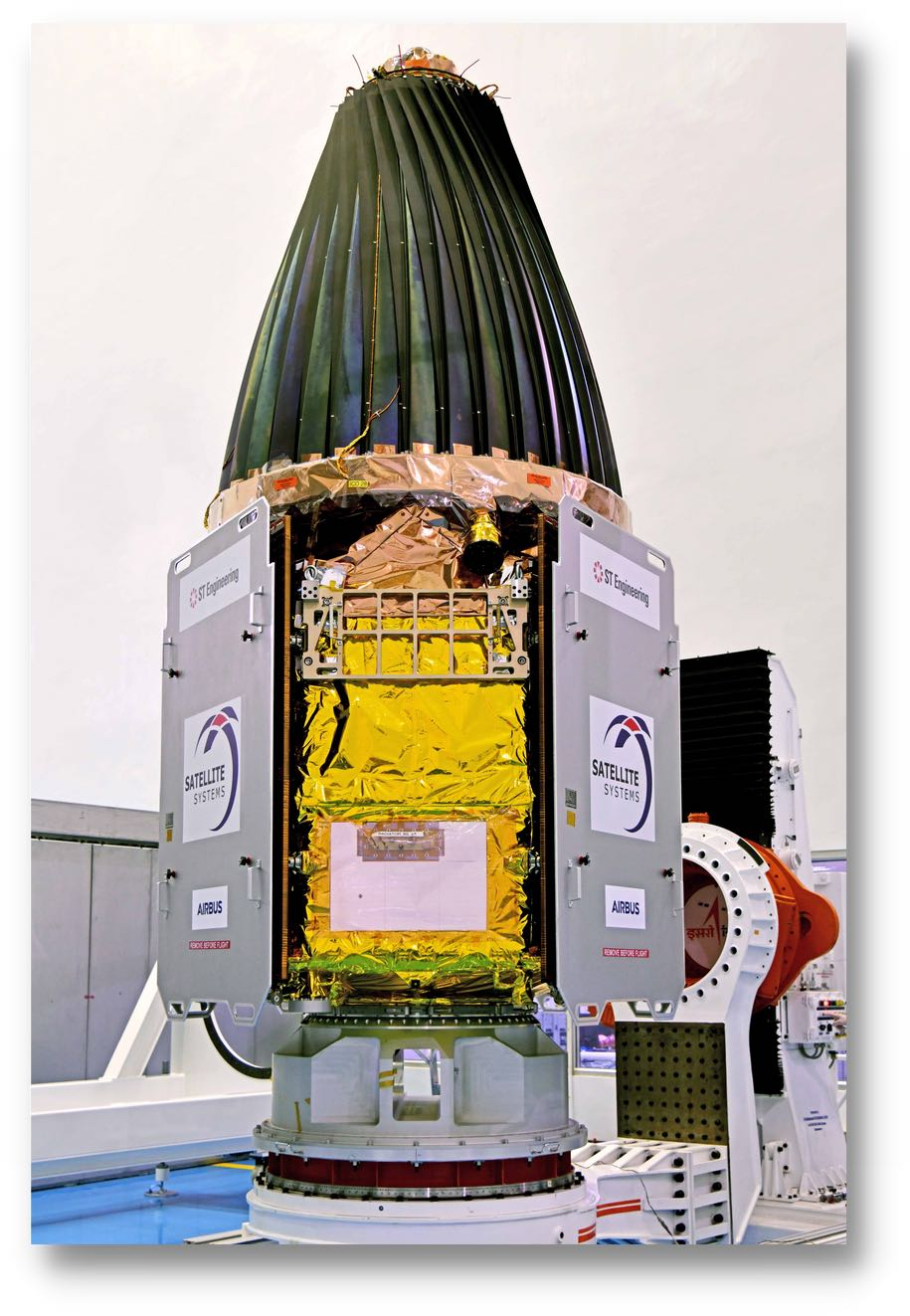
21 Apr 2023: Indian Space Research Organization (ISRO) launched a 4-stage PSLV rocket to deploy a pair of Singaporean satellites in a commercial launch contracted by its subsidiary NewSpace India Limited. The launch carried the TeLEOS-2 radar-imaging satellite, to be operated in partnership between the government of Singapore and ST Electronics. The smaller Lumelite-4 satellite was also deployed, while seven additional payloads rode attached to PSLV’s upper stage, which will remain in orbit as an experimental platform after completing the deployment of the two satellites.Launch Video.
– TeLEOS-2 is a synthetic aperture radar (SAR) satellite, capable of imaging the Earth without being affected by darkness or cloud cover. TeLEOS-2 uses the same bus as its predecessor, TeLEOS-1 (Dec 2015), but with the SAR payload installed instead of the electro-optical system aboard the earlier satellite.
– The launch also carried the Lumelite-4 to orbit. Lumelite-4 is a 12-unit CubeSat carried for the Agency for Singaporean industrial and government partners. With dimensions of 20x20x30cm and a mass of 16kg, it will be used for an on-orbit demonstration of a space-based VHF Data Exchange System (VDES) for maritime users.
– The PSLV’s upper stage will remain in orbit to host an array of experiments. Named PSLV Orbital Experimental Module 2 (POEM-2) in this role, the stage is equipped with solar panels and seven non-deployable experiment packages. It is expected to operate in this role for around a month.
– All three satellites are in a 588x618km x 9.9° orbit.
– The PSLV, or Polar Satellite Launch Vehicle, is a four-stage rocket built and operated by the Indian Space Research Organisation (ISRO). Introduced in September 1993, it has made 56 flights prior to the TeLEOS-2 mission, with 53 of these completed successfully, two failing and one resulting in a partial failure with an off-nominal orbit attained. Saturday’s launch, designated PSLV C55, will aim to continue the rocket’s current run of 15 consecutive successful missions.
-The PSLV C55 mission marked the first use of a new integration process, taking advantage of a new mobile launch pedestal (MLP), to support a PSLV mission from the First Launch Pad. Previously, PSLV rockets launched from the FLP have been built up at the launch pad, but
with the new pedestal their lower stages can be pre-assembled at a nearby PSLV Integration Facility (PIF) before they are transferred to the pad. ISRO hopes that this will allow future launch campaigns to be run in parallel.
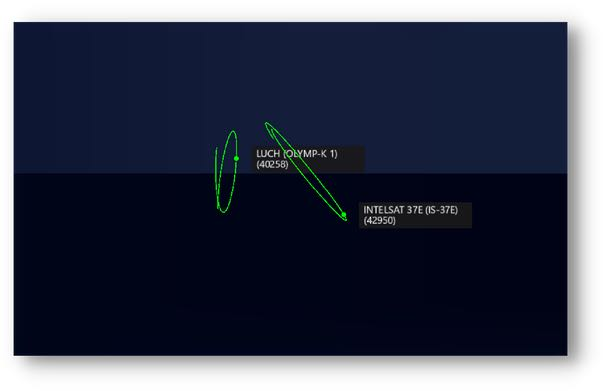
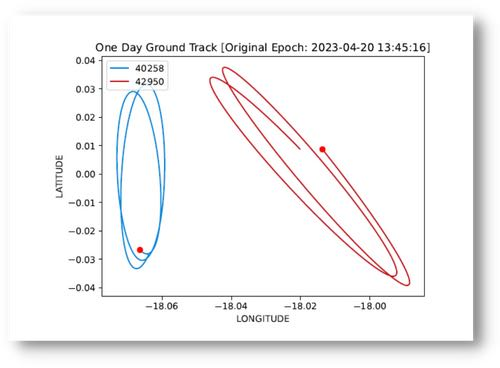
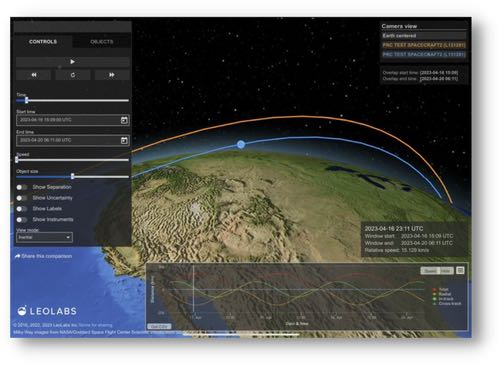
Luch/Olymp 2 Update: Russia's second suspected GEO based SIGINT satellite, Luch/Olymp-K 2, has settled into an orbital slot at 58°E longitude. There were initial unconfirmed reports the satellite was heading as far east as 167°E. Currently Olymp-K 2 is in proximity (closest approach ~308km) with COSMOS 1897, a dead…
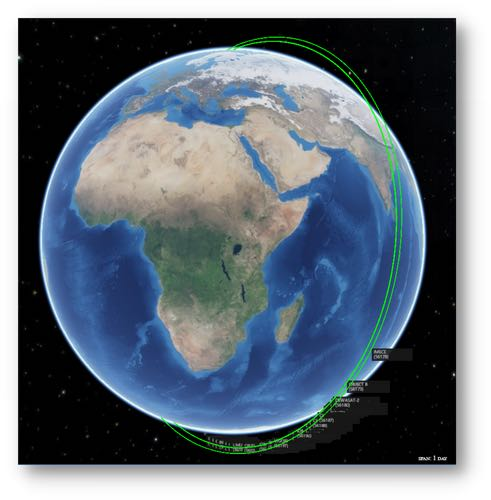
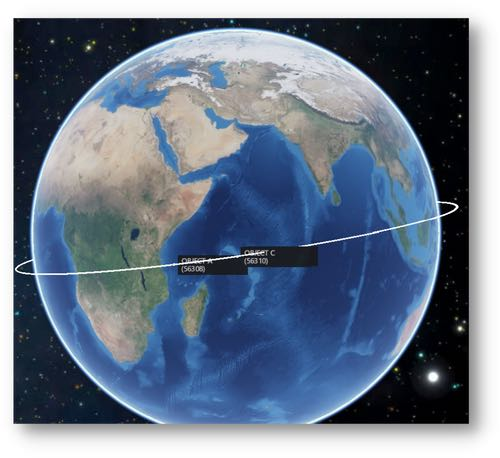
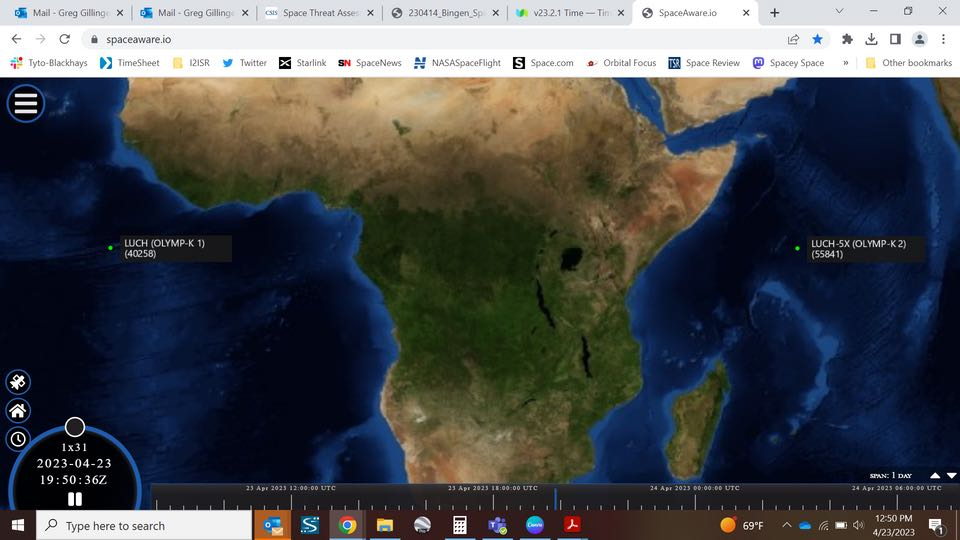
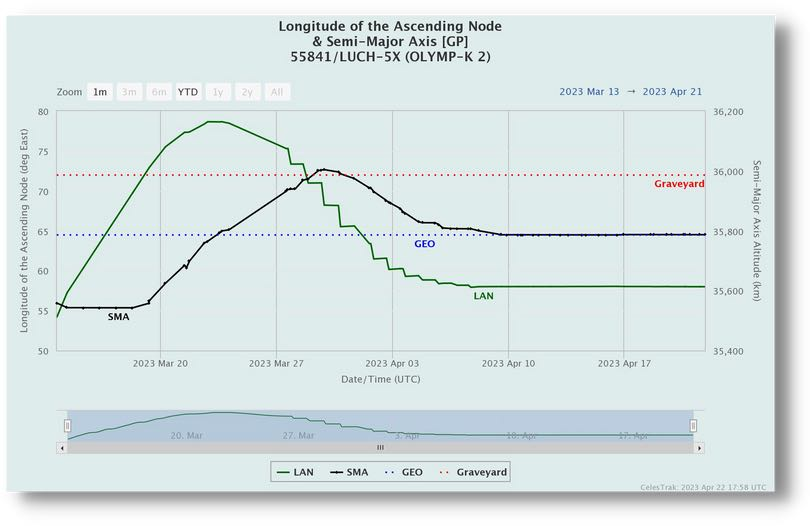
Luch/Olymp 2 Update: Russia’s second suspected GEO based SIGINT satellite, Luch/Olymp-K 2, has settled into an orbital slot at 58°E longitude. There were initial unconfirmed reports the satellite was heading as far east as 167°E. Currently Olymp-K 2 is in proximity (closest approach ~308km) with COSMOS 1897, a dead Russian COMSAT launched in 1987. Olymp-K 2’s predecessor is operating in proximity (~25km closest approach) with Intelsat 37E.
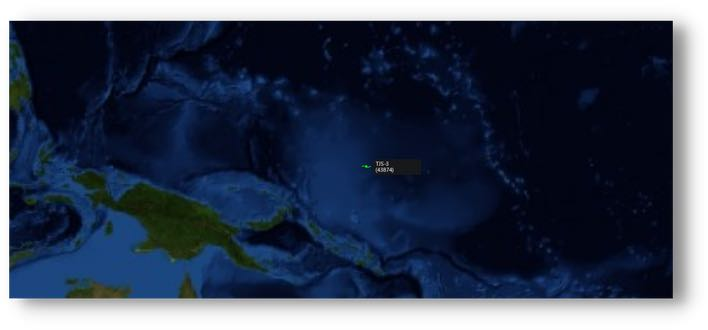
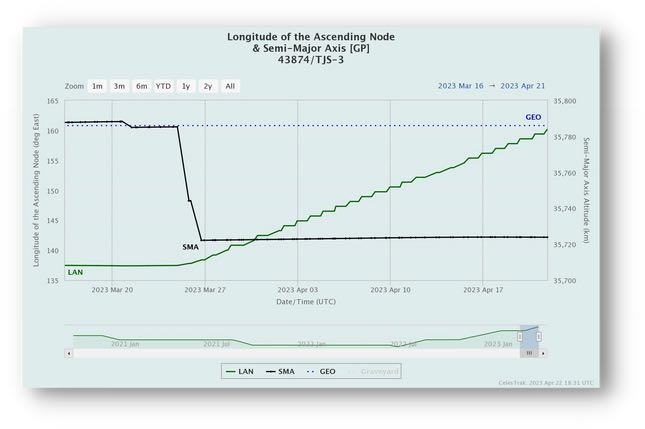
TJS-3 Update: TJS-3 continues to drift eastward and has not altered its SMA since dropping 63.1km between 24-26 Mar 2023. Latest observations have the satellite at 160.2°E and drifting ~.8° per day. SJ-23 & TL-1-03 Update: SJ-23, an experimental Chinese satellite with unknown capabilities, drifted in vicinity of a…
TJS-3 Update: TJS-3 continues to drift eastward and has not altered its SMA since dropping 63.1km between 24-26 Mar 2023. Latest observations have the satellite at 160.2°E and drifting ~.8° per day.
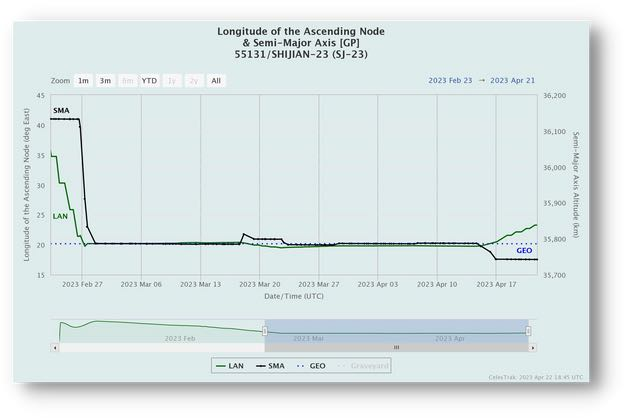
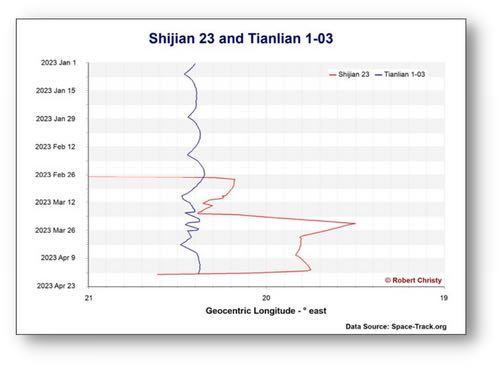
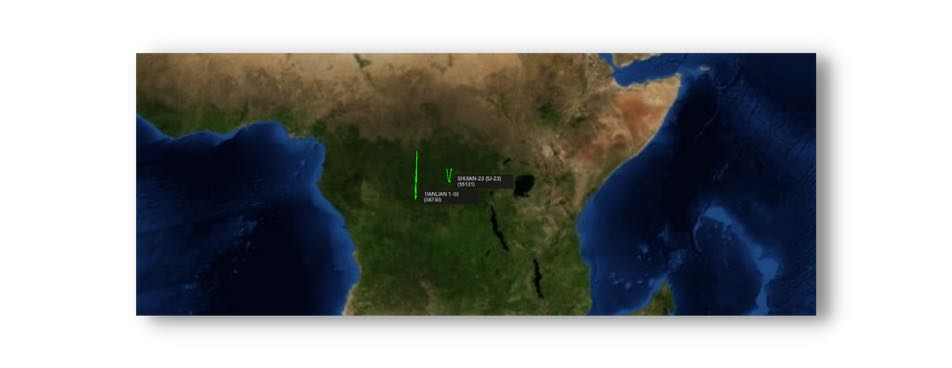
SJ-23 & TL-1-03 Update: SJ-23, an experimental Chinese satellite with unknown capabilities, drifted in vicinity of a Chinese Relay Satellite, Tianlian-1-03 in late Feb through mid-Mar. SJ-23 continued west, away from TL-1-03 for several days and then dropped ~44.2kms altitude to reverse course between 14-16 Apr 2023. As it drifted east SJ-23 crossed TL-1-03 at 20.4°E on ~16 April. As of 23 Apr 2023, SJ-23 remains eastward bound, drifting .~6° per day.
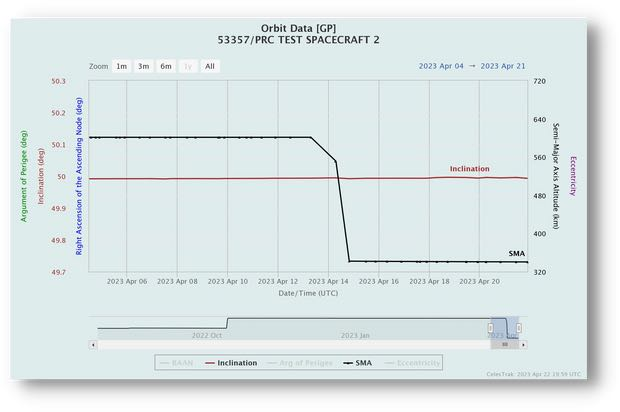
China Spaceplane Update: On 13 April 2023, China’s spaceplane reduced its altitude 43%, from 601.3 to 342.0 kms SMA. This new mission phase could indicate preparations for landing of the reusable spaceplane – or something new entirely. Since the spaceplane launched in Aug 2022, it has made multiple large maneuvers raising the object’s altitude – as well as repeated deployments, formation flying, and docking of a sub-satellite OBJECT J (NORAD ID 54218).
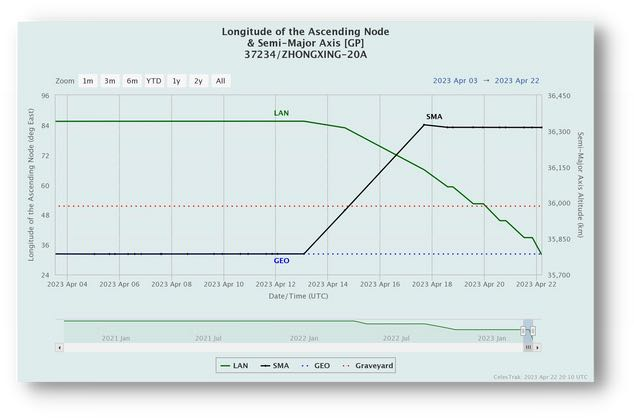
Chinasat 20A (Shentong 1B): On 13 Apr 2023, China raised the orbit of Chinasat 20A ~540km placing the satellite above the traditional “graveyard” orbit. Chinasat 20A was launched in 2010 as a suspected Chinese military COMSAT. The Shentong provide Ku-band communication with advanced multiple steerable spot beam antenna technology. This enables ground users to communicate while on the move and use secured uplink transmission for satellite antenna control.
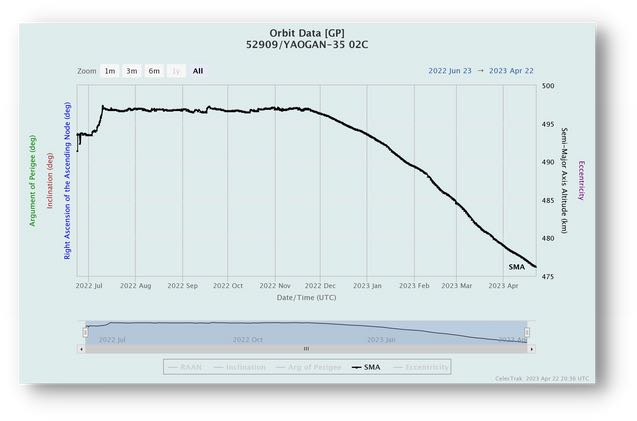
Yaogan (YG)-35/36 Constellation Update: With the exception of YG-35-02 A/B/C all of the YG-35 and 36 triplets have stabilized their orbits with SMAs of ~490km. This is a decrease from their previous avg SMA of 497kms and likely a result of experimentation to improve collection of whatever sensors are on-board the spacecraft. YG-35-02 A/B/C satellites continue to gradually decrease their SMA and have not maneuvered in several weeks. In particular, YG-35-02 C has not maneuvered in nearly 6 months.
13 Apr 2023: Secure World Foundation released their most excellent Threats to Space annual report. Read the whole report at the link above, it is a great historical record as well as an update on the latest developments. Here are some highlights from this year's report. RUSSIA: - There is strong evidence Russia…
13 Apr 2023: Secure World Foundation released their most excellent Threats to Space annual report. Read the whole report at the link above, it is a great historical record as well as an update on the latest developments. Here are some highlights from this year’s report.
RUSSIA:
– There is strong evidence Russia embarked on a set of programs since 2010 to regain many of its Cold War-era counterspace capabilities. Since 2010, Russia tested technologies for RPO in both LEO and GEO that could lead to or support a co-orbital ASAT capability. Some of those efforts have links to a Cold War-era LEO co-orbital ASAT program.
-After more than a decade of development and testing, Russia successfully demonstrated a DA-ASAT capability against a LEO satellite in 2021. It is unclear whether this system, the Nudol, will become operational soon, and it does not appear to have the capability to threaten targets beyond LEO.
-The Russian Army fields several types of mobile EW systems, some of which can jam specific satellite communications user terminals within tactical ranges. Russia can likely jam communications satellites uplinks over a wide area from fixed ground stations facilities.
-New evidence suggests Russia may be developing high-powered space-based EW platforms to augment its existing ground-based platforms.
-Russia is pursuing lofty goals of incorporating EW capabilities throughout its military to both protect its own space-enabled capabilities and degrade or deny those capabilities to its adversary. In space, Russia is seeking to mitigate the superiority of U.S. space assets by fielding a number of ground-, air-, and space-based offensive capabilities.
CHINA:
-China has conducted multiple tests of technologies for close approach and rendezvous in both low-earth orbit (LEO) and geostationary earth orbit (GEO) that could lead to a co-orbital ASAT capability.
-Public evidence indicates they have not conducted an actual destructive intercept of a target, and there is no proof these technologies are definitively being developed for counterspace use as opposed to intelligence gathering or other purposes.
-China has at least one, and possibly as many as three, programs underway to develop DA-ASAT capabilities, either as dedicated counterspace systems or as midcourse missile defense systems that could provide counterspace capabilities.
-Chinese military doctrine places a heavy emphasis on electronic warfare as part of the broader information warfare, and in recent years, China has taken steps to integrate space, cyber, and electronic warfare capabilities under a single military command.
-While there is significant evidence of Chinese scientific research and development of EW capabilities for counterspace applications and some open-source evidence of Chinese EW counterspace capabilities being deployed, there is no public evidence of their active use in
military operations.
-China has recently designated space as a military domain, and military writings state that the goal of space warfare and operations is to achieve space superiority using offensive and defensive means in connection with their broader strategic focus on asymmetric cost imposition, access denial, and information dominance.
14 Apr 2023: One day following the release of the SWF report, the Center for Strategic and International Studies (CSIS) released their equally awesome (and considerably shorter) 2023 Space Threat Assessment. The CSIS report also offers a fantastic open-source review of counterspace capabilities and operations. The CSIS…
14 Apr 2023: One day following the release of the SWF report, the Center for Strategic and International Studies (CSIS) released their equally awesome (and considerably shorter) 2023 Space Threat Assessment. The CSIS report also offers a fantastic open-source review of counterspace capabilities and operations. The CSIS report also examines Chinese and Russian space capabilities and this year also contains a chapter dedicated to Russia’s counterspace activities in support of its operations in Ukraine.
RUSSIA:
– Moscow finds itself at an inflection point. Over the past year, Russia continued to display less advanced space and counterspace capabilities than originally anticipated. Advanced counterspace weapons that were promised, such as the Peresvet and Sokol-Eshelon ground-based lasers, are nowhere to be seen on the battlefield despite Russian claims of their success.
– Widespread reports of jamming throughout Eastern Europe have been attributed to Russia, as have several distinct attacks on commercial space architectures, such as Viasat and SpaceX’s Starlink system. Moreover, Moscow continues to play a “cat-and-mouse” game in orbit, using its satellites to shadow other nations’ satellites and creating confusion and concern about the intent of these actions.
– Russia has a long history of unusual and threatening behavior in both LEO and GEO and conducted similar activities in 2022. Luch, Russia’s well-known GEO inspector satellite, maneuvered several times in 2022 to closely approach and loiter near three different Intelsat communications satellites
-Russia has demonstrated significant cyber capabilities, as showcased with its Feb 2022 Viasat hack. Recent reports have emerged on another successful cyber intrusion against a U.S. commercial satellite communications provider.
CHINA:
– Over the past year, China has continued to grow its space and counterspace assets, maintaining its status as the second-most-capable space nation after the United States.
-China maintains an extensive suite of satellite capabilities, including advanced positioning, navigation, and timing (PNT); satellite communications; intelligence, surveillance, and reconnaissance (ISR); missile warning; and space situational awareness. According to a 2022 U.S. Defense Intelligence Agency report, China doubled its number of satellites in orbit between 2019 and 2021, from 250 to 499, and surpassed all but the United States in the number of space startups receiving funding, drawing 16 percent of total global investment in these ventures.
– China maintains a substantial kinetic ASAT capability, most notably demonstrated by a debris-creating 2007 test, as well as numerous subsequent non-intercept tests in the years since.
– Co-orbital technology demonstrations prove China’s ability to rendezvous with other satellites in GEO. While these are not counterspace weapons tests, they demonstrate capability that is necessary for a co-orbital counterspace attack.
-China has ground-based lasers capable of blinding or damaging optical sensors on low-altitude satellites. Chinese universities are also working on small laser devices capable of being mounted on a satellite, though this is not a current capability
-. Previous reporting suggests that SJ-21 performed several RPOs around Compass G2 before docking and moving the defunct satellite into a GEO graveyard orbit, hundreds of kilometers above the traditional GEO belt.50 Updated information showcases that SJ-21 took Compass G2 significantly higher than a typical graveyard orbit, which is highly unusual for a debris removal mission.
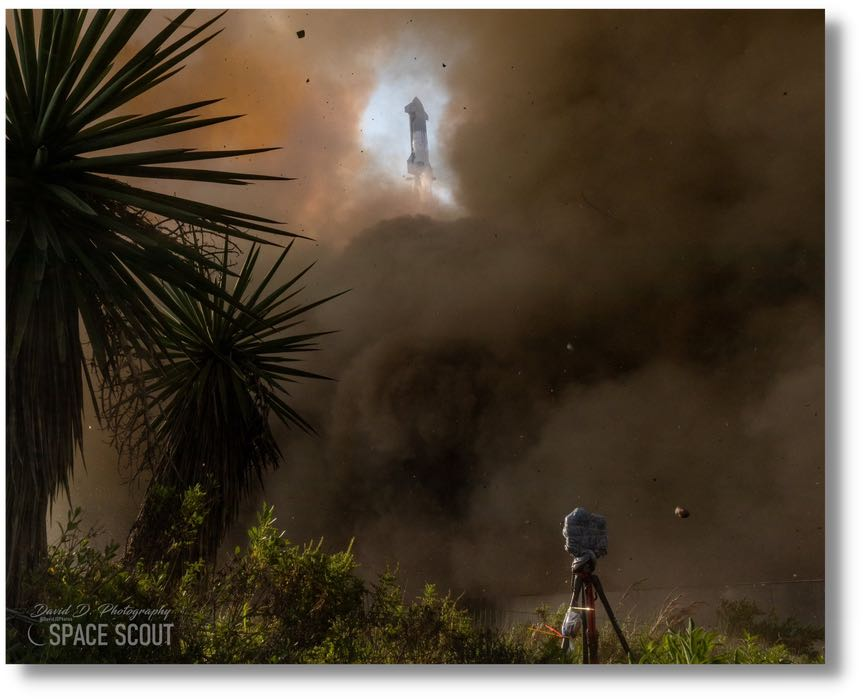
Space imagery and photographs featured in Issue 71.


Flash Insider
Subscribe to unlock full access to this Issue and the complete Flash archive.
Subscribe Now Already Subscribed? Log In